Research Intelligence 200
Paper search with the faceted rail, paper detail, compare, upload.
-
- dev only mockups dev only 404
- dev only list dev only 404
-
-
- redirect [slug] → /research/paper/…
-
- redirect [id] → /research/paper/…
MESSAI · Onboarding / Atlas
Everything the overview routes to, in full. Part I is the atlas itself — the science, access, the pipeline, categorisation, tooling, priors, the held-out audit, the roadmap, the gaps, a glossary and every unit the corpus accepts, with the interactive platform model at 07. Part II is the runbook for a corpus pass. Part III is the platform map in full. Part IV follows a prediction into operator economics and the public claims. Part V is the P&ID symbol library. Part VI is the October 2026 database and pipeline overhaul: what was wrong, what the numbers did, what is still weak. Part VII is the walkthrough by screen: what each part of the platform is for, the steps to take and how to read its numbers. Every count names the database it was measured on and when; re-measure before quoting.
Part I of VII · Onboarding atlas · 18 sections · ~35 min
MESSAI · Onboarding · 2026-09-07
The Onboarding Atlas, keeping the artifact’s numbering. Sections 01–05 are the science with no repo access needed; 06 is where the data lives and 11 the acquisition tooling; 13–14 are what the models can actually do and the held-out audit that measures it; 15–18 are the July 2026 week, the roadmap, the ranked gaps and the glossary. 07 and 12 are pointers: the platform map is Part III and the corpus runbook is Part II. The corpus reference that used to sit here as 08–10 — the pipeline, categorisation and ontology, growing the corpus — now lives in Part II as 08–10, next to the runbook it belongs to. Every number carries its date; re-measure before quoting.
This is the reference half of onboarding. If you are looking for where to start — the four routes, the six pipeline stages, what the platform can and cannot support, and your first task — that is the onboarding overview, and it takes about six minutes. This page is what you read once you know which part you need.
Part I is numbered on its own 00–18 scale, so a cross-reference like “see 08 Pipeline” means section 08 of this part. Every number here carries the database it was measured on and the date; re-measure before quoting. The other four parts, with their section counts and read times, are listed at the foot of this page.
~/.claude/projects/-Users-samfrons-repos-messai-ai/memory/MEMORY.md, then four entries in particular: feedback-corpus-lives-on-staging-not-local, feedback-grade-experiment-records-not-paper-completeness, feedback-dangling-node-modules-symlinks-false-green-typecheck, project-acquisition-path-status-2026-09-07.mes-paper-retrieval, mes-parameter-extraction, mes-data-harmonization, mes-db-migration-sync, mes-experiment-modeling, mes-knowledge-graph.scripts/quality/coupling-completeness.ts, scripts/extraction/audit-disk-vs-db.ts, and pnpm verify:science.resolveDbTarget(), gated on the Supabase project ref. Staging and production share a pooler hostname, so a hostname check proves nothing.node_modules make the type gate report false green.docs/onboarding/README.md is the ordered index: QUICKSTART, infra-access-r2-staging-prod, paper-pipeline, categorization-and-ontology, acquiring-recent-papers, streamlined-corpus-run, extractor-contract-and-gaps, the 2026-07-19–24 handoff, and CORPUS-DIAGNOSIS. Then docs/extraction/extractor-contract-and-gaps.md, docs/AGENT_HANDOFF.md, docs/PLATFORM_STATE.md, docs/TECH_STACK.md, docs/QUICKSTART.md, docs/multi-zone-deployment.md, CLAUDE.md.
Read this first if the science is new to you. A microbial electrochemical system (MES), also called a bioelectrochemical system, uses the electrochemical activity of living microorganisms to interconvert chemical and electrical energy, or to drive synthesis. Every device in the taxonomy is a variation on one cell; what changes is the reaction you drive and the product you harvest. The full treatment is on /learn/science; the two diagrams below are the pair everything later in this page assumes.
In the canonical case — a microbial fuel cell — electroactive bacteria colonise an anode and oxidise an organic substrate such as acetate or the organic load of wastewater. Oxidation releases electrons, which the bacteria deposit onto the electrode instead of onto a soluble acceptor. Those electrons travel through an external circuit to a cathode, where they reduce a terminal acceptor, often oxygen. The electron flow is a usable current; the proton flow that balances it closes the circuit through the electrolyte.
Everything on messai.io/learn/science is carried here, so either page answers the question and neither is the only copy. That page is the outward-facing account and is depth-layered behind “Read the full method” panels; this one adds what was measured internally, and says where the two disagree. Use whichever you are already in.
| On messai.io/learn/science | What it covers | Here |
|---|---|---|
| Overview | What an MES is, the reference device, why microbes, the two facts that shape the method | 01 — this section |
| System taxonomy | 17 types, 5 families, subtypes, combinations, study focus, domains | 02, measured in 09 |
| Thermodynamics | Gibbs, Nernst, the redox ladder, the loss cascade, the three efficiencies | 03 |
| Electrode kinetics | Butler–Volmer, Tafel, polarisation, internal resistance, transport, EIS | 03 |
| Biofilm & EET | Four transfer routes, model organisms, Monod, biofilm architecture | 04 |
| Performance metrics | What is measured, in what units, and the normalisation trap | 05; every unit and factor in 19 |
| Data pipeline | Discover → resolve → extract → harmonise → sync, the quality gate, verification | 08; the runbook is 10–12 |
| Bayesian priors | Hierarchical, log-scale, partial pooling, the prior record | 13 |
| From priors to predictions | Routing, split-conformal calibration, the output contract | 13, audited in 14 |
| What makes us different | Four claims, the proof numbers, open data, known limitations | below, and 17 |
| Glossary | Key terms | 18, extended with platform terms |
Sibling pages that page links out to, not duplicated here: System types, Sustainability, History of MES, the proof dashboard (live database counts and training artifacts per request) and the whitepaper — the strategic why, where the science page and this Atlas are the technical how.
| Claim | What the public page says | Where it is audited in this Atlas |
|---|---|---|
| honesty Honest data-quality signals | Every prediction ships a data_status field. Missing artifacts surface as awaiting_artifact, never a silent zero. Power-density CoV ≈ 1,285%, so point estimates always travel with context. | The output contract and its two refusal states, 13. The CoV and why no bare mean is quoted, 05. |
| coverage Full taxonomy coverage | 17 primary types + 12 combinations + multi-axis subtypes. No silent coercion of MES / MDC / MMRC papers to MFC-shaped output — every system routes through its physics family. | The taxonomy itself, 02. What the corpus actually carries, 09: primarySystemType is NULL on 10,286 visible papers, and five vocabularies describe the same papers. |
| traceability Provenance on every value | Every extracted number is linked to its source paper. About half also carry the verbatim snippet, with an extractor version and confidence — where that is missing they say so rather than implying a quote. Roughly a quarter of papers have no DOI. | Provenance fields and the disk-vs-DB audit, 08. What “done” means for a row, 08. The 2,075 no-DOI papers, 17. |
| rigour Statistics that respect the data | Hierarchical, log-scale priors that pool strength across classes — not arithmetic means of heavy-tailed distributions. The mathematically wrong v0 was retired, not shipped. | The priors and partial pooling, 13. Whether they beat a class median on paper-disjoint data, 14 — the answer is no, for every model tried. |
The proof numbers, as published: 23,568+ curated papers, 195,846 extracted value rows, 2,812 parameter-graph edges, and 97.98% out-of-sample interval coverage on MFC + MEC, with an honest-gaps section naming what is thin or unvalidated. Two of those need the footnote this Atlas adds: the coverage figure was computed on a split that 14 shows is separable at AUC 0.77–0.92, and the corpus counts are dated snapshots that differ slightly from the staging measurements below. Open data: the curated packages are public — canonical microbes, electrode materials with DFT-derived properties, the parameter ontology, and a catalog of external datasets — each shipping a SCIENTIFIC_INTEGRITY.md of known caveats, with large blobs mirrored to Hugging Face. Details in 07.
also public Live version: messai.io/learn/science → System taxonomy.
The canonical taxonomy (version 2) is 17 primary system types — 14 real devices plus 3 meta classes — with 12 combination types, multi-axis subtypes, an 11-value study-focus axis and 8 application domains, all routed for prediction through 5 physics families. It is the authoritative classifier that the extraction pipeline, the ML predictors and the UI all share; the enum lives in apps/web/src/lib/taxonomy/system-types.ts. Section 09 measures how much of the corpus actually carries each value.
Restricting the world to MFC / MEC / MDC — as most tools do — silently coerces desalination, metal-recovery, synthesis and sensing systems into fuel-cell-shaped output. The right abstraction is the physics family: the group whose transport and reaction physics actually govern the outcome. Predictions route to a family; subtypes become features, combinations become coupling rules. The rationale is statistical: branching on all 17 types would train rare classes on a handful of papers each and return noise.
| Type | Full name | Family | What it does |
|---|---|---|---|
| MFC | Microbial Fuel Cell | anodic | Oxidises organics, delivers current spontaneously |
| MEC | Microbial Electrolysis Cell | cathodic | Adds a small voltage to make H₂ at the cathode |
| MES | Microbial Electrosynthesis | cathodic | Reduces CO₂ at the cathode into organics |
| MDC | Microbial Desalination Cell | ion | Field drives ions out of a middle chamber |
| MSC | Microbial Solar Cell / Biophotovoltaic | sensor/photo | Couples phototrophy to the electrodes |
| MEFS | Microbial Electro-Fenton System | cathodic | Generates H₂O₂ / •OH to degrade pollutants |
| MESNORK | Microbial Electrochemical Snorkel | anodic | Short-circuited electrode accelerates oxidation |
| MERC | Microbial Electroremediating Cell | selective | Degrades or immobilises a target contaminant |
| MNRC | Microbial Nutrient Recovery Cell | ion | Recovers N / P (ammonium, struvite) |
| MMRC | Microbial Metal Recovery Cell | selective | Reduces dissolved metals at the cathode |
| MRB | Microbial Rechargeable Battery | anodic | Bioelectrochemical energy storage |
| MBES | Bioelectrochemical Sensor | sensor/photo | Current tracks an analyte (BOD, toxicity, …) |
| MREC | Microbial Reverse Electrodialysis Cell | ion | Harvests salinity-gradient energy |
| MCDI | Microbial Capacitive Deionization Cell | ion | Capacitive ion storage for deionization |
Three meta classes complete the 17: REVIEW (review / meta-analysis), FUNDAMENTAL (mechanistic electron-transfer studies) and OTHER (genuinely novel architectures). They are tracked so the predictor never mistakes a review’s cited numbers for fresh measurements — the same reason 26.3% of values sourced from references is a headline finding in 15 July 2026 agents. Abiotic fuel cells (PEM, SOFC, PAFC) are a separate taxonomy: the predictor stack has tuned physics for them, but they are not bioelectrochemical and are kept out of the BES classifier so a proton-exchange-membrane paper never contaminates the microbial priors.
primarySystemType, MES narrowly means Microbial Electrosynthesis, cathodic CO₂ reduction: one of the 14 devices. audit-non-bes-candidates.py uses the second sense throughout.docs/system-class-aware-predictor-architecture.md. See the ontology rules in 09.Subtypes are stored as an object of orthogonal axes because a token like acetate means something different for a synthesis product than for a substrate. Each primary type populates the axes that make sense for it.
| Axis | Used by | Example values |
|---|---|---|
| generic | MFC, MEC, MDC, MSC… | single_chamber_air_cathode · dual_chamber · tubular · stacked · sediment · plant · constructed_wetland · membraneless |
| by_product | MES | acetate · methane · ethanol · butyrate · medium_chain_fatty_acids |
| by_carbon_source | MES | pure_co2 · flue_gas · bicarbonate · direct_air_capture |
| by_metal | MMRC | copper · cobalt · chromium · silver · gold · rare_earth |
| by_contaminant | MERC | heavy_metal · perchlorate · chlorinated_solvent · nitrate · sulfate · petroleum_hydrocarbon |
| by_analyte | MBES | bod · toxicity · pathogen · dissolved_oxygen · glucose · lactate · ph · xenobiotic |
| by_power | MMRC, MBES, MCDI | self_powered · externally_powered / supplemental_voltage |
| by_mechanism | FUNDAMENTAL | direct_ET_cytochrome · direct_ET_nanowire · mediated_endogenous · mediated_exogenous · interspecies_ET |
Real reactors are often two systems at once. Rather than train a separate model per combination — which would be starved of data — each is treated as a coupling rule over the base families. The best-studied combinations carry their own variants: CW_MFC splits into horizontal_subsurface_flow, vertical_flow and floating.
The primary type says what reactor a paper is about. Two further axes say what kind of study it is and what it is for, so a query can ask “which MFC papers are about new anode materials for wastewater?” without full-text search.
materials_science · process_optimization · scale_up · biofilm_characterization · community_composition · electrode_engineering · kinetics · modeling · review_synthesis · characterization_methods · general.
power_generation · wastewater_treatment · resource_recovery · electrosynthesis · bioremediation · desalination · biosensing · general. A paper can carry several. This axis is the most specific stratum key in prior lookup, so a missing domain silently falls back to a coarser prior.
also public Live version: messai.io/learn/science → Thermodynamics + Electrode kinetics.
What a cell can do is bounded by thermodynamics; what it actually does is set by kinetics and losses. Thermodynamics gives the ceiling, and the ceiling is the gap between the two half-reaction potentials.
Each half-reaction has a standard potential on the standard-hydrogen-electrode (SHE) scale, shifted for real concentrations by Nernst. The cathode couple sits high, the anode couple sits low, and the vertical gap between them is the theoretical cell voltage. Swap the cathode couple and you have a different device.
| Half-reaction | E° (V vs SHE) | Role |
|---|---|---|
| O₂ + 4H⁺ + 4e⁻ → 2H₂O | +0.82 (pH 7) | Air-cathode acceptor (MFC) |
| Fe(CN)₆³⁻ + e⁻ → Fe(CN)₆⁴⁻ | +0.36 | Common lab catholyte |
| 2H⁺ + 2e⁻ → H₂ | −0.41 (pH 7) | MEC cathode, hydrogen evolution |
| acetate / CO₂ couple | ≈ −0.28 | Acetate oxidation at the anode |
| CO₂ → acetate (8e⁻) | ≈ −0.28 to −0.5 | Electrosynthesis target (MES) — below the anode, which is why it needs an energy input |
An air cathode (O₂/H₂O, +0.82 V) against an acetate-oxidising anode (≈ −0.28 V) gives E°cell ≈ 1.1 V. Real cells deliver 0.3–0.8 V after losses.
Kinetics turns a thermodynamic possibility into a rate. The governing relationship between overpotential and current density is the Butler–Volmer equation, with the biofilm acting as the anode’s catalyst layer.
The exchange current density j₀ captures how intrinsically fast the electrode reaction is at equilibrium; the transfer coefficient α sets how symmetric the anodic and cathodic branches are; and the Tafel slope — the straight-line region on a log-current plot — is what most papers actually report, from which α can be back-fitted. A good bio-anode has a high j₀: the reaction turns on for less overpotential, so more voltage reaches the load. Every millivolt of η is voltage you do not deliver.
Sweeping the load traces voltage against current. The three regions map one-to-one onto the three losses — activation (the steep initial drop), ohmic (the linear middle), mass transport (the final collapse) — and the power curve peaks where the external load matches the internal resistance. That peak, not the open-circuit voltage, is what a design is optimised toward, which is why extracting a single quoted “maximum power density” without its derivation method is lossy (see the derivation_method field in 12 Corpus run).
Reactant must diffuse across a thin diffusion layer to reach the electrode. Push the current higher and the surface concentration falls; when it reaches zero the current is diffusion-limited and cannot rise further, no matter the voltage. That is the collapse at the right of the curve, and the limiting current.
| Lever | Mechanism | Where it stops working |
|---|---|---|
| Shrink electrode spacing | Lower ohmic resistance → higher power | Until mass transport or short-circuiting intervenes |
| Raise electrolyte conductivity | Lower ohmic resistance | Within osmotic and biological limits |
| Grow a better biofilm | Raise j₀, lower activation overpotential at the anode | Biofilm thickness has a sweet spot — see 04 |
| Improve the cathode catalyst | The cathode is frequently the limiting electrode in air-cathode MFCs | Cost and durability |
Internal resistance is often the single largest lever on power: the sum of ohmic resistance (electrolyte, membrane, electrode spacing) and the charge-transfer resistances of both electrodes. By the maximum-power-transfer theorem, power delivered to the load is maximised when the external resistance matches the internal resistance — which is why it is one of the parameters the knowledge graph links to power with a causal edge.
Impedance (EIS). Electrochemical impedance spectroscopy applies a small AC perturbation across a frequency range and fits the Nyquist spectrum to an equivalent circuit — typically a Randles circuit — separating losses a single DC polarisation curve blends together: Rs solution resistance (the high-frequency intercept, the ohmic term), Rct charge-transfer resistance (the semicircle diameter, inversely related to j₀), Cdl double-layer capacitance, and the Warburg low-frequency diffusion tail. EIS spectra are Tier C on the extraction roadmap (12 Corpus run) — the schema does not capture them today.
also public Live version: messai.io/learn/science → Biofilm & EET.
The defining trick of MES is extracellular electron transfer (EET): electroactive bacteria route respiratory electrons onto a solid electrode instead of a soluble acceptor. Understanding EET is understanding the anode.
The four routes are usually mixed in one biofilm, which is why by_mechanism (direct_ET_cytochrome, direct_ET_nanowire, mediated_endogenous, mediated_exogenous, interspecies_ET) is a subtype axis on FUNDAMENTAL papers rather than a device class.
| Organism | Signature | Role |
|---|---|---|
| Geobacter sulfurreducens | Conductive nanowires + cytochromes | Gold-standard anode electrogen; dense conductive biofilms |
| Shewanella oneidensis | Flavin-mediated + direct | Facultative model electrogen; versatile respiration |
| Sporomusa / Clostridium (acetogens) | Wood–Ljungdahl CO₂ fixation | Electrosynthesis of acetate at the cathode |
| Methanogens (e.g. Methanosarcina) | DIET acceptor | Electromethanogenesis — CO₂ → CH₄ |
| Cyanobacteria (Synechocystis) | Oxygenic photosynthesis | Photosynthetic anodes and biocathodes (MSC) |
The mess-microbes package (07 Platform map) is the curated catalog behind this: 28 microbes, plus 181 MicrobeKineticConstant rows.
Uptake is proportional to concentration when substrate is scarce and flattens to a maximum when it is abundant. K_s is substrate-specific, which is why substrate identity is kept as a canonical feature rather than pooling glucose and acetate kinetics together — and why substrate being the worst-linked input in the corpus (0.7% coupled, see 12) is a modelling problem, not a cosmetic one. On 2026-09-08 the identity μ_max = ln 2 / doubling time validated three values the paid LLM verifier had rejected: a free invariant beating a paid check.
also public Live version: messai.io/learn/science → Performance metrics.
MES performance is reported through a compact set of metrics, but with inconsistent normalisation across the literature. Knowing exactly what a number is normalised to is the difference between a fair comparison and a meaningless one.
| Metric | Typical unit | What it tells you |
|---|---|---|
| Power density (areal) | mW/m² | Power per electrode area — the most-cited MFC metric |
| Power density (volumetric) | W/m³ | Power per reactor volume — the scale-up metric |
| Current density | mA/cm² · A/m³ | Electron flux per area or volume |
| Coulombic efficiency | % | Fraction of substrate electrons recovered as current |
| COD / BOD removal | % | Organic load removed — treatment performance |
| Cell voltage / OCV | V | Working voltage under load / open-circuit voltage |
| Internal resistance | Ω · Ω·cm² | From the polarisation slope or an EIS fit |
| Energy efficiency | % | Useful energy out / energy in |
| H₂ production rate / yield (MEC) | m³/m³/d · mol/mol | Rate and recovery for electrolysis cells |
| Product titre / rate (MES) | g/L · g/L/d | Electrosynthesis output |
| Salt removal (MDC) | % · mg/L | Desalination performance |
| Sensitivity (MBES) | signal / analyte | Biosensor response |
normalization_basis (anode vs cathode vs membrane vs volume) and value_kind / phase (peak vs steady-state), because those distinctions are worth 1.5–3× and up to 10–1000×. Peak-versus-steady-state alone produces 2–3× errors.voltage_reporting_convention, whether a value is vs Ag/AgCl, vs SHE, or a whole-cell voltage. See 12.Power density is right-skewed over orders of magnitude, so the arithmetic mean is dragged far past the median by a handful of high performers. The median describes a typical system; the mean describes almost none. Across the corpus the coefficient of variation is ≈ 1,285%. This is the concrete reason the priors are fitted on the log scale (13), and the reason the served interval on power density is four decades wide (14).
It is bounded and interpretable: a high current with low coulombic efficiency means electrons are leaking to alternative acceptors — oxygen crossover, methanogenesis, other respiration — rather than reaching the electrode. It is often more informative about the biology than power density is. On the held-out benchmark it is also the target with the widest between-paper spread (2.04 logit).
Always read the interval, the system class and the normalisation before comparing two numbers. Section 09 is how a raw name becomes a canonical slug and an SI value; section 14 is what happens when you try to predict these metrics across papers; 19 lists every unit the normaliser accepts, the factor it applies and what it refuses to convert.
Staging and prod share the same Supabase pooler host in eu-central-1, so a hostname check proves nothing. Every remote write in scripts/ passes through resolveDbTarget(), which pins staging to its project ref and demands --expect-ref for prod. Promotion is one direction, additive, schema before data.
| # | Get | From | Verify with |
|---|---|---|---|
| 1 | GitHub access to samfrons/messai-ai | the repository owner | git clone |
| 2 | .env.local + .env.development.local | the repository owner, out of band. Never chat, never git. | bash scripts/quality/preflight-corpus-work.sh |
| 3 | R2 token, bucket-scoped to messai-papers | the account owner · Cloudflare → R2 → Manage API Tokens | pnpm tsx scripts/storage/r2-test-creds.ts |
| 4 | Supabase org "Frons digital" membership | the org owner invites | open messai-staging in the dashboard |
| 5 | Vercel team: messai-ai · messai-lab · messai-api · messai-site | the team owner | pnpm tsx tools/diff-vercel-env.ts |
| 6 | rclone + PostgreSQL 17 client | brew install rclone postgresql@17 | rclone version |
| — | Prod credentials | Not on day one. Handed over per task; every prod --apply is announced first. | |
grep -c '^COPY public\.' ≈ 60–80.STAGING_DATABASE_URL — old Prisma host, empty since 2025-08-09.PRODUCTION_DATABASE_URL, DEVELOPMENT_DATABASE_URL — retired 2026-08-11. They respond with a stale 3,892-paper snapshot; pnpm backup dumped the wrong DB for months.dotenv.config() writes into process.env; resolving two targets in one process leaks the first URL into the second. Use dotenv.parse.Part III is the platform map The measured platform — zones, schema, pipeline, 3D, P&ID, open source, gaps — lives once, in the Platform map tab. This section only opens the interactive model so it is one click from the atlas.
Eight UML 2 views over one model of the whole platform. C1 is the altitude everything else hangs from: three kinds of actor, four Vercel zones, the shared packages, the state layer and the external systems. Every box with a + corner opens its own diagram — the four zones, the package graph, the persistence model and the corpus pipeline — and Esc comes back up. Structural counts were measured against this repository on 2026-09-09; corpus and science numbers deliberately stay out of the diagram and live in the dated tiles.
One repository, four Vercel projects, one Postgres. Everything a browser touches enters through apps/web, which owns the rewrite table; everything that writes to the database goes through apps/api. Click any node to open it.
Prerequisites. The memory entries to load, the six skills that carry the procedures, the three gates that tell you a run actually worked, and the rules that are never negotiable are in 00 Before you touch anything. The five-layer state table is in Part II · 00.
The rest of the platform is drawn and inventoried in Part III, once: the interactive UML model of the whole infrastructure, the site map of every page and the zone that serves it, the Prisma schema and its hub-and-spoke relation map, the data pipeline as it actually runs, the 3D stack and the four registries a new reactor model must join, the P&ID library, the nine open-source packages, and the dependency order between the gaps. This section is the orientation; that is the reference.
Every surface MESSAI ships is supposed to be built from @messai/ui and the Tailwind preset next to it. Most are. This section is the inventory a newcomer builds against — what exists, which generation is live, the rules that are not negotiable, and the measured distance between the rule and the tree. Counted against development on 2026-09-11; re-measure before quoting. Three things have moved since that count: the stock-colour rule became a lint ratchet (2026-09-12), the palette became warm monochrome (2026-10-05), and v3 was folded into v1 and archived (2026-10-06) — all noted below.
@messai/ui exports@messai/ui/v3border-radius, anywhere. Sharp corners are the intended aesthetic. Two exceptions exist and no third one does: rounded-chip (2 px) for the badge / tag / pill family, and the radio button, which uses an inline borderRadius: 9999 rather than widening the Tailwind enum. Enforced by no-restricted-syntax.<select> is banned — use Select from @messai/ui. Enforced by the same rule, with a 21-path allowlist that grandfathers surfaces mid-migration. Each follow-up removes its own entry; when the list empties the rule applies platform-wide on its own. Do not add to it.text-blue-600 and bg-red-50 have no place in a MESSAI surface — the mes-* tokens carry the meaning, so a value swap in the preset moves every page at once. Enforced since 2026-09-12 by messai/no-stock-palette as a ratchet: tools/stock-palette-allowlist.js names the 183 files that already offended, the rule is on everywhere else, and pnpm tsx tools/stock-palette-allowlist.ts refuses to make the list longer. Since 2026-10-05 the stock scales are also remapped in the preset (amber → caution ochre, red/rose → critical rust, green/teal → positive moss, blue/gray → the warm neutral ramp), so a legacy class at least lands on-palette.| Tier | Where | Count | What it is |
|---|---|---|---|
| Atoms & molecules | src/components | 48 | Button, Input, Select, Checkbox, Radio, Switch, Slider, Label, Link, Code, Tag, Badge, Pill, Divider, Skeleton, Spinner, Eyebrow, FormField, Segmented, Card, AnchoredCard … This is the tier the @messai/ui barrel exports, so it is what an import gives you today. |
| Organisms | src/components | — | Modal, Tabs, Table, Toast, Tooltip, Popover, Accordion, Banner, Breadcrumb, Pagination, DropdownMenu, EmptyState, SearchFilters, PaperCard, PaperDetailModal, MetricWithProvenance, TrustBadge. Counted in the 48 above. |
| Chrome | src/chrome | 4 | UniversalHeader (7 files), UniversalFooter (4), AuthMenu, top-bar. The cross-zone furniture — a new zone mounts these rather than drawing its own. |
| Shells | — | 0 | The v3 AppShell, LabShell and MarketingShell had no production consumer and were archived with v3 on 2026-10-06 (archive/2026-10-ui-v3/). A page mounts the chrome above directly. |
| Tokens | tailwind-preset.cjs | 1 | The single build-time source every zone extends. Colour, spacing, type scale, the rounded-chip exception, motion durations. |
The catalogue is drawn, not just listed: /design-system renders live token swatches and component examples.
This is the thing to understand before adding a component, because the obvious guess is wrong twice.
| Generation | Import path | Consumers | Status |
|---|---|---|---|
| v1 · src/components | @messai/ui | every zone | live The barrel exports this tier and nothing else. Build against it. |
| v3 · archived | — | 0 | folded into v1 Archived 2026-10-06 with its /dev/v3 proving page (archive/2026-10-ui-v3/). The two parts with production use moved into the v1 tier: DetailDrawer is now exported from @messai/ui, and the v1 Segmented gained v3's radio-group ARIA, arrow / Home / End keys, ariaLabel and per-option disabled. Its tokens had already shipped — see below. |
| app-local · apps/web/src/components/ui | relative | 8 files | duplicate 22 files on 2026-09-11, of which only 2 were thin re-export shims. The 2026-09-12 collapse moved their importers onto @messai/ui; 8 files remain, each for a stated reason — badge and the shadcn-shaped tabs / dropdown-menu would change what a page renders if swapped, and icons.tsx (468 lines) should be promoted into the library rather than deleted. |
mes-* class names were kept and their hex values pivoted, so every page picked up the new values with no code change (old→new table: docs/ui-token-reconciliation.md). On 2026-10-05 the same mechanism moved the platform to warm monochrome: one near-black ink in three shades (#0C1638 / #33406B / #6B7593) on cream #FAFAF6 and white, rules #E6E3DA. The accent is the ink — buttons, active tabs and links are monochrome — and colour only means state (caution ochre, critical rust, positive moss) or data (the categorical set, charts only). Table and rules: docs/ui-conventions.md “Colour and type tokens”; the static decks and this atlas read the same values through libs/shared/ui/src/styles/deck.css.--messai-font-sans, --messai-font-mono and --messai-font-serif. The old split (DM Mono body, IBM Plex only through a v3 shell, Crimson Text titles) is gone; hard-coded family names are the thing to avoid.bg-mes-paper with text-blue-600 looks half-migrated, because the token moved and the literal did not. 2,823 such classes remained on 2026-09-11, down from 4,489 when the v3 branch opened; the lint ratchet above means that number can only fall.| Zone | Hard-coded palette | Native select | rounded-* | Read |
|---|---|---|---|---|
| apps/web | 2,345 | 25 | 4 | Carries essentially all of the debt, and all 21 allowlist paths. |
| apps/lab | 374 | 4 | 1 | Mostly clean; the 3D surfaces are the exception. |
| apps/site | 100 | 3 | 0 | Astro islands, where Radix context is unavailable, take a documented inline disable. |
| apps/api | 3 | 0 | 1 | No UI bundle; these are incidental strings. |
| libs/shared/ui | 277 | 8 | 3 | The library itself breaks its own rules. Fix here first — a primitive that hard-codes a colour re-exports the problem to every consumer. |
@messai/ui first, then /design-system. Most of what a surface needs already exists under a name you would not have guessed — Segmented, MetricWithProvenance, AnchoredCard, TrustBadge, Eyebrow.apps/web/src/components/ui broke twenty times. Shared UI goes in libs/shared/ui; if you need it in a second zone later, it is already there.rounded-*. If a token is missing, add it to the preset — one edit that every zone inherits — rather than reaching for #3A6FA0 at the call site.@supports queries, or a component whose class chain would exceed ~6 classes and will not be reused. The module ships beside its component as <Component>.module.scss; shared variables live in libs/shared/ui/src/styles/./design-system renders the library tier. A component with no example is a component the next person re-implements.pnpm tsx tools/stock-palette-allowlist.ts to list entries that are already clean.apps/web/src/components/ui? The 2026-09-12 collapse took it from 22 files to 8. What is left changes rendering when swapped (badge, tabs, dropdown-menu) or belongs in the library (icons.tsx), so each needs a visual before/after, not a find-and-replace.Conventions in full: docs/ui-conventions.md; the token old→new table in docs/ui-token-reconciliation.md; the CSS split rule in CLAUDE.md.
Every scraper, downloader, resolver and parser that built the corpus, surveyed 2026-09-07. Two download lineages coexist: lineage A walks a 9-provider chain per paper (download_from_db.py); lineage B runs tiered batch passes built to defeat the ~11k publisher 403s (scripts/acquisition/). Free and official providers only, never Sci-Hub or LibGen. Full per-file table with status and dates: docs/onboarding/acquisition-tooling-inventory.md; visual companion: the Scraper Atlas.
| Era | From | What | Today |
|---|---|---|---|
| 0 | 2025-07 | PubMed / CrossRef / arXiv clients + pdf-parse in the research-agents lib | dead |
| 1 | 2025-08 | arXiv + PubMed scrapers, seven "final" collection rounds, Nougat OCR, quality-tier PDF store | dead |
| 2 | 2026-04-25 | Monorepo consolidation: content-addressed papers/ tree, Snakemake DAG, 9-provider download_from_db.py | active lineage A |
| 3 | 2026-05-09 | Tiered attack on the 403 wall: paperscraper → curl_cffi → Unpaywall, weekly orchestrator, BioC-PMC XML side-haul | active lineage B |
| 4 | 2026-05-18 | Admin import routes land; BullMQ queue scaffold is mock and never deployed | routes active · queue dead |
| 5 | 2026-08-14 | R2 becomes source of truth, local PDFs a cache; shared DOI / title-match / pdfHash helpers | active |
| 6 | 2026-09-03 | OpenAlex search driven by evidence gaps in effects.json; candidate-only, inserts nothing | active |
| Stage | Active today | Superseded / dead |
|---|---|---|
| discover | search-gaps-openalex.ts · openalex-gap-search.ts + admin/effects/gap-search route · search_openalex_underrepresented.py · check-openalex-mes-coverage.ts · external-search route | discover-papers-via-openalex.ts (superseded) · collect-mes-papers.ts, arxiv/pubmed scrapers, six collection rounds, research-agents external-apis.ts (dead) |
| resolve | resolve.py (4-tier sha256 → DOI) · backfill_identifiers.py · recover_dois_by_title.py · apply_recovered_dois.py · publisher-patterns.ts · scripts/lib/doi.ts + title-match.ts · check-retractions.ts | recover-doi-from-title.ts + 3 siblings (superseded) · repair-paper-* ×7, repair-citations-* (one-shot) · enrich-doi-papers.ts, add-priority-papers* (dead) |
| download | A: download_from_db.py · download_playwright.py · export_papers_from_db.sh · download_status.py — B: weekly_pipeline.sh · run-pipeline-for-source.sh · build_local_manifest.py · download_paperscraper.py · download_curl_cffi.py · download_unpaywall.py · xml_to_pmc_pdf.py · download_patents.ts · hydrate-pdfs-from-r2.ts | prepare-wastewater-modeling-cohort.py (one-shot) · download-pdfs-smart-storage.ts (dead) |
| store | Snakefile · discover.py · import_pdfs.py · build_manifest.py · rollup_*.ts · sync-papers-manifest.ts · promote_to_canonical.py · ingest_doi_list.ts · audit_duplicate_papers.py + merge-duplicate-papers.ts · recover-r2-orphans.ts · backfill-r2-source.ts · create-rows-for-orphan-pdfs.ts · pdf-hash-backfill.ts · papers/[id]/pdf route | migrate-local-to-r2.ts + backfill-r2-keys.ts (one-shot, but the only R2 upload path) · insert-openalex-niche-papers.ts, ingest-cheng-logan-2007.ts (one-shot) · pdf-storage-manager.ts, deduplication-service.ts, ~20 import-* scripts, archive/2026-07-prisma-era-scripts (dead) |
| parse | pmc-xml-to-text.ts + run-xml-batch.ts · extract_text.py (marker) · marker_pipeline.py · pdf-triage.ts · extract_tables/figures/charts.py · extract_metadata.py (GROBID) · embed.py · simple_value_extractor.ts · inventory-review-papers.ts | orchestrator.ts + retrieval.ts (v1, superseded) · Nougat stack ×5 + run_extraction.sh (superseded) · scientific_paper_extractor.py + 3 (superseded) · abstract-extractor.ts (superseded) · Nougat TS clients ×5, extract-all-mess-papers.ts + siblings, pdf-processor.ts ×2 (dead) |
admin/effects/gap-search, candidate-only. Admin import routes (admin/import, import/manual, import-priority-papers, data/process) are active.apps/api/src/lib/jobs/processors/paper-processing.ts) never ran in production: embeddings write Math.random(), extract returns a hardcoded 1250, no worker host exists. admin/papers/bulk-process front-ends it, dormant.docs/corpus-refresh-architecture.md designed a discover → acquire → extract → sync → embed → refit GitHub Actions DAG on 2026-05-30; the workflow file never landed. An earlier weekly-acquisition.yml (2026-05-11) was archived then deleted.Nougat (2025) → marker (April 2026) → reading BioC-PMC XML directly (May 2026). The XML path keeps tables intact and yields about 10% more values while skipping OCR entirely. Marker replaced Nougat because it handles tables and multi-column layout better and runs roughly ten times faster, and it pulls from R2 on a cache miss. Value extraction downstream is the separate v2 extractor. The whole 2025 Nougat stack — batch runner, FastAPI queue server, URL extractor, “research-grade” variant, PyMuPDF fallback, plus five TypeScript clients — is superseded or dead but still in the tree, with run_extraction.sh still wired to pnpm nougat:*. Do not restart from it.
Two cautions that cost time. papers/staging/resolution.jsonl is dated 2026-04-29, so DOI matches will miss and stubs named Local PDF <sha8> will be proposed — fix the SHA→DOI map before accepting them into a 23k-row corpus. And marker-quality text is patent-only today: 22 marker text files exist on disk against 1,375 values_v2.json artifacts, so everything else is PyMuPDF output.
also Part II This is the Atlas's own summary of a corpus pass. Part II is the runbook itself, stage by stage, with the today-vs-target command pairs: 01 State · 02 Fix first · 03 The run · 04 Ontology duties · 05 Extraction schema · 06 Beyond · 07 Coupling.
Every layer of the corpus pipeline already has a working component. Each one is either not wired to anything, never run, or broken by a small bug. Nothing here needs to be built from scratch; the work is to connect what exists and run it in dependency order, with a measured gate at each step. Grading a paper as complete tells you almost nothing about whether any single experiment inside it can be modeled.
The interactive pipeline map and every stage in detail are in Part II · 00 Pipeline map, under the next tab.
@@unique([paperId, label]), then reuse an existing set instead of creating one. About 4 h. Mutates staging, so it needs a stated go. Do not reach for the runId variant — it was considered and rejected, because it makes each re-run legitimately distinct, which is the behaviour being stopped.ConditionSet rows at sync time. (The three-pass extractor’s two bugs are unfixed and stay that way: it is not the extractor of record.)coupling-completeness.ts and the fixture recall check as pass/fail, then land the GitHub Actions DAG.The order is not optional because a large extraction run on the current backfill reproduces the 24,540 orphaned condition sets of the 807-paper run at ten times the scale.
Backlog is the 8,743 legacy papers whose rows carry no inline conditions; no backfill can ever couple them, so they must be re-extracted. Decided 2026-09-10 (PR #902): arm B — v2’s flat transport with the v1.2 sub-prompt families ported onto it as separate flat calls — run recency-first so 2025–26 lands before the backlog. Measured on a 20-paper slice: 95% precision [92–98], 62% modelable, $0.05 per paper, and 0 of 109 values sourced from other papers’ reference lists, where v2’s current prompt sourced 99 of 214. The three-pass variant, CMA v3 for bulk and the v1.2 orchestrator are decision history, not options. One caveat could reverse it: the gold set is LLM-adjudicated, not human-verified.
41,080 ConditionSet rows describe only 9,720 real (paperId, label) tuples, and 27,419 sets have no linked output at all (staging, 2026-09-08). The backfill re-mints a fresh generation on every run because the unique key names a runId it never sets. The approved fix, in order: collapse the duplicates, add @@unique([paperId, label]), then reuse an existing set at sync time instead of creating one — about 4 h, mutates staging, so it needs a stated go. Setting runId was considered and rejected: it makes each re-run legitimately distinct, which is the behaviour being stopped.
The measured table, the coupling diagram, the five-step fix table and both root causes with their file and line numbers are in Part II · 07 Coupling.
The platform is really about one thing: a complete experiment record — a design, a full set of conditions, and a co-measured outcome — not a paper. But the schema holds two separate systems under that name, and conflating them is the fastest way to misread this section. The corpus-derived half is ConditionSet plus ExtractedParameterData, everything measured above: one row per condition a paper reports, extracted at scale, coupled by conditionSetId. The user-authored half is Experiment, Run, and Measurement — a personal lab notebook for a signed-in researcher, entirely unrelated to paper extraction, with no shared code path. Everything above this point in this section is the first system.
The shape of that coupling — one paper, many condition sets, each carrying zero or more extracted values — is drawn once, in Part II · 07 Coupling.
apps/web/src/app/[lang]/experiments/[id]/page.tsx and apps/web/src/app/[lang]/runs/[id]/page.tsx are genuine server components — they call prisma.experiment.findUnique / prisma.run.findUnique directly, with force-dynamic, and render real rows, not mocked data. But they read the user-authored trio above, not ConditionSet. There is no listing page for either route, and the only inbound link anywhere in apps/web/src is one card on /projects/[id], which itself requires a signed-in session scoped to that user's own projects. There is no page anywhere in apps/web that lets a visitor browse the corpus's coupled experiment records — that story lives only in coupling-completeness.ts script output and the onboarding docs.
| Route | Reads | Reachable from | Verdict |
|---|---|---|---|
| /projects | prisma.project.findMany, scoped to ownerId | auth-gated, no discovery surface found | real, personal |
| /experiments/[id] | prisma.experiment.findUnique + Run, Project, MethodologyPreset | one card on /projects/[id] | real, no listing |
| /runs/[id] | prisma.run.findUnique + Experiment; dumps inputs/outputs as raw JSON | cards on /experiments/[id] | real, no schema-aware rendering |
The corpus-wide coupling story on this page — 1,760 complete records, the two bugs above, the class-median result at 14 — has no dedicated UI at all today.
The priors turn a pile of comparable measurements into a defensible expectation with honest uncertainty. They are hierarchical, fitted on the log scale, and sampled with NUTS. A prediction is not a prior look-up: it routes to a physics family, draws the base estimate from the hierarchical prior, then passes through a calibration layer.
Power density, current density and resistance are log-distributed across orders of magnitude, so their arithmetic mean is dominated by a few large values and is not a sensible estimate. The earlier v0 approach — analytic method-of-moments — was retired in May 2026 as mathematically wrong for these metrics, not merely imprecise. Everything is now fitted on the log scale.
A shared hyper-prior sits above every system-type estimate. Classes with abundant data stay close to their own evidence; sparse classes are shrunk toward the global expectation rather than over-fitting three noisy points, and the amount of shrinkage is learned from the data, never assumed. Full pooling would erase real between-class differences — an MFC and an MEC are not the same device. No pooling would hand each sparse class a model built on too little data to trust. The hierarchy interpolates by the evidence, so priors degrade gracefully on rare classes instead of returning confident nonsense.
| Field | Meaning |
|---|---|
| mu_log, tau_log | Fit-scale location and precision on the log scale |
| mu | Back-transformed central estimate |
| ci95_low / ci95_high | Back-transformed 95% credible interval |
| scale | log or linear — how the metric was modelled |
| R-hat, ESS, divergences | MCMC health diagnostics, per stratum |
Read via GET /api/parameters/[slug]/hierarchical-prior. Always check the diagnostics on sparse strata: a wide interval with R-hat ≈ 1.0 is trustworthy uncertainty; a tight interval built on three data points is not. A condition fitted as an outcome produces R-hat ≈ 3 and ESS 2 — the failure mode the July modeler agent found (15).
insufficient_inputs means the routed class does not have enough evidence to answer; awaiting_artifact means a computed input is missing. A fabricated confident number is worse than an honest gap, so the engine returns the gap.The public methodology page reports 97.98% out-of-sample coverage across seven strata (n = 940), MFC + MEC only. That number was computed on the stored fit_validation_role split, which 14 Held-out error shows a classifier can separate from design covariates alone — so it is not a held-out result. Treat it as unmeasured until the benchmark is re-run. The audit itself, its adversarial AUCs, and what every model scores on a paper-disjoint split are in 14.
Treat a prediction as a prior to be updated by your own data, not as ground truth. For a novel design the interval will often span an order of magnitude — and given a corpus CoV near 1,285%, anything narrower would be dishonest. Stated limitations from the public page, worth carrying here: extraction success is not currently measured; the Gemini fallback over-assigns OTHER (about 52% versus about 14% on Haiku); holdout validation covers MFC + MEC only; canonical mapping sits near 51.6% on that page’s count against 45% measured on staging 2026-09-07 (08); the physics layer is a 0-D mean function and the calibration is plain split-conformal.
Measured 2026-09-02 on the local corpus, read-only, branch feat/bes-benchmark-v1 (not merged into development or main as of 2026-09-08; the package lives at services/ml-engine/training/benchmark/ on that branch only). The first paper-disjoint, leakage-audited held-out set for BES performance prediction. The result is a clean negative. Markdown port: docs/onboarding/held-out-benchmark.md; visual companion: the bes-benchmark-v1 artifact.
| Target | Transform | Rows | Papers | Within-paper SD | Between-paper SD | B1 class×domain median (the bar) | Best model |
|---|---|---|---|---|---|---|---|
| power_density_areal | log10 W/m² | 1,037 | 305 | 0.61 dex | 1.10 dex | 0.80 dex | M1 0.81 · M2 0.81 (fail) |
| current_density_areal | log10 A/m² | 911 | 242 | 0.61 dex | 1.16 dex | 0.78 dex | B2 0.72 · M2 0.82 (fail) |
| coulombic_efficiency | logit | 600 | 190 | 0.96 | 2.04 | 1.19 | M2 1.10 (fail) |
| cod_removal | logit | 1,045 | 291 | 0.86 | 1.35 | 1.06 | B0 0.94 · B2 0.99 (fail) |
3,593 rows from 590 papers after eight recorded filters (7,336 → 6,884 vintage v2/curated → 6,466 verifier not failed → 5,338 not cited from another paper → 5,281 no physics/dedupe flags → 5,023 BES not review → 4,965 physical bounds → 3,593 exact duplicates removed). Three splits pass the paper-level adversarial audit (hash 0.46–0.53, group 5-fold 0.41–0.62, temporal ≥2024 0.43–0.58); the stored fit_validation_role split leaks on every target (0.77–0.92). Between-paper spread is roughly twice within-paper, so there is explainable variance; the covariates the corpus holds (temperature 49%, pH 44%, anode material 74%, HRT 6%, inoculum 0%) do not explain it.
| Artifact | What it says | What it actually is |
|---|---|---|
| calibration.json (live, 2026-07-22) | 517 rows · 95.9% coverage · ECE 0.036 | A random row-level 80/20 split of a 7-feature RandomForest. Papers straddle train and test. Its own power-density test R² is −3.7 × 10⁶. σ is re-estimated from the same held-out residuals, then pooled across volts, ohms and W/m², so the coverage is close to tautological. |
| “372 held-out, ECE 1.96%” | quoted on 6 surfaces | No such file. The lab app bundled a third vintage (377 rows) at build time, so lab and web showed different numbers for the same concept. |
| fit_validation_role split | 97.98% OOS coverage · 940 obs | Not exchangeable. A classifier on design covariates alone tells fit papers from validation papers at AUC 0.77–0.92 against a permutation null ≈ 0.50. Every May coverage, conformal and PSIS-LOO number was computed on it. |
Served 95% interval/api/ml/predict | “calibrated” | A hard-coded ±25% band multiplied by a conformal q̂ fitted to a different model’s residuals. The version-drift warning fires on 100% of responses, correctly. |
A LightGBM classifier on design covariates, one vector per paper, 5-fold. 0.5 is exchangeable; above 0.65 the split leaks. The stored split leaks on every target; the three benchmark splits sit at the null, which is what makes them usable.
| Split | power | current | CE | COD | Verdict |
|---|---|---|---|---|---|
stored fit_validation_role | 0.899 | 0.920 | 0.770 | 0.845 | leaks on all four |
| hash split | 0.519 | 0.470 | 0.464 | 0.531 | at the null |
| group 5-fold | 0.600 | 0.618 | 0.412 | 0.602 | passes |
| temporal ≥ 2024 | 0.429 | 0.524 | 0.580 | 0.491 | passes |
Gate: a ≥10% RMSE cut against B1 (the median of training papers in the same system class and application domain), with disjoint CIs, on both paper-disjoint splits, direction-correct on 2024+. Median absolute error, group 5-fold out-of-fold, paper-grouped bootstrap CIs.
| Model | power | current | CE | COD |
|---|---|---|---|---|
| M1 · LightGBM, 35 design covariates | −3.2% | −1.5% | −4.0% | +1.5% |
| M2 · class median + residual GBM | −6.0% | −4.0% | −2.8% | −0.9% |
| M4 · RidgeCV, one-hot + imputed | −21% | −33% | −24% | −8% |
| Same gate, one peak value per paper | fail | fail | fail | fail |
| B1 · class×domain median (the bar) | 0.795 dex | 0.784 dex | 1.194 | 1.056 |
| B2 · served priors v2 | 0.831 | 0.719 | 1.199 | 0.989 |
| B3 · served physics, where it can predict | 0.462 n=15 | — | 1.953 n=22 | 1.306 n=58 |
Top GBM gain features are substrate concentration, publication year, reactor volume and electrode area at 9–18% each — no physical driver dominates, and publication year appearing at all is a tell. The covariates the corpus holds for these rows are thin: temperature 49%, pH 44%, anode material 74%, HRT 6%, inoculum 0%.
| Interval | coverage: power | current | CE | COD | mean width (power) |
|---|---|---|---|---|---|
| B2 · served priors v2 | 0.894 | 0.901 | 0.915 | 0.822 | 4.10 decades |
| B1 · residual band | 0.882 | 0.846 | 0.867 | 0.856 | 4.02 |
| M3 · conformal quantile regression | 0.913 | 0.919 | 0.895 | 0.873 | 4.43 |
| served ±25% band | 0.000 | — | 0.000 | 0.190 | 0.22 |
Target coverage is 0.90. Coverage is bought with width: a 4-decade band on power density spans 0.0001 to 10 W/m². M3 is never narrower than the class-median band. The served band is narrow and wrong.
predictForSystem requires temperature, pH, HRT and COD. It predicted on 118 rows (3.3%); 3,463 returned insufficient inputs and 12 were an unroutable class or unit. The top missing-input combinations: HRT alone on 959 rows, all four on 482, pH + HRT on 453, temperature + HRT on 412, temperature + pH + HRT on 344, HRT + COD on 247 — 15 combinations in all. HRT is the binding one, and batch reactors do not have one. The old skill harness filled the gaps with 30 °C, pH 7, 12 h and 1000 mg/L; the benchmark does not, which is why the abstention is visible for the first time.
manifest.json; the handoff is docs/handoffs/2026-09-02-bes-benchmark-v1.md.conformal-apply.ts:417), and return insufficient_inputs instead of the 46-paper heuristic when design covariates are absent. The 2026-09-08 MFC commits (bf69e8a49, 4aa9cb2e3, 6a81c5840) fixed material-slug resolution and the null contract, not the interval.run_benchmark_v1; the served band should then cover ~90% instead of 0%.holdout_set as an external test.Since 2026-09-02 on the same branch: a within-study contrast census (2026-09-07, staging, read-only) found 18 factor × outcome pairs clearing 10 papers; continuous vs batch operation raises current density ~0.47 dex and power ~0.40 dex in 80–83% of papers, and raising R_ext lowers current density in 8 of 9 papers — the physics direction cross-paper models never recovered. Do not conflate with the separate cohort benchmark export (scripts/derived/build-benchmark-export.ts, regenerated as schema 2.0 from staging in PR #862 on 2026-09-08), which feeds /methodology#schema.
Three Claude Managed Agents ran for the first time, then at corpus scale. Each proved from its own direction that the platform's problems sat upstream of everything being tuned. Click any dot for the detail; bold-ringed dots are the ones to know.
The schema was never the problem. conditionSetId, uncertaintyPlus/Minus/Type, derivationMethod, bbox all existed. They were unpopulated.
| Agent | Job | Gate |
|---|---|---|
| screener | topic (core / peripheral / off_topic) × doc_type, verbatim evidence, 0–1 confidence, printable-ratio triage before reading | 8 pass/fail criteria; any write fails the run |
| extractor | every outcome tied to the condition set it was measured under; chases reference-electrode convention and substrate basis | orphan outcomes declared, never guessed; writes drafts, never the DB |
| modeler | outcome vs condition vs context; merge slugs onto the 687-row vocabulary; serve / withhold | "do not soften the gate"; found omnibus_pass rewards vacuity |
Sessions run server-side; IDs in EXTRACTION-LEDGER.csv; outputs under docs/corpus-screening-agent/run-0N-*/. Agents hold no credential — presigned URLs only, because vault placeholders cannot sign SigV4.
8 Sept 2026 to 27 Aug 2027, in three phases and eighteen workstreams, each with dated deliverables. The roadmap is organised around one first-of-a-kind brewery installation; every other pillar either feeds it or funds it.
Open the full page for the interactive version and every detail.
Two dates are hard. The Villano meeting, with the ISMET president, sits at roughly 15 Oct 2026. The P1 gate, a funding event or two paid studies, falls on 19 Dec 2026.
| Pillar | Workstreams |
|---|---|
| A Platform & observability | A1 Product analytics + observability · A2 Agentic ops loop · A3 Reliability + tech-debt burndown |
| B Science & data | B1 Data acquisition + harmonization + analysis · B2 Model quality + validation · B3 Publications + reporting standard |
| C Brewery FOAK | C1 Brewery FOAK design dossier · C2 Wet-lab partner + de-risking experiments · C3 Pilot instrumentation / DAQ |
| D Community & partnerships | D1 ISMET partnership · D2 Researcher outreach (tester + collaborator pipeline) · D3 Open source + community |
| E Commercial | E1 Go-to-market + first customer · E2 DAC track · E3 Opportunity portfolio |
| F Company | F1 Funding + runway · F2 Legal / IP / data licensing · F3 Team + hiring |
Where this connects: 12 Corpus run above is workstream B1's ground truth. Its measured coupling and acquisition state is what B1's milestones are scheduled against.
Two views of the same backlog. The first is by area, drawn from the onboarding docs; the second is the platform’s own P0 to P2 ranking — P0 blocks the corpus machine, P1 bounds what can be modeled or served, P2 is hygiene. Both are dated. Nothing here is a wish list: every row names what unblocks it.
One register. P0 blocks the corpus machine, P1 bounds what can be modelled or served, P2 is hygiene; rows marked — are known gaps that have not been ranked against the others yet.
| Sev | Area | Gap | Current state | What unblocks it |
|---|---|---|---|---|
| P0 | acquisition | Acquisition stalled since 2026-05-09 | Five blockers keep weekly_pipeline.sh from completing; of the 1,405 papers from 2025–26 only 322 are PDF-backed (23%). 2026-09-08 | Fixes 5–7 landed 2026-09-10 (R2 push + hydrate, PDF triage, --input-format pmc-xml). Remaining: a real recency-first run with R2 and DB credentials. |
| P0 | coupling | Coupling backfill mints duplicate ConditionSets | 41,080 rows exist; only 9,720 are real. The backfill has no runId, so it re-mints sets it cannot recognise as present. 2026-09-08 | Code landed (#893: collapse-duplicate-condition-sets.ts, unique-key migration, reuse at sync). Remaining: run the collapse and migration on staging, then prod. Do this before any large run. |
| P0 | pipeline | Extraction and acquisition are not scheduled | weekly_pipeline.sh and simple_value_extractor.ts run by hand; corpus-refresh.yml is a 2026-05-30 design with no code. Only refits run weekly. | Land the GitHub job-DAG, or a scheduled routine step for discover → acquire → extract with the budget cap. |
| P1 | ontology | Canonicalization coverage, not extraction, bounds modelability | 55% of EPD rows have a NULL canonical slug on staging (80.7% when first measured on local). Modelable 31,924 against a ceiling near 40–50k. | Extend the alias maps and canonicalize-name.ts; re-run refresh-all steps 2–3. |
| P1 | pipeline | Section-chunk vectors live on disk only | embed.py writes chunk vectors to disk; no DB table holds them, so nothing served can search full text. Abstracts cover 13,788 of 23,579 (58%). 2026-09-08 | The chunk table landed (migration 20260910120000_add_paper_chunk_vectors). Remaining: the embedding backfill. |
| P1 | schema | Two geometry tables not unified | ReactorGeometry (~47 typed columns) feeds the resource-recovery demo and quality scripts; the paper 3D route reads ExperimentalContext + ConditionSet. 2026-09-08 | Pick one as the source of truth and make the other a view over it. |
| P1 | schema | Papers ↔ Materials / Microbes orphaned | anodeMaterials and cathodeMaterials are strings; the PaperMaterial and PaperMicrobe junctions are mostly empty. | Backfill the junctions from extraction. The read routes exist since 2026-10-02: /api/materials/[id]/papers and /api/microbes/[id]/papers (match on canonicalId; MaterialPaperCrossref is not merged in). |
| P1 | pipeline | Unread corpus | 1,444 BioC-PMC XML files parsed but never re-extracted (~$70–150); 2,075 no-DOI papers unreachable; MDPI, Wiley, ACS and Elsevier 403s. | A cost-gated v2 run over the XML; the curl_cffi path for no-DOI URLs. |
| P1 | ui | Confidence and integrity caveats are not surfaced | The parameter detail page now carries an “Honest framing” block citing the CoV and SCIENTIFIC_INTEGRITY.md, and v1 prior intervals are gated (see below). The parameter API responses still carry no aggregate confidence. | Add confidence to the parameter responses; a collapsible callout on the parameter pages. |
| P1 | priors | GP-SCM fits are data-limited, and can be silently dark in prod | 12 of 27 MFC nodes fitted; new fits are interpolation artifacts (energy_efficiency flat at 43.02%), toc_removal has one joint observation. A blank GP_SCM_SERVICE_URL disabled the pillar for about seven weeks in July 2026 while it looked wired. | Targeted paid re-extraction for the biofilm and biomass nodes — do not lower --min-samples. Check the Vercel env on messai-api. |
| P1 | pipeline | Weekly routine output never landed | No npe-health.json exists anywhere in the tree, so either the routine has never run with --commit or its commit step has not fired. | Run weekly-ml-audit.sh --commit once by hand, then confirm the scheduled session exists. |
| P1 | schema | Prod FK under-population | About 33k ExtractedParameterData rows in prod lack parameterDefinitionId, which affects FK and DAG read paths, not the modelable count. | A ref-gated backfill, staging first. |
| P2 | ml | No feedback or retraining loop | Outcome capture landed (PredictionOutcome, RecordResultsForm, /experiments/predictions, shared computeDrift). No drift-triggered refit runs yet. | A feedback widget posting to the predictions route; weekly regeneration when drift exceeds 5%. |
| P2 | chat | Chat tools missing for four packages | queryDatasets (catalog.json) and queryMethods (the hunter physics-violation flags) landed 2026-10-02. mess-hypotheses holds only synthetic generators and mess-learning holds unsourced figures, so neither is wrapped. | One tool per package in @messai/ai-chat. |
| — | infra | No rotation runbook for R2 keys or the Supabase service-role key. Rotating R2 revokes every presigned URL at once. | not yet ranked | a decision on cadence and owner |
| — | pipeline | ~1,354 screened-in papers still unextracted; full backlog ≈ $929 Opus / $368 Sonnet vs a ~$100 envelope. | not yet ranked | an explicit go |
| — | pipeline | Agent drafts sit as PENDING; nothing promotes them. The review queue now reads and writes ExtractedParameterData.validationStatus (approve/reject, 2026-10-02); validation/[itemId], export, jobs, metrics and user-activity under admin/extraction still read the missing paper columns. | not yet ranked | a review-queue UI |
| — | extractor | The v2 system_class prompt taught the legacy 30 buckets while the enum was the canonical 17; 14 of 18 types got the literal string "undefined" as guidance. Fixed 3d89f2901, 2026-09-08, 5-paper smoke passed. | not yet ranked | re-extract the classes affected before the fix; the MEC smoke paper a5ccb99a still fails on both code paths |
| — | taxonomy | Screener verdicts (topic / doc_type / cull) never reach the DB; Tier 3 human review has columns but no writer; 688 papers flagged taxonomyNeedsReview. | not yet ranked | the loader exists (scripts/db/load-cull-manifest.ts, dry run by default); smoke 5 rows on staging, then apply |
| — | taxonomy | Three parallel system-type columns (primarySystemType, systemType with 8 indexes, v1_1_primary_system_type with no writer); benchmark export reads the frozen one first. | not yet ranked | a migration that collapses to primarySystemType |
| — | ontology | The pinned parameter-definitions-rich.json (825) is 10 definitions behind staging (835), so the per-slug fixtures, the npm package and the 826-node KG snapshot are stale. 29 slugs with no definition (membranematerial, cathodematerial, anodematerial, maxpowerdensity, mode, design …) carry over 10,000 rows with no unit, range or FK. | not yet ranked | re-export rich.json, regenerate fixtures + snapshot; add or alias the 29 orphan slugs |
| — | agents | Presigned-URL expiry blocks a scheduled v3 deployment. | not yet ranked | run-time minting or per-run attachment |
| — | acquisition | weekly_pipeline.sh now pushes new PDFs to R2 (2026-09-10) and the skill lists all 9 providers (2026-10-02); neither has run end to end on a fresh batch. | not yet ranked | fix 5 of the 2.5 h list; a one-line skill edit |
| — | priors | The v1 parameter-detail route now runs the same serving gate as /api/ml/predict (2026-10-02), but its validation never pairs with the served fit, so it gates on fit quality only. 8 large-N slugs omitted from served v2 at the 180 s timeout. | not yet ranked | named follow-ups from #736 / 1e77b1b3d |
check-cross-package-imports.sh now fails on dangling node_modules symlinks, on a tsc that crashes or is missing, and on a run that loads too few app source files; each case was shown to fail (2026-10-02).archive/2026-10-bullmq-scaffold/; bullmq/ioredis dropped from apps/api (2026-10-02).203549b7, 70991c3c; the last lab metadata strings 2026-10-02).@next-auth/prisma-adapter is installed; @tanstack/react-query is only used by a test util, so devDependencies is correct.fra1 region pinned in apps/api/vercel.json; the session-artifact backup script imports the apps/api R2 client (2026-10-02).EXTRACTION-LEDGER.csv reconciled from disk by refresh-ledger.py: 178 extracted, 2 missing_output (2026-10-02).0ed50246, #891).ProcessFlowDiagram.tsx is marked as deliberate deck artwork, not a P&ID; engineering drawings stay in @messai/pid-schematic./api/chat (2026-05-12).715b63e96).4778f8589, bef7acedd). The lab UI still passes proxy inputs.ANTHROPIC_MODEL with a sane default — that 2026-05 item is closed.Science terms are as defined on messai.io/learn/science; platform terms are as used in the repo. Where a term means two things, both senses are given — that ambiguity has cost time before.
primarySystemType: Microbial Electrosynthesis, cathodic CO₂ reduction — one of the 14 devices.SLUG_TO_KIND). A slug outside it is never SI-normalised and never modelable. This, not the category, is the modelable gate.resolveDbTarget()A value keeps the unit its paper printed. Before it can feed the priors, scripts/quality/normalize-to-si.py routes its slug to a quantity kind, cleans the unit string and converts it to that kind’s one canonical unit — or holds it out and writes why. Everything below is generated from that script (pnpm generate:units-glossary, rerun on every commit that touches it), so it states what the pipeline does, including what it refuses to convert. The same reference is the last section of the Glossary tab on messai.io/methodology and /parameters.
290 parameter slugs → 41 quantity kinds → 240 accepted unit spellings
| Form | Where it lives | What it is |
|---|---|---|
| As reported | ExtractedParameterData.unit | The paper's unit string, verbatim. It is a machine key (joins, conversion), so the database never rewrites it. |
| As displayed | formatUnit() · @messai/i18n | Typeset for the screen only: mW m-2 → mW m⁻², m3/d → m³/d, mL H2/L/d → mL H₂/L/d. |
| As modelled | canonical.si_valuecanonical.si_unitcanonical.applicable_to_modelingcanonical.exclusion_reason | The value in its kind's canonical unit, written by the normaliser, with whether the priors may use it and, if not, why. |
SLUG_TO_KIND). A slug with no kind is not touched: it keeps its raw value and never reaches the priors.route_kind() moves a density reported per volume (W/m³, A/m³, mA/L) to its volumetric kind, and a resistance reported per area (Ω·cm²) to the area-normalised kind. Areal and volumetric values are never pooled.Before the lookup the unit string is trimmed, MΩ and MW are spelled out as megaohm and megawatt (lower-casing would turn mega into milli), and the string is lower-cased. Unicode minus signs and dashes become -, superscript digits become digits, µ and μ become u, Ω becomes ohm, a middle dot becomes a space, and every spaced negative exponent in a chain becomes a slash (mg L⁻¹ d⁻¹ → mg/l/d). The digit of -2 and -3 is kept, so areal and volumetric units stay apart.
| As written | After cleanup | Converts under |
|---|---|---|
| "mW m⁻²" | mw/m2 | power_density (×10⁻³), irradiance (×10⁻³) |
| "mW·m⁻²" | mw/m2 | power_density (×10⁻³), irradiance (×10⁻³) |
| "mA cm-2" | ma/cm2 | current_density (×10) |
| "W m⁻³" | w/m3 | power_density_volumetric (×1) |
| "mg L⁻¹" | mg/l | concentration_mg_l (×1) |
| "mS cm⁻¹" | ms/cm | conductivity (×0.1) |
| "µA/cm²" | ua/cm2 | current_density (×0.01) |
| "μA/cm²" | ua/cm2 | current_density (×0.01) |
| "Ω·cm²" | ohm cm2 | resistance_area_normalized (×10⁻⁴) |
| "kΩ" | kohm | resistance (×1,000) |
| "MΩ" | megaohm | resistance (×10⁶) |
| "mΩ" | mohm | resistance (×10⁻³) |
| "M ohm" | megaohm | resistance (×10⁶) |
| "MOhm" | megaohm | resistance (×10⁶) |
| "MΩ·cm" | megaohm cm | no factor: not converted |
| "MW" | megawatt | no factor: not converted |
| "°C" | °c | temperature_c (×1) |
| "K" | k | temperature_c (-273.15) |
| " W/m^2 " | w/m^2 | power_density (×1), irradiance (×1) |
| "mL/L/d" | ml/l/d | h2_rate (×10⁻³), ch4_rate (×10⁻³) |
| "mg L⁻¹ d⁻¹" | mg/l/d | acetate_rate (×10⁻³), concentration_rate_n (×1), concentration_rate (×1), loading_rate_cod (×10⁻³) |
| "m³ m⁻³ d⁻¹" | m3/m3/d | h2_rate (×1), ch4_rate (×1) |
| "kg COD m⁻³ d⁻¹" | kg cod/m3/d | loading_rate_cod (×1) |
| "m² g⁻¹" | m2/g | specific_surface_area (×1) |
| "mA.m-2" | ma.m-2 | current_density (×10⁻³) |
| "Ω cm⁻²" | ohm/cm2 | no factor: not converted |
Three limits remain. Case is folded for every other prefix, so ML (megalitre) would be read as mL. A dot between units is not a separator, so mA.m-2 converts only because that spelling is listed. And a unit written the wrong way round, such as Ω cm⁻² for Ω·cm², finds no factor and stays unconverted. megawatt has no factor on purpose: no MES reactor reports one, so such a value is held out.
Every kind with its canonical unit, each unit spelling it accepts (as matched after cleanup) with its factor, and the slugs routed to it. The field is named si_unit, but the canonical unit follows MES reporting practice: SI for most kinds, and °C, h, L, mg/L or kWh/m³ where the literature reports in those. A kind served in another unit (in API responses, pages and exports) says so under its canonical unit.
41 of 41 kinds
| Kind | Canonical unit | Accepts | Slugs |
|---|---|---|---|
| power_density | W/m²Served in mW/m² |
| 5 slugspowerDensity, power_density, power_density_areal, maximum_power_density, avgpowerdensity |
| power | W |
| 2 slugsmaximum_power, power_requirement |
| current_density | A/m² |
| 6 slugscurrentDensity, current_density, current_density_areal, exchange_current_density, photocurrent_density, limiting_current |
| current | A |
| 3 slugscurrent, peak_current, short_circuit_current |
| voltage | V |
| 20 slugsvoltage, cell_voltage, open_circuit_voltage, openCircuitVoltage, ocv, operating_voltage, anode_potential, cathode_potential, applied_potential, appliedPotential, applied_voltage, peak_voltage, redox_potential, oxidation_reduction_potential, standard_potential, overpotential, maximum_power_point, open_circuit_voltage_cell, stack_voltage, oxidation-reduction_potential |
| electrode_potentialHeld out of the priors | V |
| 1 slugelectrode_potential |
| cv_potential_windowHeld out of the priors | V |
| 1 slugcyclic_voltammetry_potential_window |
| fraction | fractionServed in % |
| 54 slugscoulombic_efficiency, faradaic_efficiency, current_efficiency, energy_recovery, energy_efficiency, cod_removal, bod_removal, nitrogen_removal, salt_removal, metal_removal_efficiency, chromium_removal_efficiency, azo_dye_removal, ammonium_removal, chlorinated_compound_removal, cathodic_h2_recovery, cathodic_current_efficiency, electron_recovery_efficiency, phosphorus_removal, nitrate_removal, heavy_metal_removal, lipid_content, relative_abundance, membrane_water_uptake, toc_removal, tn_removal, tss_removal, conversion_efficiency, biofilm_coverage, biofilm_attachment, biofilm_porosity, lipid_yield, metal_recovery_purity, phosphorus_recovery, ammonia_recovery, biocrude_yield, loading_percentage, contaminant_removal_efficiency, chromium_removal, copper_removal, pathogen_removal, ch4_content_biogas, faradaic_efficiency_co2, ammonia_removal, ammonium_recovery, phosphate_recovery, power_efficiency, photosynthetic_efficiency, charge_efficiency_cdi, round_trip_efficiency, mineralization_efficiency, struvite_formation_rate, dye_decolorization_rate, substrateremovalrate, h2_purity |
| resistance | ohm |
| 9 slugsinternal_resistance, internalResistance, ohmic_resistance, charge_transfer_resistance, chargeTransferResistance, external_load, electrochemical_impedance, polarization_resistance, diffusion_resistance |
| temperature_c | C |
| 9 slugstemperature, operating_temperature, influent_temperature, effluent_temperature, maximum_operating_temperature, minimum_operating_temperature, temperature_fluctuation, storage_temperature, ambient_temperature |
| ph | pH |
| 9 slugsph, pH, cathodic_ph, anodic_ph, effluent_ph, influent_ph, ph_level, pH_level, ph_setpoint |
| time_h | h |
| 17 slugshrt, retention_time, hydraulic_retention_time, acclimation_time, startup_time, doubling_time, cell_doubling_time, duration, batch_duration, lag_time, response_time, light_duration, dark_duration, photoperiod, voltage_monitoring_interval, current_monitoring_interval, monitoring_frequency |
| area | m² |
| 7 slugsanode_area, cathode_area, electrode_area, membrane_area, electrode_surface_area, anode_area_cell, cathode_area_cell |
| volume_l | L |
| 14 slugsreactor_volume, anode_chamber_volume, cathode_chamber_volume, total_volume, working_volume, inoculum_volume, volume, sample_volume, chamber_volume, cell_volume, middle_chamber_volume, reactor_volume_total, batch_volume, headspace_volume |
| concentration_mg_l | mg/L |
| 47 slugssubstrateConcentration, substrate_concentration, cod_concentration, bod_concentration, alkalinity, total_organic_carbon, volatile_fatty_acids, total_kjeldahl_nitrogen, total_solids, volatile_solids, total_suspended_solids, total_dissolved_solids, acetic_acid_concentration, butyrate_concentration, propionic_acid_concentration, biomass_concentration, influent_cod, effluent_cod, influent_bod, effluent_bod, dissolved_oxygen, half_saturation_constant, phosphate_ion_concentration, phosphate_concentration, nitrate_concentration, ammonium_concentration, salt_concentration, biofilm_density, wastewater_discharge, phosphorus_concentration, nitrogen_concentration, ammonium_ion_concentration, contaminant_concentration_initial, metal_concentration_initial, buffer_concentration, mediator_concentration, calcium_ion_concentration, magnesium_ion_concentration, sulfate_ion_concentration, chloride_ion_concentration, potassium_ion_concentration, iron_concentration_catalyst, nitrogen_concentration_initial, phosphate_concentration_initial, influent_tn, influent_tp, influent_tss |
| h2_rate | m³/m³/d |
| 2 slugsspecific_h2_production, h2_yield |
| acetate_rate | g/L/d |
| 7 slugsspecific_acetate_production, acetate_production_rate, butyrate_production_rate, propanediol_production_rate, formic_acid_production_rate, biomass_productivity, volumetric_biomass_productivity |
| ch4_rate | m³/m³/d |
| 2 slugsbiogas_production, ch4_production_rate |
| conductivity | S/m |
| 3 slugselectrolyte_conductivity, electrical_conductivity, membrane_proton_conductivity |
| concentration_rate_n | mg N/L/d |
| 3 slugstan_removal_rate, nitrate_consumption_rate, tn_removal_rate |
| concentration_rate | mg/L/d |
| 5 slugssulfate_removal_rate, desalination_rate, cod_removal_rate, bod_removal_rate, metal_deposition_rate |
| specific_capacitance | F/g |
| 1 slugspecific_capacitance |
| cost_per_m3 | USD/m³ |
| 2 slugstreatment_cost, specific_capital_cost |
| flow_rate | L/h |
| 6 slugsflow_rate, flowRate, anolyte_flow_rate, air_flow_rate, feed_rate, influent_flow_rate |
| tafel_slope | mV/dec |
| 1 slugtafel_slope |
| phase_angle | deg |
| 1 slugphase_angle |
| mass_transfer_coefficient | m/s |
| 1 slugmass_transfer_coefficient |
| yield_mass | g/g |
| 2 slugspropanediol_yield, acetate_yield |
| count | count |
| 5 slugsotu_count, shannon_diversity_index, shannon_index, simpson_index, cycle_count |
| loading_rate_cod | g COD/L/d |
| 1 slugorganic_loading_rate |
| scan_rate | mV/s |
| 1 slugcyclic_voltammetry_scan_rate |
| specific_rate | 1/h |
| 6 slugsspecificGrowthRate, specific_growth_rate, growth_rate, k_degradation_rate, maximum_growth_rate, decay_rate |
| irradiance | W/m² |
| 2 slugslight_intensity, photon_flux_density |
| specific_surface_area | m²/g |
| 3 slugsspecificSurfaceArea, specific_surface_area, bet_surface_area |
| length | m |
| 25 slugsaverage_pore_size, pore_size, membrane_thickness, electrode_thickness, electrode_diameter, electrode_distance, electrode_spacing, biofilm_thickness, electrode_surface_roughness, cell_diameter, cell_height, cell_width, cell_length, length, reactor_height, reactor_width, reactor_length, channel_depth, channel_width, nanoparticle_size, particle_size, membrane_pore_size, light_wavelength, root_zone_placement, electrode_spacing_cell |
| surface_tension | mN/m |
| 1 slugsurface_tension |
| energy_per_volume | kWh/m³ |
| 2 slugsspecific_energy_consumption, energy_consumption |
| iec | meq/g |
| 1 slugion_exchange_capacity |
power_density_volumetricSplit from power_density by unit | W/m³ |
| 2 slugspower_density_volumetric, volumetricPowerDensity |
current_density_volumetricSplit from current_density by unit | A/m³ |
| 1 slugcurrent_density_volumetric |
resistance_area_normalizedHeld out of the priorsSplit from resistance by unit | ohm m² |
| No slug of its own: reached only through route_kind() |
The normaliser processes the v2 extraction cohorts, and the v1 ones on request. Rows it has not processed can carry si_unit strings left by older canonicalisers; the units in this table are the only ones it writes.
| Rule | What happens |
|---|---|
| Areal vs volumetric | On a power or current density slug, a unit containing /m3, /m^3, /cm3, /cm^3, /l, /ml, /ul is volumetric. It converts to W/m³ or A/m³ under its own kind and is held out of the priors, which pool by slug. An areal unit on a volumetric slug is a basis conflict: neither converted nor re-slugged. |
| Area-normalised resistance | Ω·cm² and Ω·m² measure something different from Ω. They convert to Ω·m² under their own kind and are held out of the priors. |
| Percent and fraction | Efficiencies and removals are stored as a fraction from 0 to 1, not as %. A value above 1.5 whose unit is "", fraction, dimensionless, ratio is read as a percentage and divided by 100. |
| Temperature | The canonical temperature is °C, as MES papers report it, not kelvin. Kelvin (k, kelvin, °k, deg k) is the one offset: -273.15 is added, not multiplied. |
| Electrode potentials | For anode_potential, cathode_potential, applied_potential, appliedPotential, electrode_potential, redox_potential, oxidation_reduction_potential, oxidation-reduction_potential, standard_potential, a value stays modelable only on the SHE scale, stated in the unit, the parameter name or the extracted reference. Ag/AgCl, SCE, RHE and other references are not converted: no offset is applied until the offsets are signed off. A potential with no stated reference is held out. |
| Recognised, not converted | Some units are listed on purpose without a factor, because converting them needs something the row lacks: a molar mass for mM or mol/L, a basis for a per-gram or per-area rate. The kinds table marks them “not converted”. |
| Literature aggregates | Values whose derivation is meta_analysis_aggregate, literature_review_aggregate, cited keep their converted value but never feed the priors: a review median or a cited value is not a measurement made in the paper it was extracted from. |
Written to canonical.exclusion_reason when a row is held out; canonical.applicable_to_modeling is then false.
| Reason | Meaning |
|---|---|
| unit_not_convertible:<kind> | The kind has no factor for this unit, or lists it as not converted. The si_value and si_unit keys are removed. |
| basis_conflict:areal_unit_on_volumetric_slug | An areal unit on a slug that names a volumetric basis. Whether the slug or the unit is wrong is still open. |
| kind_not_modelable:<kind> | Converted, but the kind is held out of the priors: electrode_potential, cv_potential_window, resistance_area_normalized. |
| potential_no_reference | An electrode potential with no stated reference electrode. |
| potential_reference_not_converted | An electrode potential against a reference other than SHE; no offset is applied. |
| derivation:<method> | A literature aggregate or a cited value; the derivation method follows the colon. |
| File | Role |
|---|---|
| scripts/quality/normalize-to-si.py | Converts each value to its kind's canonical unit and gates modelability. The source of every table above. |
| libs/shared/units/src/units.generated.ts | This glossary's data, generated from the normaliser by pnpm generate:units-glossary. A test fails while it is stale. |
| scripts/quality/fixtures/unit-cleanup-examples.json | The cleanup examples above. The Python tests and the TypeScript port both run them. |
| libs/shared/i18n/src/notation.ts | formatUnit(), display only: typesets a stored unit string for the screen. |
| open-source/mess-parameters/data/parameter-definitions-rich.json | ParameterDefinition.unit: the unit a parameter is usually reported in, shown in the parameter catalog. It is not the normaliser's canonical unit: power density is listed in mW/cm² there and stored in W/m². |
| libs/shared/ml/src/predictions/output-fields.ts | Maps each served prediction output to the slug and canonical unit the calibration layer uses: power from mW/m² to W/m², efficiencies from % to a fraction. |
| services/ml-engine/gp_scm/unit_normalizer.py | A separate normaliser for GP-SCM training, with other targets (mW/m², mA/m², % from 0 to 100). It reads a missing unit as its target unit and drops values it cannot convert. |
| archive/2026-10-canonicalize-v1/services/ml-engine/canonicalize/canonicalize.py | An older canonicaliser, archived 2026-10-19. Its si_unit strings (raw units, K, words) are not the normaliser’s; scripts/quality/archive-legacy-canonical-si.py moves the ones it left to legacy_si_value / legacy_si_unit. |
| scripts/derived/lib/unit-normalizer.ts | Unit classes for the contradiction builder, so that an areal value is never compared with a volumetric one. |
| open-source/mess-parameters/scripts/verify/unit_families.ts | The open-source package's unit audit: unit families with their own canonical units (mW/m², mA/m², mL) and sanity ranges. |
| scripts/quality/run-physics-checks.py | Cross-checks between values of one paper, such as P ≤ V²/4R, with their own conversion table and bounds. |
| scripts/lib/bounds-checks.ts | Bounds verdicts on canonical.si_value; a fraction above 1, for example, is invalid. |
| apps/api/src/lib/parameters/sweep-axes.ts | Converts corpus values into the units of the lab's sweep axes. It refuses MΩ, which lower-casing would confuse with mΩ. |
| apps/lab/src/app/lab/utils/unit-display.ts | The lab's metric/imperial switch. Display only: values stay metric. |
| libs/shared/electrochemistry/src/scientificConstants.ts | Physical constants (CODATA 2018), such as the Faraday constant in C/mol. |
| libs/shared/electrochemistry/src/reference-electrode.ts | Reference-electrode offsets to SHE for the physics models. The corpus normaliser does not apply them. |
These tables were written independently and do not share one canonical unit. Power density, for one, is W/m² in the normaliser, mW/m² in the predictions and the package audit, and mW/cm² in the parameter catalog. Compare values only after converting them to one unit.
Part II of VII · Running the corpus · 11 sections · ~80 min
How a batch of new papers should move from OpenAlex to modelable rows on staging, and what actually happens today.
Read this first. Every later section details one row of the table below.
The organizing fact. Every layer of the corpus pipeline already has a working component. Each one is either not wired to anything, never run, or broken by a small bug. Nothing here needs to be built from scratch. The work is to connect what exists and run it, in dependency order, with a measured gate at each step.
These are architectural layers — where the machinery lives — not pipeline stages. The six lifecycle stages a paper passes through are acquire → screen → extract → sync → harmonize → promote; each layer below serves one or more of them.
| Layer | What exists | Measured state | The fix | Detail |
|---|---|---|---|---|
| Acquire | weekly_pipeline.sh, curl_cffi, Unpaywall, search-gaps-openalex.ts | Stalled since 2026-05-09. 2025–26 literature 322 of 1,405 PDF-backed (23%) | The 5 blockers, about 2.5 h | §2 |
| Extract | v2 simple_value_extractor.ts; 3-pass extract-with-conditions.ts | v2 covers 807 of 9,550 papers. 3-pass never run: pass 2 works, pass 1 fails 3 of 5, pass 3 rejects 21 of 24 | Flatten pass-1 schema; make pass-3 selective; v2 system_class fixed 3d89f2901 | §3, §5 |
| Couple | ConditionSet schema; coupling-completeness.ts metric | 1,760 complete records at inputs≥3. 41,080 sets are 9,720 real; backfill mints duplicates | Collapse, add @@unique([paperId, label]), emit sets at sync and delete the backfill (runId was rejected — §7) | §7 |
| Vectorize | embed_papers.py (abstracts); embed.py (section chunks) | Abstracts 13,788 of 23,579 (58%). Chunk vectors exist on disk only; no DB table | Backfill abstracts; add a chunk table and promote from disk | 0f |
| Automate | docs/corpus-refresh-architecture.md | Designed 2026-05-30, never landed. Nothing runs unattended | The GHA workflow, staging-default, budget-capped | §6 |
Each layer's output is the next one's input. Coupling hygiene comes first because a large extraction run on the current backfill reproduces the 24,540 orphaned sets of the 807-paper run at ten times the scale.
@@unique([paperId, label]), reuse an existing set instead of creating one. About 4 h. Mutates staging, so it needs a stated go. The runId variant is the rejected fix; §7 says why.ConditionSet rows at sync time.coupling-completeness.ts and the fixture recall check as pass/fail, then land the GHA DAG.Each of these already exists in the repo. None is wired in.
scripts/acquisition/search-gaps-openalex.ts reads gaps[] from within-paper-effects.json and searches for exactly the evidence the models lack.scripts/quality/voi-covariate-priority.ts ranks what to extract next by expected information gain, instead of oldest first.ConditionSet per condition with a verbatim snippet. On the two papers where it worked it found 7 and 9 conditions.canonical_slug is proposed during extraction and verified offline, instead of matched afterwards by a script plateaued at 45%.For the 8,743 legacy papers whose rows carry no inline conditions, no backfill can ever couple them. They must be re-extracted.
| Extractor | Per paper | Backlog cost | Coupling |
|---|---|---|---|
| v2 | $0.05 | about $440 | inline per-value fields |
| 3-pass, after fixes | $0.12 | about $1,050 | one experiment record per condition |
| CMA v3 | $0.93 | about $8,100 | 100%, measured on run-03 |
Recommendation: the 3-pass for bulk with CMA on a 20-paper benchmark slice, recency-first so 2025–26 lands before the backlog.
An agent starting cold should read, in this order, before running anything.
~/.claude/projects/-Users-samfrons-repos-messai-ai/memory/MEMORY.md, then these four entries: feedback-corpus-lives-on-staging-not-local (local Supabase is empty), feedback-grade-experiment-records-not-paper-completeness (the atomic unit is the experiment record, not the paper), feedback-dangling-node-modules-symlinks-false-green-typecheck (46 root node_modules links are dead; a passing tsc proves nothing until you have seen it fail), and project-acquisition-path-status-2026-09-07.mes-paper-retrieval, mes-parameter-extraction, mes-data-harmonization under .claude/skills/.docs/extraction/extractor-contract-and-gaps.md for what the extractor really emits versus what the public methodology page claims.Gates an agent must run and report before claiming a cohort is done: scripts/quality/coupling-completeness.ts (read-only, Q4 per class), scripts/extraction/audit-disk-vs-db.ts, pnpm verify:science.
Rules an agent must not cross: every remote DB write goes through resolveDbTarget() and is gated on the Supabase project ref, never the hostname; no paid extraction without a 3-paper smoke; archive, never delete; never quote a corpus number older than the last re-measurement.
ResearchPaper.abstract_embedding is a pgvector column written by services/ml-engine/training/embed_papers.py (BAAI/bge-large-en-v1.5) and read by apps/api/src/app/api/research/semantic-search/route.ts. On staging 2026-09-08: 13,788 of 23,579 papers carry one, 10,497 of them visible. 13,251 papers have an abstract over 50 characters, so coverage tracks abstract availability and the remaining gap is mostly papers with no abstract to embed.
Section-level chunk vectors are a different story. The open-source pipeline's embed.py writes chunks.jsonl and vectors.npy per paper to disk, and no table in the database holds them, so nothing served can search full text. Closing this is two steps: run the abstract backfill for new cohorts as part of stage 8, then add a chunk table and a promote script so the on-disk vectors become queryable. The corpus-refresh design already calls the abstract backfill the highest-value, lowest-risk first move, because it hardens the RAG layer behind the lab agent with no queue and no new infrastructure.
Written 2026-09-07 from source and from read-only counts on staging (the canonical staging project; ref in docs/staging-access.md). Local Supabase is empty and the local PDF cache is empty; R2 holds the bytes. Re-measure before quoting any number here.
| Fact | Value | Source |
|---|---|---|
| Last OpenAlex discovery run | 2026-05-09 | papers/staging/last-sync.json |
| Last PDF acquired | 2026-08-06, one file | staging pdfAcquiredAt |
| 2025–26 visible papers with a PDF | 322 of 1,405 (23%) | staging publicationDate + pdfHash |
| 2025–26 visible papers untyped | 735 of ~1,405 | staging primarySystemType IS NULL |
| Extracted rows with a canonical slug | 90,518 of 199,896 (45%) | staging ExtractedParameterData.canonical->>'canonical_slug' |
| Corpus-refresh automation | none | docs/corpus-refresh-architecture.md is Status: proposed |
The corpus thins exactly where it should be growing. 2023 has 2,000 papers and 521 PDFs; 2025 has 1,249 and 225.
Do these before the first cohort. Each one removes a manual workaround from §3. The rule for all of them: resolve the database through resolveDbTarget() in scripts/lib/db-target.ts (TypeScript) or add_target_argument() / resolve_or_exit() in scripts/quality/db_target.py (Python), gate on the Supabase project ref rather than the hostname, and make --target staging the default.
| # | Fix | File | Min | Unblocks |
|---|---|---|---|---|
| 1 | Route the four fake---target scripts through resolveDbTarget(). They read DATABASE_URL_STAGING, which no env file sets, and fall through to whatever DATABASE_URL is loaded. | scripts/extraction/sync-papers-to-db.ts scripts/extraction/classify-title-abstract.ts scripts/acquisition/ingest_doi_list.ts scripts/acquisition/search_openalex_underrepresented.py | 30 min | stages 1, 2, 4, 6 |
| 2 | Add a --target passthrough to refresh-all.sh steps 2 to 5. Its four Python stages now require --target and exit 1 without it, which is why --apply is broken. | scripts/quality/refresh-all.sh | 15 min | stage 8 |
| 3 | Remove --source-tag from stage 3 of the per-source pipeline. It's passed to download_curl_cffi.py, which accepts only --limit, --dry-run and --workers. Argparse exits 2 and || echo swallows it. | scripts/acquisition/run-pipeline-for-source.sh line 100 | 5 min | stage 5 |
| 4 | Make download_curl_cffi.get_database_url() consult os.environ first. Today it reads .env.development.local, then .env.local, then .env, so it cannot be pointed at staging. It is the only MDPI, Wiley, ACS, Elsevier and IWA path. | scripts/acquisition/download_curl_cffi.py | 5 min | stage 3 |
| 5 | Insert an R2 upload stage between promote and sync in both pipelines. They stop at the local hardlink today. | scripts/acquisition/weekly_pipeline.sh scripts/acquisition/run-pipeline-for-source.sh | 30 min | stage 4 |
| 6 | Give the PyMuPDF text stage the R2 hydrate fallback. The stage is an inline Python heredoc; marker_pipeline.py already fetches on a cache miss — copy that. | scripts/acquisition/run-pipeline-for-source.sh lines 174–207 | 20 min | stage 5 |
| 7 | Wire the PDF triage helper into the text stage. Its only importer today is the dormant BullMQ mock. | apps/api/src/lib/ingestion/pdf-triage.ts | 30 min | stage 5 |
--since and sort=publication_date:desc to scripts/discover-papers-via-openalex.ts, which hardcodes currentYear - 10 at line 253 and sorts by relevance. Make scripts/acquisition/search_openalex_underrepresented.py --insert-to-db append to papers/staging/papers-to-download.csv, so the weekly path can download what it discovers.resolveDbTarget() rule. Every fix above reduces to the same instruction: gate database resolution on the Supabase project ref, not the hostname — staging and prod share a pooler host — and default to --target staging.Eight runbook steps, not a different pipeline: they are the operational expansion of the six lifecycle stages (acquire → screen → extract → sync → harmonize → promote) named on the onboarding overview. Point the shell at staging once, explicitly, before anything else.
set -a; source .env.local; set +a          # SUPABASE_STAGING_DIRECT_URL, R2_*, AI_GATEWAY_API_KEY, OPENALEX_API_KEY, UNPAYWALL_EMAIL, CROSSREF_MAILTO
export DATABASE_URL="$SUPABASE_STAGING_DIRECT_URL"
export DIRECT_URL="$SUPABASE_STAGING_DIRECT_URL"
export DATABASE_URL_STAGING="$SUPABASE_STAGING_DIRECT_URL"
unset DATABASE_URL_LOCAL                   # db_target.py refuses a non-local value here
export PAPERS_ROOT="$(pwd)/papers"
echo "$DATABASE_URL" | grep -q "$STAGING_REF"   # the staging project ref, from docs/staging-access.md || echo "ABORT: not staging"
Do not source .env.development.local or .env.production.local in this shell. Preconditions: papers/.venv with curl_cffi, paperscraper, psycopg2, pymupdf and boto3 (all present 2026-09-07; playwright and snakemake are missing), and rclone on the path.
Find recent BES papers on OpenAlex and write a reviewable manifest.
papers/.venv/bin/python3 scripts/acquisition/search_openalex_underrepresented.py \
  --since 2025-01-01 --max-per-bucket 100 --min-score 0.5 \
  --output papers/acquisition/openalex-recent-$(date +%F).json
papers/.venv/bin/python3 scripts/acquisition/search_openalex_underrepresented.py \
  --since 2025-01-01 --max-per-bucket 100 --insert-to-db --apply --i-understand-this-mutates-staging
Hits blocker 2: the mutation flag does not resolve a URL, so the writes land wherever DATABASE_URL points. The env block above is what makes it staging. Broad-term discovery needs scripts/discover-papers-via-openalex.ts:253 edited by hand first; it has no --since.
papers/.venv/bin/python3 scripts/acquisition/search_openalex_underrepresented.py \
  --since 2025-01-01 --max-per-bucket 100 --insert-to-db --apply --target staging
pnpm tsx scripts/discover-papers-via-openalex.ts --since=2025-01-01
After fix 1 and the two discovery tweaks.
papers/acquisition/openalex-recent-<date>.json exists and its candidate list is non-empty.Turn a reviewed DOI list into tagged ResearchPaper rows, and append the DOIs to the download CSV.
pnpm tsx scripts/acquisition/ingest_doi_list.ts \
  --input papers/staging/manual-doi-lists/$(date +%F)-recent-bes.jsonl \
  --source-tag recent-bes-$(date +%F) \
  --applies-to-domain wastewater_treatment,resource_recovery \
  --apply --i-understand-this-mutates-staging
Hits blocker 2, same as stage 1.
pnpm tsx scripts/acquisition/ingest_doi_list.ts \
  --input papers/staging/manual-doi-lists/$(date +%F)-recent-bes.jsonl \
  --source-tag recent-bes-$(date +%F) \
  --applies-to-domain wastewater_treatment,resource_recovery \
  --apply --target staging
After fix 1: the same command with --target staging in place of the acknowledgement flag.
SELECT count(*) FROM "ResearchPaper" WHERE source = 'recent-bes-<date>' equals the DOI count, and papers/staging/papers-to-download.csv grew.Fetch PDFs from free and official providers only. Never run two downloaders at once; they share the attempts log.
papers/.venv/bin/python3 scripts/acquisition/download_paperscraper.py --limit 200
papers/.venv/bin/python3 scripts/acquisition/download_unpaywall.py --source-tag recent-bes-$(date +%F) --limit 200
papers/.venv/bin/python3 scripts/acquisition/download_curl_cffi.py --limit 200
The third hits blocker 4 and cannot see staging. Either patch get_database_url() or temporarily point .env.development.local's DATABASE_URL at staging.
papers/.venv/bin/python3 scripts/acquisition/download_paperscraper.py --limit 200
papers/.venv/bin/python3 scripts/acquisition/download_unpaywall.py --source-tag recent-bes-$(date +%F) --limit 200
papers/.venv/bin/python3 scripts/acquisition/download_curl_cffi.py --limit 200
After fix 4: the same three commands, run in sequence, with no env juggling.
papers/staging/download-attempts.jsonl. Read it before calling any paper unavailable. A 403 from a publisher is a TLS fingerprint block, not closed access. No Sci-Hub, no LibGen.Content-address the PDFs, get the bytes into R2, register them against staging rows, then set the R2 keys.
papers/.venv/bin/python3 scripts/acquisition/promote_to_canonical.py            # dry-run
papers/.venv/bin/python3 scripts/acquisition/promote_to_canonical.py --apply
pnpm tsx scripts/storage/migrate-local-to-r2.ts --limit 250                     # dry-run manifest
pnpm tsx scripts/storage/migrate-local-to-r2.ts --apply
pnpm tsx scripts/extraction/sync-papers-to-db.ts --dry-run --limit 250          # read papers_matched_by_doi and the stub count
pnpm tsx scripts/extraction/sync-papers-to-db.ts --apply --i-understand-this-mutates-staging
pnpm tsx scripts/storage/backfill-r2-keys.ts                                    # dry-run
pnpm tsx scripts/storage/backfill-r2-keys.ts --apply
Hits blocker 1 (no pipeline uploads to R2) and blocker 2 on the sync. Two cautions: papers/staging/resolution.jsonl is dated 2026-04-29, so DOI matches will miss and stubs named Local PDF <sha8> will be proposed — fix the SHA to DOI map before accepting them into a 23k-row corpus. And the two key-backfill scripts disagree about provenance: backfill-r2-keys.ts sets pdfSource='r2' while backfill-r2-source.ts preserves the acquiring provider. Pick one per cohort and record which.
After fixes 1 and 5: promote, upload and key-backfill run inside run-pipeline-for-source.sh; only the sync dry-run stays a deliberate human step.
SELECT count(*) FROM "ResearchPaper" WHERE source='<tag>' AND "r2Key" IS NOT NULL equals the downloaded count, and the sync's stub counter is 0 or explained.Turn PDFs into the full.md the extractor reads. No text means no error, no output and no cost, so this stage failing is silent.
pnpm papers:hydrate --dry-run                     # only if reprocessing older papers
pnpm papers:hydrate
bash scripts/acquisition/run-pipeline-for-source.sh --tag recent-bes-$(date +%F) --skip-ingest --skip-acquisition
Hits blocker 5: stage 3 inside that script fails harmlessly on the bad --source-tag. Papers get PyMuPDF, not marker; marker-quality text is patent-only today, and 22 marker text files exist on disk against 1,375 values_v2.json artifacts. pdf-triage.ts classifies nothing in this path.
bash scripts/acquisition/run-pipeline-for-source.sh --tag recent-bes-$(date +%F) --skip-ingest --skip-acquisitionAfter fixes 3, 6 and 7: the same one-line invocation, with the R2 fallback covering an empty local cache and triage routing low-printable-ratio PDFs to needs_ocr instead of into the extractor.
papers/extracted/<aa>/<sha>/marker-v1/full.md (or the legacy v0-legacy/text/full.md) exists for every cohort SHA.Decide relevance and system type before paying for value extraction. A row classed OTHER or unknown is an acceptance failure, not a result.
pnpm tsx scripts/extraction/classify-title-abstract.ts --limit 200 --apply --i-understand-this-mutates-staging
# optional higher-resolution screen, about $1.02 per 100 on Sonnet
python3 scripts/storage/mint-presigned-urls.py --shas /tmp/new-200.txt --out /tmp/presigned.json
cd docs/corpus-screening-agent && ./launch.sh && ./poll.sh
pnpm tsx scripts/classify-system-taxonomy.ts --apply --limit=200
Hits blocker 2 on the first command. The title and abstract classifier only touches rows where primarySystemType IS NULL, so run it first and let the free regex classifier mop up the rest. Use Cerebras, not Gemini: on a 21-paper sample Gemini put papers with "microbial fuel cell" in the title into OTHER about 38 points more often than Haiku.
pnpm tsx scripts/extraction/classify-title-abstract.ts --limit 200 --apply --target staging
# optional higher-resolution screen, about $1.02 per 100 on Sonnet
python3 scripts/storage/mint-presigned-urls.py --shas /tmp/new-200.txt --out /tmp/presigned.json
cd docs/corpus-screening-agent && ./launch.sh && ./poll.sh
pnpm tsx scripts/classify-system-taxonomy.ts --apply --limit=200
After fix 1: the same sequence with --target staging.
primarySystemType IS NULL, and papers/staging/classify-attempts.jsonl has one line per paper.Approved decision. Run the cohort through v2 Haiku in bulk, and run a 20-paper benchmark slice through the CMA Opus extractor so the quality gap is measured rather than argued.
pnpm tsx scripts/extraction/phase6-smoke-test.ts --n 3                          # about $0.15, do this first
pnpm tsx scripts/extraction/simple_value_extractor.ts \
  --sample-from papers/staging/recent-bes-$(date +%F)-extraction-manifest-markdown.json \
  --input-format markdown --provider gateway
pnpm tsx scripts/extraction/sync-values-v2-to-db.ts --apply --only-missing
pnpm tsx scripts/extraction/audit-disk-vs-db.ts --fail-on-gap
# benchmark slice, 20 papers on CMA Opus v3
cd docs/corpus-screening-agent && ./launch.sh && ./poll.sh
The extractor writes no DB rows; the sync does, against DATABASE_URL. Pass --only-missing on an already-harmonized corpus, because the sync otherwise delete-and-reinserts every paper it walks and resets canonical_slug, si_value and conditionSetId. The CMA loader docs/corpus-screening-agent/load-all.py writes only to LOCAL_DATABASE_URL, so the benchmark slice lands locally and is compared, not promoted.
Unchanged for the bulk path. The benchmark path becomes one command once load-all.py grows a ref-gated --target.
audit-disk-vs-db.ts exits 0 with zero disk-only artifacts. Compare the two runs on rows per paper, condition coupling and reactor geometry before choosing the extractor for the next cohort.Make the new rows modelable, then refresh everything derived from them.
pnpm tsx scripts/quality/backfill-condition-sets.ts --apply
papers/.venv/bin/python3 scripts/quality/backfill-canonical-slugs.py --apply --confident-only --target staging
papers/.venv/bin/python3 scripts/quality/backfill-canonical-slugs.py --apply --target staging
papers/.venv/bin/python3 scripts/quality/normalize-to-si.py            --apply --target staging
papers/.venv/bin/python3 scripts/quality/run-physics-checks.py         --apply --target staging
papers/.venv/bin/python3 scripts/quality/detect-contradictions.py      --apply --target staging
pnpm tsx scripts/db/backfill-verifier-passed.ts --apply
pnpm tsx scripts/derived/build-within-paper-input.ts
papers/.venv/bin/python3 services/ml-engine/training/fit_all_effects.py \
  --input services/ml-engine/data/within-paper-input.csv \
  --output services/ml-engine/training/artifacts/within-paper-effects.json
pnpm tsx scripts/derived/build-measure-priorities.ts
pnpm tsx scripts/acquisition/search-gaps-openalex.ts
pnpm dag:snapshot
pnpm verify:science
Hits blocker 3: scripts/quality/refresh-all.sh --apply cannot run these itself, so the stages are by hand.
bash scripts/quality/refresh-all.sh --apply --target staging --skip-priors
pnpm tsx scripts/acquisition/search-gaps-openalex.ts
pnpm dag:snapshot && pnpm verify:science
After fix 2.
--skip-priors, 1 to 4 hours with the priors refit.epd_total is unchanged across the run (harmonization is pure jsonb_set), pnpm verify:science is green, and /admin/observability shows the cohort.| Stage | Path | Cost | Wall time |
|---|---|---|---|
| Discover | OpenAlex | $0 | < 2 min |
| Download | paperscraper + unpaywall + curl_cffi, 0.5 s per host, 4 workers | $0 | 20–60 min |
| Store | hardlink + migrate-local-to-r2 + key backfill | $0 (storage ~$0.015/GB-month) | 2–5 min |
| Text | PyMuPDF | $0 | 2–5 min |
| Screen | classify-title-abstract on Cerebras · CMA Sonnet | $0 · $1.02 | 8 min · overnight |
| Extract | v2 Haiku 4.5 · CMA Opus v3 | $5–10 · $93 | 50–110 min · overnight, 12 parallel |
| Harmonize | quality stages + derived + priors | $0 | 15 min with --skip-priors, else 1–4 h |
200 papers end to end: the cheap path is $10 to $20 and 4 to 6 hours mostly unattended. The high-fidelity path is about $188 and one overnight.
Six TEXT or TEXT[] columns on ResearchPaper, none guarded by a Postgres enum. The taxonomy lives only in apps/web/src/lib/taxonomy/system-types.ts (TAXONOMY_VERSION = 2), so the writers are the only enforcement.
| Axis | Column | Values | Staging state |
|---|---|---|---|
| 1 Primary system type | primarySystemType | 17: MFC, MEC, MES, MDC, MSC, MEFS, MESNORK, MERC, MNRC, MMRC, MRB, MBES, MREC, MCDI, REVIEW, FUNDAMENTAL, OTHER | 8,397 typed; NULL on 10,286 visible papers |
| 2 Subtypes | primarySubtypes JSONB | 8 axes: generic, by_product, by_carbon_source, by_metal, by_contaminant, by_analyte, by_power, by_mechanism | generic 377 · by_product 45 · by_analyte 28 |
| 3 Combination | combinationType + variant, partner | 12, resolved by SPECIALIZATION_RANK | 131 tagged; CW_MFC 70, MFC_AD 17 |
| 4 Study focus | study_focus | 11 | 950 set; NULL on 22,629 |
| 5 Application domains | application_domains TEXT[] | 8 canonical, plus 6 non-canonical from an earlier writer | wastewater_treatment 3,859 · power_generation 3,395 |
| 6 Paper type | paper_type | EXPERIMENTAL, REVIEW, MODELING, META_ANALYSIS, PERSPECTIVE, OTHER, plus 2 patent | OTHER 11,644 · EXPERIMENTAL 9,859 · REVIEW 1,216 |
Three writer tiers, and the order matters. Run regex first, then the title and abstract classifier, then let full-text extraction fill the rest.
classifyByRegex() via scripts/classify-system-taxonomy.ts, also at OpenAlex ingest. Writes all 16 taxonomy columns. Skips taxonomyVersion = 2 unless --force. 7,822 papers carry taxonomySource = regex.primarySystemType IS NULL; Zod-validated, a parse failure never writes. 175 papers.paper_header pass, landed by scripts/extraction/sync_taxonomy_to_db.ts, matched by DOI then pdfHash, COALESCE(new, existing) so nothing is wiped. 833 papers.Two ordering traps. scripts/classify-paper-type.ts nulls primarySystemType when it is REVIEW or FUNDAMENTAL, treating them as leakage, and both other writers put them back, so the result depends on execution order. And three parallel system-type columns exist: primarySystemType (canonical), systemType (free text, 8 indexes, OpenAlex writes "BES"), and v1_1_primary_system_type (no writer, but read first by the benchmark export). They agree on 5,855 papers and differ on 1,572.
What you run per cohort: tier 1, then tier 2, then extraction. What you review: the 688 papers with needsReview = true, the 14,443 with a NULL confidence, and the 735 recent visible papers still untyped. Tier 3 human review has columns (taxonomyReviewedBy, taxonomyReviewedAt) and no writer, so nothing drains that queue. A minimal writer would be a script that takes a reviewed CSV of paper id, primarySystemType and reviewer, writes the two review columns plus taxonomySource = 'human', and refuses to run without a ref gate.
Fixed 2026-09-08 in 3d89f2901; the mechanism is kept here because it is the pattern to watch for. In scripts/extraction/simple_value_extractor.ts the Zod enum for system_class was the canonical 17 plus not_BES, but the .describe() text the model actually read enumerated the legacy 30 buckets, and .catch('OTHER') coerced every legacy answer silently. SYSTEM_CLASS_GUIDANCE was keyed by the 30 legacy names, so 14 of the 18 valid values (everything except MFC, MEC, MDC and not_BES) received the literal string "undefined" as per-class guidance. An as [string, ...string[]] cast collapsed the inferred type to string, which is why Record<SystemClass, string> never caught it. Three further copies of the same defect sat in Rule 7 of the header prompt and in the cited_from_system_class example. The fix removed the cast, so the map is now exhaustive-checked; re-keyed the guidance to the canonical 18; rewrote the three prompts; and raised the output cap to 64k because real per-class expectations made a data-dense paper exceed 32k. Smoke on five papers: the MES paper f9ba8929 went from OTHER to MES; MDC and MFC unchanged; the MEC paper fails on old and new code alike.
Physics families (anodic_oxidation, cathodic_reduction, ion_transport, selective_reduction, sensor) are a calibration and out-of-distribution grouping described only in docs/system-class-aware-predictor-architecture.md. There is no TypeScript constant. Do not treat them as a code-level axis.
Five stacked layers. A value must clear all of them to be modelable.
| # | Layer | Vocabulary | Size | Lives in |
|---|---|---|---|---|
| 1 | Category | ParameterCategory enum + free-text subcategory | 18 values, 15 used; 179 subcategories | ParameterDefinition.category |
| 2 | Canonical slug | snake_case plus legacy camelCase | 835 definitions; 492 seen in rows | EPD.canonical->>'canonical_slug' (JSONB, not a column) |
| 3 | Kind | physics quantity | 205 slugs → 39 kinds; 41 SI bases | scripts/quality/normalize-to-si.py |
| 4 | Role | four competing vocabularies | 25 primaryRole · 3 pclass · 4 CausalRole | ParameterClassification, modeler CSV, KG model |
| 5 | DAG node | curated subgraph / full snapshot | 31 nodes, 29 edges / 826 nodes, 2,792 edges | parameter-dag-edges-named-only.json, dag-snapshot.json |
A raw name becomes a slug through four tiers: unit-aware rules first (bare "current" with /m² becomes currentDensity, "cod" with % becomes cod_removal, "cod" with mg/L becomes cod_concentration), then exact match on the alias index, then token-set ratio at or above 90 ("confident"), then token-sort ratio at or above 87 with a token-count ratio of 0.6 or more ("likely"). A single-word name with no exact hit is refused.
Your recurring jobs per cohort.
backfill-canonical-slugs.py --apply --confident-only --target staging, then the same without --confident-only, then normalize-to-si.py --apply --target staging.pending_review entries in open-source/mess-parameters/data/parameter-aliases-extended.json. They include "th" → ph, "it" → ph and "which" → ph, the edit-distance false positives behind the pH incident that made 79.4% of ph rows implausible.ParameterDefinition rows for the 29 slugs that appear in rows with no definition. membranematerial, cathodematerial, anodematerial, maxpowerdensity, mode, design and _provenance_metadata alone exceed 10,000 rows. A slug with no definition has no unit, range, category or foreign key, so it is invisible to the catalog and ungated by validation.pnpm dag:snapshot, which is currently 826 nodes.("power_density", "w/m3") to UNIT_FACTORS; route_kind() splits volumetric out on purpose, and re-merging contaminates the power-density posterior by roughly 1000×.| ✓ | Criterion |
|---|---|
| ☐ | audit-disk-vs-db.ts --fail-on-gap exits 0 with zero disk-only artifacts. |
| ☐ | 100% of cohort papers have a non-NULL primarySystemType and a taxonomySource, with zero OTHER or unknown left unexplained. |
| ☐ | New numeric rows carrying a canonical_slug are at or above the corpus mean of 45%, targeting 60% or better. |
| ☐ | Every new row has derivationMethod and the uncertaintyPlus / uncertaintyMinus / uncertaintyType columns populated where the extractor found them. These are columns, not JSONB (Rule §8). |
| ☐ | phase6-smoke-test.ts --n 3 passed before any bulk extraction spend. |
| ☐ | pnpm verify:science is green against scripts/science-baseline/priors-v2.json. |
| ☐ | /admin/observability shows the cohort, and epd_total did not move during harmonization. |
The atomic unit for the platform's goal is the experiment record: a ConditionSet carrying a populated input vector AND at least one linked output, not the paper. scripts/quality/coupling-completeness.ts states this in its own header — the objective is conditional models P(outputs | inputs, system_type) per class. Papers are specialists, not generalists, so per-paper field fill-rate is the wrong metric, and scoring against a universal schema punishes exactly the diversity the corpus needs.
Per-cohort checklist.
| ✓ | Criterion |
|---|---|
| ☐ | Run coupling-completeness.ts before and after the cohort; record Q4 (complete records per class). |
| ☐ | Every new v2 paper ends with at least one ConditionSet and its outputs linked. |
| ☐ | No paper gains more ConditionSets than it has distinct reported operating conditions; flag anything over about 10 as fragmentation. |
| ☐ | epd_coupled rises by at least the number of new numeric rows the cohort added. |
| ☐ | The four sanity slugs (powerDensity, cod_removal, current_density_areal, power_density_areal) stay above 80% linked. |
As of 2026-09-08 the public methodology tab still documents the v1.2 orchestrator; the refresh is tracked under roadmap B1/A3. Its component, apps/web/src/app/[lang]/parameters/components/methodology/ExtractionMethodologyTab.tsx (a near-duplicate lives at apps/lab/src/app/methodology/components/ExtractionMethodologyTab.tsx), says in its own header comment that it documents "every field the v1.2 LLM extractor produces." That schema is apps/api/src/lib/extraction/v1-schema.ts (1,025 lines of Zod), driven by scripts/extraction/orchestrator.ts and the nine sub-prompts in scripts/extraction/prompts/v1/. Per the root CLAUDE.md that stack has been parallel-deprecated since 2026-05-08. The active extractor, scripts/extraction/simple_value_extractor.ts, emits a different and much smaller shape. A new engineer who reads the methodology page and then opens a real values_v2.json file will not find most of what the page describes.
| Field group | v1.2 (deprecated) | v2 (active) | CMA v3 | Why it matters |
|---|---|---|---|---|
| Classification gate | yes | no | no (separate screening stage) | Filters non-BES papers before spending on extraction. |
| Primary system type | yes | yes (system_class) | yes (system_type) | The 17-type taxonomy axis; every downstream router keys off it. |
| System variants | yes | no | no | Architecture sub-variants within one system class. |
| Application domains | yes (full-text LLM) | no (relies on the separate title/abstract classifier) | no | "What works for X application" filtering. |
| Geometry (topology, volumes, areas, distance) | yes | partial (anode_projected_area_cm2, cathode_projected_area_cm2, membrane_area_cm2; no topology_class, volumes, or inter-electrode distance) | partial (reactor_geometry object with ~40 fields, no topology_class enum) | Drives 3D template selection and area-vs-volume normalization. |
| Materials (id + as_reported + treatments + catalyst) | yes | partial (catalyst present, no treatments[], no canonical id / as_reported split) | partial (material name strings, no treatments[]) | Same material with different pre-treatment can span a 25× performance range. |
| Microbial analysis | yes | no | no | Sequencing platform, diversity indices, dominant_taxa[]. |
| Electrochemistry (i0, alpha, Tafel, E_eq, overpotential partition) | yes | no | no | Butler-Volmer kinetic parameters for the multiphysics validation harness. |
| Condition sets | yes (array) | partial (inline per-value fields + Rule 2b coupling instruction, no separate array) | yes (array, measured 100% outcome coupling on run-03) | Binds a value to its operating point; without it a number has no context. |
| Per-observation provenance (value_type / is_normalized_to / section / page / snippet / confidence / uncertainty / replicates / technique) | yes | partial (see 5.2 — phase, value_kind, derivation_method, normalization_basis, section_source, snippet, confidence, uncertainty, replicates_n, measurement_technique all present; no page) | yes (all present, including page) | Prevents pooling a peak value with a steady-state value, or an anode-area density with a volume density. |
| Polarization curves | yes (digitized point series) | no | no (curve peaks land as individual observation rows, not a digitized series) | Internal resistance and peak power come from fitting the curve, not one number. |
| EIS spectra | yes | no | no | Nyquist-intercept resistances. |
| Microbial kinetic constants | yes | no | no | Monod/Contois growth-kinetics inputs. |
| Electrochemical kinetics | yes | no | no | i0/alpha/Tafel-slope inputs to the Butler-Volmer fit. |
| Author limitations / concept tags / cited models | yes | no | no | Audit trail and cross-paper concept linking. |
The obvious hypothesis is that value_type, is_normalized_to, reference_electrode + voltage_reporting_convention, and per-observation condition binding are missing from v2 and need adding. Grepping the schema shows that is only true for one of them.
value_type (peak vs steady-state) is already in v2 as three fields shipped 2026-05-08: phase (startup/steady_state/degradation/transient), value_kind (point/mean/peak/min/max/range_low/range_high/…), and derivation_method (polcurve_pmax, steady_state_at_rext, ocv_at_zero_current, tafel_backfit, …). The extractor's own prompt notes derivation_method coverage was under 7% before a 2026-community rule aggressively defaulted it — this is a fill-rate problem, not a schema gap.is_normalized_to (area basis) is already in v2 as normalization_basis (anode_projected_area / cathode_projected_area / membrane_area / reactor_volume), same rule family, same fill-rate caveat.reference_electrode is half-present: reference_electrode_type exists on the paper-level paper_header. voltage_reporting_convention (is a value vs Ag/AgCl, vs SHE, or a whole-cell voltage) is genuinely absent from v2 — this is the one real net-new Zod field.temperature_c, ph, substrate, hrt_hours, cod_mg_l, external_resistance_ohm) plus an explicit "Rule 2b COUPLING" prompt instruction shipped 2026-07-11 to fill them on every outcome row. The measured 27 full-tuple rows in the corpus (memory/project-extraction-coupling-gap-2026-07-11.md) is a fill-rate / extraction-reliability gap against a schema that already has the fields, not a missing field.The one confirmed multiplier evidence in the repo: the methodology page's own "why" lines say conflating peak and steady-state values "produces 2-3× errors" and that area-basis mismatches run "1.5-3× to 10-1000×." The voltage-prior contamination incident (memory/project-include-v1-harmonization-2026-07-08.md) is a related but distinct failure — a non-MES cohort mis-canonicalized to voltage pushed the fitted mean to 53.9 V against a correct value near 0.5 V; that is a canonicalization defect, not a value_type / is_normalized_to schema gap. The 45% canonical-slug coverage figure is in the state strip in §1.
voltage_reporting_convention is a genuine schema change: one field on the per-value schema, one prompt line, a 5-paper smoke. Raising fill-rate on phase / value_kind / derivation_method / normalization_basis / hrt_hours / cod_mg_l is prompt reinforcement plus a fill-rate audit on a recent extraction batch — cheaper than a schema change, but it is real, ongoing work, not a solved problem.Tier B — next phase, high value.
| Item | Unblocks | Effort |
|---|---|---|
| Geometry block (topology_class, volumes, inter-electrode distance) | 3D template selection, volume-normalized density comparisons | 2-3 d |
| Polarization curves (digitized point series) | Internal resistance and peak power fit, not a single quoted number | 3-5 d |
dominant_taxa[] | Cross-paper organism-vs-performance analysis | 2-3 d |
Materials treatments[] | Separates a 25× pre-treatment effect from the base-material signal | 1-2 d |
Tier C — later.
| Item | Unblocks | Effort |
|---|---|---|
| EIS spectra | Nyquist-intercept resistance extraction | 3-5 d |
| Electrochemical kinetics (i0, alpha, Tafel) | Butler-Volmer curve fitting | 3-5 d |
| Microbial kinetic constants | Monod/Contois priors | 2-3 d |
| Author-stated limitations, concept tags, cited models | Audit trail, cross-paper concept linking | 2-3 d |
| Validation Layers 2/3/5/6 | Full multi-layer validation orchestration | 1-2 wk |
| Option | Trade-off |
|---|---|
| 1. Extend v2 with the one real Tier A gap plus a fill-rate push | Cheapest, keeps the active path. Add voltage_reporting_convention (~1 day incl. a 5-paper smoke) and audit + reinforce fill-rate on the fields already shipped. No new pipeline to maintain. |
| 2. Adopt CMA v3 as the extractor of record | Already measured at $0.93/paper with 100% outcome-condition coupling on run-03 (docs/corpus-screening-agent/CORPUS-DIAGNOSIS.md). load-all.py writes only to LOCAL_DATABASE_URL today — needs a ref-gated --target before it can promote past local. About 12x the per-paper cost of v2 Haiku. |
| 3. Resurrect the v1.2 orchestrator | The schema and nine prompts already exist, so it looks free. It was deprecated 2026-05-08 for cost (nine sub-prompt calls per paper) and reliability, not for missing fields. Do not do this without re-litigating why it was dropped. |
simple_value_extractor.ts.values_v2.json rows are not schema-blind on value type or normalization basis (phase/value_kind/normalization_basis exist), but fill rate on those fields is uneven — check the unit string and these fields by hand before comparing power densities across papers.scripts/extraction/prompts/v1/ are live, working code, but the path is deprecated. Do not extend them.condition_sets + observations arrays keyed by condition_set_label, plus reactor_geometry, figures, unresolved) and its loader, docs/corpus-screening-agent/load-all.py, is local-only today.| Item | Why | Effort | Unblocks |
|---|---|---|---|
| GitHub Actions corpus-refresh job-DAG, staging-default and budget-capped | Every run is manual today; the design in docs/corpus-refresh-architecture.md never landed | 3–5 d | Unattended weekly growth |
| Playwright URL → PDF path for no-DOI papers | 2,078 papers have neither a DOI nor a PDF; open-source/mess-parameters/scripts/papers/download_playwright.py exists but is unwired | 2–3 d | The largest unreachable block |
| Consume the BioC-PMC XML backlog | 1,444 files idle, about $70–150; the parser scripts/extraction/lib/pmc-xml-to-text.ts works and the extractor takes --input-format pmc-xml, but run-pipeline-for-source.sh hardcodes markdown | 1 d + $ | Full text without a PDF download |
| Promote the four JSONB harmonization keys to columns | canonical_slug, si_value, si_unit and applicable_to_modeling sit in JSONB while 88 code sites filter on them (Rule §8) | 3–5 d | Query plans, Prisma types, ML reads |
| Gap 18 four-value relevance enum, plus screener verdicts into the DB | is_bes_paper is binary; the screener's topic and verdict axes reach no column | 2–3 d | Prior weighting by relevance |
Retire one of backfill-r2-keys.ts / backfill-r2-source.ts | They disagree about pdfSource, so provenance depends on which ran last | 2 h | One provenance story |
| Archive the BullMQ mock | apps/api/src/lib/jobs/processors/paper-processing.ts returns hardcoded values and is the only importer of pdf-triage.ts | 2 h | Stops it reading as working code |
| Decision | Options |
|---|---|
| Extractor for the 2025–26 cohort | taken v2 Haiku in bulk plus a 20-paper CMA Opus benchmark slice, so the quality gap is measured on this corpus rather than argued from run-03. |
| Where CMA output lands | give load-all.py a --target with a ref gate, or keep a local staging area and promote later |
| BioC-PMC XML | 1,444 files, ~$70–150, parser exists at scripts/extraction/lib/pmc-xml-to-text.ts; the per-source script's markdown hardcode is the only thing in the way |
pdfSource semantics | backfill-r2-keys.ts sets pdfSource='r2'; backfill-r2-source.ts preserves acquisition provenance. Retire one. |
| Stub rows on staging | accept Local PDF <sha8> rows from sync-papers-to-db.ts, or fix the SHA→DOI map first |
| The no-DOI 2,078 | build the Playwright URL→PDF path or leave them |
docs/onboarding/acquiring-recent-papers.mddocs/onboarding/categorization-and-ontology.mddocs/onboarding/paper-pipeline.mddocs/onboarding/infra-access-r2-staging-prod.mdCoupling is not wired into any gate today — coupling-completeness.ts is referenced only by a July 2026 handoff and a spec doc, and is run by hand. Nobody measures it during the corpus run. The two bugs below make every re-run worse.
Coupling is a shape before it is a number. One paper carries many ConditionSet rows — one per experimental condition it reports — and each set couples zero or more extracted values through conditionSetId:
conditionSetId. Green boxes are linked outputs — the best-coupled rows in the corpus. The rose box is the real gap: an unlinked input row, not a missing output.Green boxes are linked outputs, the best-coupled rows in the corpus. The rose box is the real gap: an unlinked input row, not a missing output. Two systems share the word “experiment” in this schema — the corpus-derived ConditionSet + ExtractedParameterData pair measured below, and the user-authored Experiment / Run / Measurement notebook trio, which has no shared code path with extraction. Everything in this section is the first.
Measured against canonical staging (the canonical staging project; ref in docs/staging-access.md), 2026-09-08:
| Metric | Value |
|---|---|
| EPD rows, total | 199,896 |
| EPD rows, numeric | 125,498 |
EPD rows coupled to a ConditionSet | 68,139 |
ConditionSet rows | 41,080 |
| Distinct (paperId, label) pairs | 9,720 |
Duplicate ConditionSet copies | 31,360 (up to 24 copies of one label) |
Papers with any ConditionSet | 1,022 of 23,579 |
ConditionSets per such paper | median 28, mean 40, max 307 |
| Deduped sets with ≥1 linked output | 2,720 of 9,720 |
| Deduped sets complete at inputs≥3 | 1,760 |
| Deduped sets complete at inputs≥5 | 825 |
| Sets with zero linked EPD and zero PolarizationPoint | 27,419 (66.7%) |
| Within-paper conditional triples (current_density_areal × temperature) | 2 papers |
Two intuitions are wrong here, and both cost time if assumed. Outputs are NOT the unlinked side — they are the best-linked rows: powerDensity 91.8%, current_density_areal 86.0%, power_density_areal 83.3%, cod_removal 83.1%. The unlinked side is inputs: substrate 0.7%, ph 5.9%, temperature 8.5%. And this is NOT primarily a backfill problem — only 807 of 9,550 papers with extracted rows carry v2 rows (63,514 rows, 100% linked); the other 136,382 rows are legacy-extractor output carrying no inline conditions, 0% linked by construction. The free recovery pool caps at 3,678 rows (2,064 from v2-opus-max-2026-05-11, 1,127 from the llama v1.0 batch) — an estimated yield of low hundreds of complete records.
Two root causes.
scripts/quality/backfill-condition-sets.ts:210 calls createMany({ skipDuplicates: true }) against @@unique([paperId, label, runId]) at prisma/schema.prisma:3742, but never sets runId. Postgres treats NULLs as distinct, so the constraint never fires and every re-run mints a new generation.scripts/extraction/sync-values-v2-to-db.ts:497 deletes a paper's v2 rows and re-inserts them (payload at :557) with conditionSetId unset, stranding the previous generation of sets.Fix order.
| # | Fix | Effort | Result |
|---|---|---|---|
| 1 | Collapse the 31,360 duplicate sets, repointing child FKs to the survivor | 1h | Unblocks the constraint and corrects every downstream count |
| 2 | Add @@unique([paperId, label]) plus a migration | 1h | Duplicates MUST be collapsed first (fix 1) or CREATE UNIQUE INDEX fails. Setting runId instead is the wrong fix — it makes each re-run legitimately distinct, which is the behavior we want to stop |
| 3 | Reuse an existing (paperId, label) set instead of creating one | 2h | Reattaches the 27,419 orphans |
| 4 | resolveDbTarget()a8875ecd1) | done | Was the bare-PrismaClient footgun. All three now gate on the Supabase project ref; a non-local URL without an explicit --target hard-refuses |
| 5 | Broaden the extractor-version filter at backfill-condition-sets.ts:131 from = to a version set | 3h | Unblocks the 3,678-row recovery pool |
Defects.
| Severity | Defect | Fix |
|---|---|---|
| high | skipDuplicates no-ops on a NULL-bearing unique key | Make the key NULL-free |
| high | Re-sync orphans sets it deletes and re-inserts without relinking | Re-link after insert in the same script |
new PrismaClient() in all three writer scriptsa8875ecd1 | resolveDbTarget(), ref-gated | |
continue on a failed batch skips the link update and still exits 0a8875ecd1 | Counts failed batches, exits 1 | |
| medium | NULL hashed as a distinct tuple value splits one run across sets | Hash only the stated keys |
| low | No index on ConditionSet(paperId, label) | Supplied by the unique index in fix 2 |
Fixes 1-3 remain prerequisites for any large v2 run, not optional cleanup (fix 4 landed in a8875ecd1). The 807-paper run produced 37,043 sets for 8,435 real tuples and orphaned 24,540 of them; running v2 over ten times the papers without these fixes reproduces that at ten times the scale.
Source: docs/onboarding/streamlined-corpus-run.md. Numbers measured on staging (canonical staging) 2026-09-07.
apps/web/src/app/[lang]/experiments/[id]/page.tsx and apps/web/src/app/[lang]/runs/[id]/page.tsx are genuine server components — they call prisma.experiment.findUnique / prisma.run.findUnique directly, with force-dynamic, and render real rows, not mocked data. But they read the user-authored trio above, not ConditionSet. There is no listing page for either route, and the only inbound link anywhere in apps/web/src is one card on /projects/[id], which itself requires a signed-in session scoped to that user's own projects. There is no page anywhere in apps/web that lets a visitor browse the corpus's coupled experiment records — that story lives only in coupling-completeness.ts script output and the onboarding docs.
| Route | Reads | Reachable from | Verdict |
|---|---|---|---|
| /projects | prisma.project.findMany, scoped to ownerId | auth-gated, no discovery surface found | real, personal |
| /experiments/[id] | prisma.experiment.findUnique + Run, Project, MethodologyPreset | one card on /projects/[id] | real, no listing |
| /runs/[id] | prisma.run.findUnique + Experiment; dumps inputs/outputs as raw JSON | cards on /experiments/[id] | real, no schema-aware rendering |
The corpus-wide coupling story on this page — 1,760 complete records, the two bugs above, the class-median result at 14 — has no dedicated UI at all today.
Measured 2026-09-07 on staging: papers with extracted rows already exceed papers with a PDF, and 55% of extracted rows have no canonical slug (45% do). The binding constraint is harmonization, not extraction. "Run more extraction" is usually the wrong lever.
| Stage | Run | Cost gate | Skill |
|---|---|---|---|
| acquire | cd open-source/mess-parameters && PAPERS_ROOT=$REPO/papers pnpm papers:all | free providers only; never two downloaders at once | mes-paper-retrieval |
| screen | papers/.venv/bin/python3 scripts/db/audit-non-bes-candidates.py | free; human reviews the CSV before hiding anything | docs/corpus-screening-agent |
| taxonomy | pnpm tsx scripts/extraction/classify-title-abstract.ts --provider cerebras | free tier ~12 papers/min; never accept OTHER as done | system-types.ts |
| extract | pnpm dotenv -e .env.development.local -e .env.local -- pnpm tsx scripts/extraction/simple_value_extractor.ts --batch 200 --provider gateway | ~$0.05/paper · smoke with phase6-smoke-test.ts --n 3 | mes-parameter-extraction |
| sync | … scripts/extraction/sync-values-v2-to-db.ts --apply --only-missing && … audit-disk-vs-db.ts --fail-on-gap | free; run is not done until audit exits 0 | mes-parameter-extraction |
| harmonize | bash scripts/quality/refresh-all.sh --apply --skip-priors | alias classifier ~$5–7 per 15k names; DB only via deterministic backfill | mes-data-harmonization |
| promote | re-run the script with --target=staging --apply · then pnpm backup --target=prod and the same script with --target=prod --expect-ref=<ref> --apply · prisma migrate deploy for schema | backup first; staging verifies before prod | mes-db-migration-sync |
One home for this table. The five-layer state table — what exists at each layer, what it measured on staging, and the fix — lives in Part II · 00, section 0a, where it is actually used to plan a run and where each row links to the section that details it. It used to be restated here and in section 07 Platform map as well; three copies drift, and two of them did.
Order is not optional: coupling hygiene first (a large v2 run on today's backfill reproduces the 24,540 orphaned sets of the 807-paper run at ten times the scale), then the acquisition blockers, then extraction recency-first on the 1,405 papers from 2025–26, then vectorization, then gates and automation. Full sequence: docs/onboarding/streamlined-corpus-run.md §0b.
canonical_slug mapped to a real ParameterDefinitionsi_value + si_unit, volumetric routed to its own kindapplicable_to_modeling true, verifierPassed truesystem_class one of the 17 canonical types, not OTHERcreateMany({skipDuplicates}) against @@unique([paperId, label, runId]) with runId never set; sync-values-v2-to-db.ts:497 deletes and re-inserts a paper's rows with conditionSetId unset. Writer scripts ref-gated in a8875ecd1.messai.io/learn/science presents five stages — discover → resolve → extract → harmonise → sync — where the six-stage view above splits categorization out and carries promotion to the end. Same machine, different cut. Two properties it states that are worth holding on to: each stage is idempotent and resumable, so adding one PDF only triggers downstream work for that paper; and nothing is asserted that cannot be traced back to a sentence in a paper.
extractorVersion, extractedAt, a confidence, the conditions, and the source snippet.How a paper enters. Candidates come from CrossRef, PubMed, ArXiv, Unpaywall and OpenAlex, plus curated admin imports. Each PDF is fingerprinted by SHA-256, its DOI resolved, and it is hardlinked into a hash-keyed store. Deduplication runs at three layers — byte-identical SHA-256, DOI, and canonicalised title — so the same paper arriving from three sources becomes one record. The v2 extractor then makes its LLM call, Anthropic Haiku primary with Gemini or Groq fallback when the gateway is throttled — and the Gemini fallback is exactly the one that over-assigns OTHER at about 52% against about 14% on Haiku, so a throttled run silently degrades classification.
Trust is stratified by section: tables > methods > results > discussion, with a ±200-character window kept back to the source. A run is not “complete” until the disk→DB sync lands the rows with full provenance and the disk-vs-DB audit is clean — the same gate as audit-disk-vs-db.ts --fail-on-gap above.
Passing extraction is not the same as being trained on. Five conditions decide, and a paper failing any of them stays in the corpus with needs_review = true — visible, but out of the training set until cleared.
| Check | Condition |
|---|---|
| Relevance | is_bes_paper = true and not retracted (the retraction sweep is check-retractions.ts, 11) |
| Typed | primary_system_type set, and not a review or modelling paper |
| Confidence | At least one value at confidence ≥ 0.7 |
| Internal arithmetic | P ≈ V·I within 15% · CE ≤ 100% · mass-balance closure |
| Cross-paper | No cross-paper consistency flag |
validationStatus PENDING (09), and 6,449 rows carry verifierPassed = true.The public page carries dated snapshots; the numbers elsewhere in this Atlas are re-measured on staging. They are close, and the gaps are all explainable — but quote the measured column, with its date.
| Quantity | Public page | Measured (staging) | Why they differ |
|---|---|---|---|
| Papers in the corpus | 23,568+ | 23,579 2026-09-08 | Snapshot drift; the corpus grew by a handful of rows. |
| Papers with ≥ 1 extracted value | 9,518 | 9,550 | Same drift. |
| Extracted value rows | 195,846 | 199,896 2026-09-07 | Same drift. |
| Canonical mapping rate | 51.6% | 45% 2026-09-07 | The one worth checking. 90,518 of 199,896 rows carry a canonical slug on staging. The public figure may be computed over numeric rows only, or predate the last re-measurement. Either way it is a ceiling on modelability, not a cosmetic number. |
| Canonical slugs / definitions | 825 | 835 | Exactly the known gap: the pinned parameter-definitions-rich.json is 10 definitions behind staging, which is why the fixtures, the npm package and the KG snapshot are stale (17). |
| Parameter-graph edges | 2,812 | 2,792 KG snapshot | The snapshot is regenerated separately from the live graph; nine wastewater edges were also dropped by an invalid edgeType in July (09). |
Two different things hide under "categorization". A paper is classified on six axes (which reactor, which subtype, which coupling, what kind of study, which application, what document). A value extracted from that paper is classified through five stacked ontology layers before it can be modeled. All counts below are staging, ref
All six are plain TEXT or TEXT[] columns on ResearchPaper. No Postgres enum guards any of them; the 17-type taxonomy lives only in apps/web/src/lib/taxonomy/system-types.ts (TAXONOMY_VERSION 2), so the writers are the only enforcement.
MFC generic has 21 values (single_chamber_air_cathode … algae_cathode). MES splits into by_product (acetate, methane, ethanol, butyrate, MCFA, mixed) × by_carbon_source (pure_co2, flue_gas, bicarbonate, direct_air_capture). Regex writes a flat array; the LLM writes an object. Both land in the same column.
Combinations are coupling rules, not new predictors. Regex resolves two anchors by SPECIALIZATION_RANK (MES 13 … MFC 2): the more specialised type becomes primary, the other becomes combinationPartner.
Orthogonal to reactor type: "which MFC papers are about new anodes" is primary=MFC × focus=materials_science. NULL on 22,629 papers.
Dotted chips are values outside the canonical 8, written by an earlier writer. Two writers (LLM classifier, regex backfill) share the column with no provenance marker. This axis is the most specific stratum key in prior lookup, so a missing domain silently falls back to a coarser prior.
The extractor emits 11 classes (methods, theoretical, review_narrative …); the DB keeps 6. "methods" folds into OTHER and is unrecoverable. REVIEW and FUNDAMENTAL also exist as system types; classify-paper-type.ts nulls them out and classifyByRegex puts them back.
The July screener classifies every PDF on four axes: route (born_digital | needs_ocr, by printable ratio), topic (core | peripheral | off_topic, judged by what the paper is about, not keyword count), doc_type (primary_research | thesis | review | proceedings | reference_work | other) and verdict (keep | keep_flagged | cull). No column on ResearchPaper holds any of them. topic is the higher-resolution version of is_bes_paper; cull is the same action as is_hidden; nothing carries either across.
| run-02 · 200 papers | primary | thesis | review | other | total |
|---|---|---|---|---|---|
| core | 62 | 1 | 11 | 3 | 77 |
| peripheral | 15 | 0 | 21 | 3 | 39 |
| off_topic | 59 | 1 | 16 | 7 | 83 |
Verdicts: keep 59 · keep_flagged 17 · cull 123. The 1,400-paper Sonnet sweep culled 10.8%, not 61.5%, because a free term-density pre-filter had already removed ~2,780 zero-mention documents. Do not average the two runs.
v1_1_primary_system_type. No writer; read first by the benchmark export and the physics skill.systemType, a free-text legacy column with 8 indexes that OpenAlex ingest fills with "BES". It agrees with primarySystemType on 5,855 papers and differs on 1,572.In scripts/extraction/simple_value_extractor.ts the Zod enum for system_class is the canonical 17 + not_BES, but the .describe() text the model actually reads still enumerates the legacy 30 buckets (MFC_dual_chamber, photo_MFC, MES_acetogenic …). The field is .catch('OTHER'), so a model that follows the prompt is silently coerced to OTHER. SYSTEM_CLASS_GUIDANCE is keyed by the same 30 legacy names: twelve canonical types (MSC, MEFS, MESNORK, MERC, MNRC, MMRC, MRB, MBES, MREC, MCDI, REVIEW, FUNDAMENTAL) and bare MES have no entry, and the values prompt interpolates the literal string "undefined" for them. The type check that should catch this is disabled by an as [string, ...string[]] cast. Fixed 2026-09-08 in 3d89f2901. The cast is gone (the map is now exhaustive-checked against PRIMARY_SYSTEM_TYPES + not_BES), SYSTEM_CLASS_GUIDANCE is keyed by the canonical 18, the describe text, Rule 7 and the cited_from example were rewritten, the fallback is OTHER with a stderr warning, and the output cap rose 32k → 64k. The commit measured 14 of 18 types without guidance. Smoke on 5 papers: MES paper f9ba8929 OTHER → MES; MDC, MFC unchanged; MEC a5ccb99a fails on old and new code alike. Every extraction before the fix remains suspect for system_class.
A raw string like "Power Density" with unit "mW/m2" passes through five independent layers. They are not one taxonomy and they do not nest. Layer 1 is for browsing; layer 3 is the physics; the modelable gate lives at layer 3, not layer 1.
| kind | SI base | slugs | example slugs |
|---|---|---|---|
| fraction | fraction | 37 | cod_removal, coulombic_efficiency, nitrate_removal, relative_abundance |
| concentration_mg_l | mg/L | 31 | cod_concentration, substrate_concentration, dissolved_oxygen |
| voltage | V | 15 | voltage, open_circuit_voltage, applied_potential, anode_potential |
| ph · length · resistance · volume_l | pH · m · ohm · L | 9 · 9 · 8 · 8 | ph, electrode_spacing, internal_resistance, reactor_volume |
| power_density | W/m² | 6 | power_density_areal, maximum_power_density; W/m³ is routed away |
| current_density | A/m² | 6 | current_density_areal, exchange_current_density |
| temperature_c | °C | 6 | temperature; Kelvin is an additive offset, not a factor |
| held out | — | 5 kinds | power_density_volumetric, current_density_volumetric, resistance_area_normalized, electrode_potential, cv_potential_window |
A slug outside SLUG_TO_KIND is never SI-normalized and never modelable. Also held out by derivation: meta_analysis_aggregate and literature_review_aggregate (a review's median over 1,073 articles is not a reactor).
| modeler pclass | n | top by papers |
|---|---|---|
| OUTCOME | 71 | power_density_areal 302 · cod_removal 301 · open_circuit_voltage 238 · internal_resistance 213 · current_density_areal 211 · coulombic_efficiency 163 |
| CONDITION | 43 | temperature 405 · electrode_surface_area 257 · reactor_volume 255 · ph 252 · external_load 162 · hydraulic_retention_time 117 |
| CONTEXT | 21 | voltage 329 · cod_concentration 150 · bod_concentration 56 · anode_potential 42 · cell_voltage 37 (role depends on system: applied in MEC, produced in MFC) |
A condition has no population mean to estimate, so conditions fitted as outcomes produce R-hat ≈ 3, ESS 2. The rich 25-value ParameterClassification.primaryRole (bulk_observable 219, tunable_operating_param 145 …) covers 706 of 835 definitions, 220 at low confidence, and is independent of pclass.
| tier | rule | score | note |
|---|---|---|---|
| 0 | unit-aware rule: bare "current" + /m² → currentDensity; "cod" + % → cod_removal; "cod" + mg/L → cod_concentration; "power" + /m³ → power_density_volumetric | 95 | volumetric patterns listed first so /m³ is not stolen by /m² |
| 1 | exact match on normalized text against the alias index (ParameterDefinition slug+name → YAML dag-node aliases → parameter-aliases-extended.json 6,721 aliases in 438 groups → rich definitions) | 100 | earlier sources win via setdefault; YAML overrides because it carries semantic warnings |
| 2a | single-word raw name with no exact hit → refuse | — | "Current" token-matches a dozen slugs at 100; never lower this guard |
| 2b | multi-word, rapidfuzz token-set ratio ≥ 90 | ≥90 | "confident" tier, applied first with --confident-only |
| 2c | multi-word, token-sort ratio ≥ 87 and token-count ratio ≥ 0.6 | ≥87 | "likely" tier; a 2-word name cannot match a 5-word slug |
The LLM alias classifier (classify-raw-names-with-catalog.ts, Haiku via the Gateway) only edits the alias data file; the DB changes solely through the deterministic backfill. The extended file's 79 pending_review entries include "th" → ph, "it" → ph, "which" → ph: exactly the edit-distance false positives behind the pH incident (79.4% implausible, ISBNs scraped as pH, fixed on LOCAL only in PR #750). ph is the largest slug in the corpus at 12,280 rows.
open-source/mess-parameters/data/parameter-definitions-rich.json is a flat array of 825 entries (measured 2026-09-08; package.json's own description still says “704 parameters”, stale, ignore it). Each entry carries 23 fields: identity (id, slug, name, category, subcategory), typing (unit, data_type, min_value, max_value, allowed_values, is_required), and prose (definition, typical_values, measurement_methods, affecting_factors, performance_impact, limitations, cost_analysis, related_parameters, references, compatible_systems, priority, usage_count). It is a generated artifact, not a hand-edit target — the database has been the source of truth since e0f66f500 (07), which is what the 825-vs-835 gap two tables up (09) actually is: rich.json waiting on its next regeneration.
| Step | Script | Produces |
|---|---|---|
| 1 | sync-from-database.js | parameter-definitions-rich.json |
| 2 | generate-parameter-fixtures.ts | one public/data/parameters/<slug>.json fixture per parameter, DAG-role annotated; prunes fixtures on disk but absent from rich.json, archived (never deleted) under a 10% stale-ratio safety ceiling |
| 3 | generate-parameters-optimized.ts | parameters-optimized.min.json — what the catalog UI actually fetches |
Step 3 is wired into apps/web's prebuild, so every local or Vercel build regenerates the catalog from whatever rich.json happens to be on disk at build time. Step 2's 10% ceiling is a safety refusal, not a cleanup convenience: a truncated rich.json fails loudly instead of silently archiving hundreds of fixtures.
/parameters/* route map| Route | What it is |
|---|---|
| /parameters | Server shell + client page, 5 in-page tabs (catalog, correlations, global, sweep, methodology) switched by query string — most of the routes below are thin redirects into this one page |
| /parameters/[slug] | Per-parameter detail — the same component the catalog embeds inline as an expand-to-full-screen panel |
| /parameters/knowledge-graph | The d3-force KG renderer: evidence, causal structure, correlations, gaps in one view |
| /parameters/dag | Deprecated redirect (2026-07-18) → /parameters/knowledge-graph; the old AntV G6 DAG explorer is archived |
| /parameters/correlations · /global · /methodology | Redirect stubs → /parameters?tab=…, no UI of their own |
| /parameters/sweep | Also a redirect stub in apps/web — but the multi-zone rewrite intercepts this exact path to apps/lab's real Logan-grade sweep UI first, whenever LAB_ZONE_URL is set |
/parameters/dag, /parameters/correlations, /parameters/global, /parameters/methodology, and apps/web's own copy of /parameters/sweep are not standalone pages — all five redirect into /parameters?tab=…. apps/web's /parameters/sweep stub is additionally dead in any zoned environment: the multi-zone rewrite sends that exact path to apps/lab instead. Run pnpm dev alone, with no LAB_ZONE_URL set, and the dead apps/web stub is what actually serves — use pnpm dev:zones to see the real sweep UI locally.
/protocols, shipped July 2026, is a second knowledge graph that is easy to mistake for a corpus-mined companion to the parameter DAG above. It is not: it is a hand-authored reference ontology of experimental procedure steps (prepare growth medium, heat-treat the anode, set electrode spacing, …), with edges of type precedes / requires / alternative_to / produces between them. Four lenses share one data substrate behind a single shell — method graph, an ordered protocol DAG, a drag-and-build protocol builder, and a method→outcome overlay — switched via ?view= with a shared ?step= selection.
Every one of the 68 edges carries learnedFromData: false, paperSupportCount: 0, and coOccurrence: 0; all 53 nodes carry provenance.basis: "curated", though the type system allows corpus and hybrid nodes that don't exist yet. No Prisma model backs any protocol node, edge, or step, and there is no /api/protocols* route — the client fetches a static protocol-snapshot.json directly, regenerated by hand via pnpm protocols:snapshot, not by the web prebuild. Vocabulary (10 process stages, 6 categories, 4 edge types) is defined once locally and never imported from the canonical system-types.ts taxonomy — the cost shows up in the corpus-evidence file's system histogram, which contains an unvalidated code, “MESNORK”, leaking straight through from raw corpus data.
No protocol node or edge links to an Experiment, ConditionSet, or ExtractedParameterData row (12) — there is no join from a paper to a protocol path, so /protocols cannot be used to reproduce a specific paper's method. The detail drawer currently reads “Reported in N papers” for a grounded step, which overstates what the number means: it is the underlying parameter's corpus paper count, not evidence the step itself appears in N papers. A fix for that wording, plus corrected and higher coverage counts (e.g. power_density 157→166, cod_removal 76→107), was written in August 2026 but sits on an unmerged branch, fix/site-science-errors — the live surface still shows the stale numbers.
Acquisition has been stalled since May. The last OpenAlex discovery cursor is 2026-05-09, the last PDF landed 2026-08-06, and no paper row has been created since July. The 2025–2026 literature in staging is mostly metadata: 1,405 visible papers, 322 with a PDF. Twelve steps get new papers all the way to analysis today; four of them need a workaround and one is broken.
DATABASE_URL_STAGING, which no env file sets, and fall through to whatever DATABASE_URL is loaded. Commit 1122e53a0 fixed this for scripts/quality only.--target and exit 1 without it, which also kills weekly step 7 and both sync post-hooks.os.environ. It is the only MDPI / Wiley / ACS / Elsevier / IWA path.--source-tag to a script that has no such flag; argparse exits 2 and the error is swallowed.| Stage | Path | Cost | Wall time |
|---|---|---|---|
| Discover | OpenAlex, --since 2025-01-01 | $0 | < 2 min |
| Download | paperscraper + curl_cffi + unpaywall | $0 | 20–60 min |
| R2 + register | migrate-local-to-r2 + backfill-r2-keys + sync-papers-to-db | $0 | 5 min |
| Text | PyMuPDF (Marker is patent-only) | $0 | 2–5 min |
| Screen | classify-title-abstract on Cerebras · CMA Sonnet screener | $0 · $1.02 | 8 min · overnight |
| Extract | v2 Haiku 4.5 · CMA Opus v3 (100% coupling, geometry, figures) | $5–10 · $93 | 1–2 h · overnight |
| Analyze | quality refresh + derived + priors | $0 | 15 min with --skip-priors, else 1–4 h |
200 recent papers end to end: cheap path $10–20 and 4–6 h mostly unattended; high-fidelity path about $188 and one overnight. CORPUS-DIAGNOSIS.md is the case for the second: the cheap corpus is why 4.1% of papers are modelable and 1 of 135 priors converged. Measured CMA cost is $0.93/paper (run-03), not the $0.63 sometimes quoted.
--target staging (sync-papers-to-db, classify-title-abstract, ingest_doi_list, search_openalex_underrepresented) through resolveDbTarget(). 30 min.--target passthrough to refresh-all.sh steps 2–5. 15 min.--source-tag from run-pipeline-for-source.sh stage 3. 5 min.os.environ before dotenv. 5 min.Decisions only you can make: which extractor for the 2025–26 cohort; whether CMA output may land on staging (load-all.py writes only to LOCAL_DATABASE_URL); whether to spend ~$70–150 on the 1,444 idle BioC-PMC XML files; which of backfill-r2-keys (sets pdfSource=r2) or backfill-r2-source (preserves provenance) survives.
| Group | Scripts | Today | Fix |
|---|---|---|---|
| fake flag | sync-papers-to-db.ts · classify-title-abstract.ts · ingest_doi_list.ts · search_openalex_underrepresented.py | accept --target staging, resolve DATABASE_URL_STAGING ?? DATABASE_URL | resolveDbTarget() |
| no target | discover-papers-via-openalex.ts · sync-values-v2-to-db.ts · audit-disk-vs-db.ts · phase6-smoke-test.ts · backfill-r2-keys.ts · backfill-r2-source.ts · scripts/derived/* (44 files) | bare PrismaClient or bare DATABASE_URL, no ref gate | export DATABASE_URL=$SUPABASE_STAGING_DIRECT_URL for now; resolveDbTarget() properly |
| hardcoded local | download_curl_cffi.py · run-pipeline-for-source.sh · docs/corpus-screening-agent/load-all.py | dotenv beats os.environ · DB_URL defaults local · LOCAL_DATABASE_URL only | code change |
| correct | scripts/lib/db-target.ts · scripts/quality/db_target.py | gate on project ref, refuse :6543, --expect-ref for prod | the reference implementations to migrate onto |
Full runbook with every command, the env block that points a shell at staging safely, and the per-step DB target: docs/onboarding/acquiring-recent-papers.md.
Part III of VII · Platform map · 11 sections · ~50 min
Platform map · orientation · re-measured 2026-10-07
samfrons/messai.ai · development
Every surface MESSAI ships, what feeds it, and what is still dark. Requests enter apps/web and are rewritten to site, lab and api by URL path. Only apps/api writes to Postgres. Everything to the left of the zones is a person or a script; everything to the right is state or a model.
Eight UML views over one model of the whole platform. C1 is the altitude everything else hangs from: three kinds of actor, four Vercel zones, sixteen shared packages, the state layer, and the external systems. Every box with a + corner opens its own diagram — the four zones, the package graph, the persistence model and the corpus pipeline — and Esc comes back up.
Notation is UML 2 kept to the marks that carry meaning at this altitude: «stereotypes» above every name; the component icon, tabbed package, cylinder and dog-eared artifact shapes; a dashed open arrow for a dependency, a solid one for a call over the wire, a filled diamond for composition, dotted for wired-but-dormant. Colour matches the Platform Map legend below, so the two agree.
One repository, four Vercel projects, one Postgres. Everything a browser touches enters through apps/web, which owns the rewrite table; everything that writes to the database goes through apps/api. Click any node to open it.
Structural counts (routes, pages, packages, Prisma models, rewrite paths) were measured against this repository on 2026-09-09; each view names the command that produced them. Corpus and science numbers deliberately do not appear in the diagram — those are dated per tile in Parts I–III, and a diagram is the easiest place for a stale number to hide.
Batch work has no worker host: scripts run on an operator's machine or in the weekly Claude routine. The BullMQ queue scaffold was archived on 2026-10-02 (archive/2026-10-bullmq-scaffold/); background work uses Next after() or Vercel Queues, and the Upstash store that remains holds rate-limit buckets. Blue cards are Vercel zones, green are shared libraries or live services, amber are scripts, dashed are dormant.
The same map, from the same data, is the deck at /decks/platform-map. The figure below draws its nodes and paths; every node it draws is a card further down this section.
Every request enters through the messai-ai Vercel project (apps/web), which owns / and rewrites everything else to the other three zones.
One canonical RAG chat endpoint with the full tool registry (chat bifurcation resolved 2026-05-12). Tools read the DB and the computed JSON artifacts.
Local dev reads and writes the staging Supabase project since 2026-10-01: every .env.development.local points DATABASE_URL and DIRECT_URL at it, so pnpm dev:*, build:local, pre-deploy and db:migrate:local all touch staging. The Supabase CLI stack on :54322 (2026-05-07 → 2026-10-01) is retired. Docker compose for the ML engine on :8001. PDF store on disk is a cache of R2 since 2026-08-14 (pnpm papers:hydrate).
Marketing and docs surface, in English at bare URLs and in German under /de/ (Astro i18n fallback, 2026-09-29). Reads the DB only for the server-rendered /methodologies pages; no API routes.
Owns /, /research, /papers, /parameters, /protocols, /admin, /dashboard, /hunter, /insights, /datasets, /experiments, /runs, /survey. The only zone with rewrites. Every page lives under src/app/[lang]/ and is served in English at /x and in German at /de/x (2026-09-29). Reads the DB in server components; every write is a fetch to /api.
/lab/*, /lab/dac (electrochemical DAC workspace, 2026-08-25), /models/*, /predictions/*, /methodology, /parameters/sweep. Owns the heavy 3D tree; the seven wastewater unit-process models moved to @messai/process-3d on 2026-09-08 so other zones render the same geometry (apps/lab keeps re-export shims).
All /api/* handlers. Heavy server deps live here: Sentry, AI SDK, AWS SDK (R2), pdf-parse. Only zone that writes to Postgres. Background work runs in Next after(); the BullMQ scaffold and its bullmq / ioredis deps were archived on 2026-10-02.
NextAuth v4 with the Prisma adapter (two adapters installed — a known P1 cleanup). Sessions, accounts and verification tokens are Prisma models.
Anything used by more than one zone lives here; apps never import each other's src/. Wired via tsconfig paths, transpilePackages, and workspace:* deps.
libs/shared/ui @messai/ui — design system + Tailwind preset, sharp corners onlylibs/shared/i18n @messai/i18n — English and German message bundles (German under /de/ since 2026-09-29) and the scientific-notation normalizerlibs/shared/ml @messai/ml — runFullPrediction, per-class routing, priors v2 readerlibs/shared/ai-chat — chat tools, live embed via HF routerlibs/shared/electrochemistry — analytical predictForSystem, 5 physics familieslibs/shared/dac — electrochemical DAC model (2026-08-25)libs/shared/electrode-3d, component-catalog — electrode recipes + catalog datalibs/shared/mes-3d @messai/mes-3d — shared MES R3F parts (reactor parts, particle flows, labels, studio lighting), promoted out of apps/site on 2026-08-10; used by apps/lab, apps/web and apps/sitelibs/shared/process-3d @messai/process-3d — the seven wastewater unit-process models and <ProcessModelScene>, promoted out of apps/lab on 2026-09-08 so non-lab zones render the same geometrylibs/shared/pid-schematic @messai/pid-schematic — ISA-5.1 P&ID sheets from a declarative PidSpec, checked by a lint pass; one sheet per catalog reactor model via getModelPidSpec, shown in the lab catalog, /lab/schematic and /demo/resource-recoverylibs/shared/wiki @messai/wiki — the parameter wiki: typed sections, section diff, three-way merge, role rules; every edit waits for a moderator (2026-09-25)libs/shared/platform-map @messai/platform-map — this map: the /decks/platform-map deck and the onboarding atlas render the same datalibs/feature/lab-cad @messai/lab-cad — parametric MES design graph, validators and preview compilerSingle Prisma client. Server contexts import @messai/database/server; there is no db export. Client-safe Zod schemas only outside server modules.
Prebuilt outputs of the quality/ML scripts, committed to git and served statically. API routes under research/* and parameters/[slug]/* read DB-first with these as fallback (60s ISR).
hierarchical-priors-v2.json — served by /api/ml/predicthierarchical-priors-v1.json — parameter pages, wastewater overlayresearch/calibration.json (npe-health.json is expected here but absent)protocols/protocol-snapshot.json — 97 nodes / 130 edgesAll corpus acquisition, extraction, quality refresh and model refits are standalone scripts run by hand or by the weekly Claude routine. There is no worker host.
Replaced two GitHub Actions crons (npe-nightly, ml-retrain) that burned ~1,350 min/month. Runs in a Claude remote environment; commits only npe-health.json when it changed. No npe-health.json exists in the repo, so no committed run has landed yet; the 2026-09-03 commit that added step 5b was a dry-run.
No lint/test/build CI. Validation is local via husky pre-commit/pre-push and pnpm pre-deploy. Three workflows remain, all hand-triggered.
changesets.yml — version PRssync-public-mirrors.yml — push open-source/* to Messai-io/MESS-*, publish npm/PyPI via OIDCfit-priors-v2.yml — OOM-safe priors refitOne schema, two live environments, staging and prod; local dev points at staging since 2026-10-01 (the :54322 local stack is retired). Pooled DATABASE_URL :6543 for the app, DIRECT_URL :5432 for migrations and bulk. Staging and prod share the pooler host — writes gate on the project ref.
Local papers/pdf-storage/objects/ is only a cache. Hydrate before any job that reads PDFs off disk.
Token buckets for every /api/* request in the apps/web proxy, and per-route budgets in apps/api (chat, sweep, MCP tools). The store is the Marketplace database messai-ratelimit, connected 2026-10-01 (libs/shared/rate-limit/src/limiter.ts); with no store configured the limiter lets every request through, as in local dev. Whether the prod env is set was not checked from this machine. This box used to be the BullMQ queue scaffold: it never enqueued a job, its processors were TODOs and no worker host existed. It was archived on 2026-10-02 (archive/2026-10-bullmq-scaffold/).
Chat and extraction go through the Vercel AI Gateway with provider fallback gateway → gemini → groq → ollama (local). Extraction costs ~$0.05–0.10 per paper.
Semantic search embeds the query live via router.huggingface.co, then pgvector cosine on abstract_embedding. Batch backfill uses the Docker TEI service instead.
Gaussian-process structural causal model over the named parameter DAG. Reached from /api/ml/predict behind the hybrid opt-in via GP_SCM_SERVICE_URL. A blank value darkened it for ~7 weeks in 2026-07; the client now names that case in its fallback reason. Whether the Fly app is up and the prod env is non-blank was not checked from this machine. Trains with scikit-learn, not torch. Served pickle carries zero non-zero physics means, so no redeploy was warranted after the 2026-07-31 fit.
FastAPI + Python: batch embeddings (HF TEI), Nougat OCR, pgmpy fitted posteriors (cached JSON, no live server), NPE simulator, hierarchical priors trainers, conformal calibration. Runs from docker-compose.ml.yml with its own postgres/redis/mlflow for experiments.
| From | To | Path | Kind |
|---|---|---|---|
| Researcher browser | apps/web | HTTPS messai.io | live request path |
| apps/web | apps/site | rewrite /about /learn … | live request path |
| apps/web | apps/lab | rewrite /lab /models … | live request path |
| apps/web | apps/api | rewrite /api/* · all writes | live request path |
| AI chat & agents | apps/api | POST /api/chat | live request path |
| apps/web | @messai/database | server reads | server-component / build-time read |
| apps/lab | @messai/database | server reads | server-component / build-time read |
| apps/api | @messai/database | reads + writes | live request path |
| @messai/database | Supabase Postgres | Prisma · pooled :6543 | live request path |
| apps/api | Cloudflare R2 | PDF bytes | live request path |
| apps/web · api | Upstash Redis | rate-limit buckets | live request path |
| apps/api | AI Gateway | chat + tools | live request path |
| apps/api | HF Inference Router | embed query | live request path |
| apps/api | GP-SCM on Fly.io | ?hybrid=true | live request path |
| apps/api | Computed JSON artifacts | JSON fallback · ISR 60s | server-component / build-time read |
| apps/web · lab · api | @messai/* shared libs | imports @messai/* | server-component / build-time read |
| apps/api | next-auth | sessions | live request path |
| Operator scripts | Supabase Postgres | sync scripts · DIRECT_URL :5432 | batch or script |
| Operator scripts | Cloudflare R2 | hydrate / migrate | batch or script |
| Operator scripts | AI Gateway | extraction LLM calls | batch or script |
| Weekly Claude routine | Computed JSON artifacts | refits → commits JSON | batch or script |
| Weekly Claude routine | GP-SCM on Fly.io | GP-SCM fit | batch or script |
| GitHub Actions | Computed JSON artifacts | fit-priors-v2 | batch or script |
| GitHub Actions | ML engine | workflow_dispatch | batch or script |
| ML engine | Supabase Postgres | batch embed → pgvector | batch or script |
| Computed JSON artifacts | apps/web | static /data/* | server-component / build-time read |
Every page MESSAI serves at messai.io, by product area, the zone that answers it, and the API
handlers and database tables behind it. It is read off the source when the site builds, so it
cannot drift from the code: a page added to any zone shows up here on the next deploy, a page
that builds but never serves is called out rather than listed as live, and a call that cannot
work is flagged where it is made. All 165 URLs are also served in German under
/de/.
The same pages, followed through the code: which /api/* handler each one calls,
which Prisma models that handler reads or writes, and which models a server component reads
itself. Pick a page to see everything behind it, or a table to see every page that depends on
it. A call to an endpoint that does not exist, a method the handler does not export, a link to a
page nobody serves, or a diagnostic handler left open is marked where it happens.
Search, read and interrogate the paper corpus and what was extracted from it.
Paper search with the faceted rail, paper detail, compare, upload.
Retired paper browser: 308-redirects to /research.
Parameter catalog, per-slug detail and community wiki, knowledge graph, diagnostics.
Field guides for the organisms in MES: EET, growth envelope, ecology, safety.
The experimental-protocol knowledge graph: procedure steps, order, dependencies.
The corpus browser: models, components, organisms, parameters, protocols and papers over one filter rail, with provenance on every item.
Corpus-level rollups: contradictions between papers and coverage gaps.
Physics violations, untried opportunities and statistical anomalies.
Pooled priors, empirical distributions and calibration by parameter and class.
A corpus-grounded second opinion on an MES manuscript.
An author’s reproducibility report card and the tools that fit their work.
Old component links, forwarded to the lab catalog.
Dataset detail.
Build a reactor, run it through the calibrated predictor, track the result.
The 3D simulator, the model catalog, P&ID sheets, the virtual sensor and the guide.
One catalog reactor model: spec, 3D, P&ID.
The lab’s prediction console.
Curated scenarios through the calibrated predictor, with intervals or a refusal.
How extraction and modelling work, field by field.
Experiments and their predictions.
A single run.
The end-to-end resource-recovery demo: influent to mini-TEA.
The reproducibility scorer.
Guided research workflows, literature to scale-up.
The science, the methods, the API and the decks.
Lessons, science, systems, history, sustainability, and this onboarding library.
The Systems Atlas: fourteen device types in five physics families, each with its half-reactions and a 3D reactor wired to a live prediction.
The user manual.
The methodology library, one page per method.
One page per predictor: relations, assumptions, calibration artifacts and rigor gates.
The MESS explorer.
The public API, endpoint by endpoint.
The REST API reference for developers.
Use MESSAI from an AI assistant over the MCP server.
The design system: tokens, type and components.
Pitch, partner and conference decks.
The white paper.
Who it is for, the public proof, partners and conference surfaces.
The home page.
The company and the founder’s letter.
Use cases: researchers, companies, institutions.
The investor landing page.
The platform overview: corpus, ML stack, taxonomy, architecture.
The live data-moat and prediction-accuracy dashboard.
How to work with MESSAI.
Partner briefings (Helmholtz-UFZ).
The circular-polymer design lab.
The EU-ISMET 2026 talk hub.
The tailored community survey.
Sign-in, onboarding and the pages that belong to one user.
Sign in, sign up, verify, reset.
Pick a persona; get routed to the right first page.
The signed-in dashboard.
The user’s profile.
The user’s projects.
Read-only shared research snapshots.
Where a denied request lands.
Privacy, terms, cookies and the legal notice.
Privacy policy.
Terms of use.
Cookie policy.
Cookie preferences.
Legal notice (Impressum).
Admin-only and development surfaces. Not linked from the public chrome.
Corpus, extraction, users, wiki moderation, feedback, observability.
Development tools.
Computed with the map, so this list is as current as the build. A defect is a page that cannot be reached, a chrome link that sends the reader somewhere it should not, or an interaction that cannot work: a call to an endpoint nobody answers, a method the handler does not export, a link to nothing, a diagnostic handler left open to anyone. The by-design overlaps are listed so nobody “fixes” them.
No defects at build.
/papers · redirect — messai.io answered 200 No page, layout or chrome imports these files, so nothing a reader does can hit them — some are dead code, some are run only by a script (a seed, a backfill). They break the day a page imports them: fix the call, or delete or move the file.
apps/web/src/lib/server/seed-dashboard-ontology.ts apps/web/src/lib/server/seed-dashboard-ontology.ts apps/web/src/lib/server/seed-dashboard-ontology.ts apps/web/src/lib/server/seed-dashboard-ontology.ts apps/web/src/lib/server/seed-dashboard-ontology.ts apps/web/src/lib/server/seed-dashboard-ontology.ts | URL | Overlap | Why it is fine |
|---|---|---|
/ | zone root | apps/lab/src/app/page.tsx answers only at the lab zone’s own deployment; messai.io/ is apps/web’s home page. |
/ | zone root | apps/site/src/pages/index.astro answers only at the site zone’s own deployment; messai.io/ is apps/web’s home page. |
/parameters/sweep | local-dev fallback | apps/web/src/app/[lang]/parameters/sweep/page.tsx forwards to /parameters?tab=sweep under next dev; in production messai.io hands /parameters/sweep to apps/lab. |
Old addresses that 308 to a live page, so inbound links keep working. They are redirects in config, not page files, so they are not on the board.
| Old URL | Now | Declared in |
|---|---|---|
/commercial | /solutions/companies | apps/web/next.config.js |
/solutions/for-industry | /solutions/companies | apps/web/next.config.js |
How it is built. apps/site/src/lib/site-map.ts walks
apps/web/src/app/[lang], apps/lab/src/app and
apps/site/src/pages, decides the serving zone from
apps/web/multi-zone-rewrites.json, the sign-in gate from proxy.ts, the
admin aliases and retired URLs from next.config.js, and nav membership from
nav-data.ts. A new top-level section lands in “Unfiled” until it gets a one-line
description there. tools/lint-multi-zone-paths.ts warns about the same shadowing at
commit time.
apps/site/src/lib/data-flow.ts then follows each page’s imports — its nested
layouts, components and the @messai/* libs they use, minus what the zone’s root
layout already loads — and collects every /api/… URL, the method of the
fetch() carrying it, and every prisma.<model> call and raw-SQL
table. It reads each apps/api handler’s methods, guard and models the same way, and
every model from prisma/schema.prisma. It is static analysis: a URL assembled
wholly at run time is invisible to it, so the links it draws are a floor and a missing link is
not proof of absence. A new API namespace lands in “Other” until it is filed in
API_FAMILIES there.
Four lanes, read top to bottom. Every script is dry-run by default and needs --apply --target to write. The scheduled part is lanes 3 and 4: the weekly Claude routine refits priors, effects, calibration and GP-SCM. Discovery, download and LLM extraction are still hand-run; the GitHub job-DAG that would automate them is a design, not code.
A paper enters as a DOI, becomes a PDF in R2, becomes text, becomes extracted values, becomes canonical SI rows, and finally becomes a prior or an embedding that a route can serve. Every arrow drawn dashed below is a script someone runs by hand.
The only stage nobody pushes to you, so it is poll-based. Weekly step 2 discovers new DOIs since the cursor; search-gaps-openalex.ts (2026-09-03) runs gap queries into papers/acquisition/gaps-<date>.json and the admin route records a GapSearchRun.
Bounded to 2,000 per tier per run. curl_cffi impersonates Chrome to get past MDPI/Wiley/ACS/Elsevier 403s. 2,075 no-DOI papers remain unreachable by this path.
Content-addressed by pdfHash. Since 2026-08-14 the bytes live on R2 and the local store is a cache; migrate-local-to-r2.ts / backfill-r2-keys.ts keep ResearchPaper.r2Key populated.
Source of truth for PDF bytes.
Creates or links ResearchPaper rows. Mutation gate mirrors the whole pipeline: dry-run unless --apply --target {local|staging|prod}; prod requires --expect-ref.
Hub of the schema. Carries pdfStoragePath, r2Key, aiSummary, taxonomy columns (primarySystemType TEXT), demo content, and the pgvector abstract_embedding.
Pulls the needed PDFs from R2 into the local cache before any extraction cohort runs.
Nougat runs as an overnight batch via pnpm nougat-batch. 1,444 BioC-PMC XML files are parsed by an existing parser but not yet re-extracted (cost-gated ~$70–150).
The active extractor (v1.6 orchestrator deprecated 2026-05-08). Writes JSON under papers/extracted/<aa>/<sha>/; every run must end with its sync exiting 0 (Rule §7). 9,511 papers done as of the last full run.
Five sequential jobs against the local corpus, ending in job E which syncs all four artifact types to the DB. Ollama-backed with provider fallback; manifest survives SIGTERM.
Still present and runnable; hard-code claude-sonnet-4-6 (P1 cleanup). Populate ExtractedTableData / ExtractedFigureData / ExperimentalContext.
Lands rows with full provenance. audit-disk-vs-db.ts fails pre-deploy on disk-only drift. Launch-blocker fields (derivationMethod, uncertainty±, catholyteBuffer) are proper columns, not JSONB.
Per-paper extracted values with conditions, canonical slug, SI-normalized numericValue, verifierPassed. Staging measured 55% of rows with a NULL canonical_slug (109,378 of 199,896) on 2026-09-07. The binding constraint on modelability is canonicalization coverage, not extraction.
Typed sidecar tables linked by paperId. ConditionSet carries phAnolyte/phCatholyte/reference electrodes as columns; ReactorGeometry has ~47 typed columns.
Idempotent, dry-run by default. Volumetric densities route to their own kinds so they never pool with areal values in priors. Propagation order is staging → prod (local dev reads staging since 2026-10-01), additive and ref-checked.
Steps 6–9 of refresh-all. v2 is Student-t, per-class stratified, nutpie sampler; the full fit must use the OOM-safe batched runner. Never ship a FAST-mode artifact. Both v1 and v2 must be refit together.
Effects now fit from the DB, not just the table CSV, with gap records feeding the OpenAlex gap search. KG correlation matrix is slug-keyed Pearson + Spearman.
Batch backfill of the pgvector column. If the service is down the embedding is silently skipped and nothing retries.
12/27 MFC nodes fitted after the present-parent fix; binding constraint is joint-data coverage.
Committed to main by the routine only on substantive change; a commit deploys all four Vercel projects.
runFullPrediction reads priors v2, conformal calibration, OOD detection and runtime physics validation. Non-MFC classes route to the analytical predictor; MFC keeps the data-tuned path.
Semantic search: live query embedding → pgvector cosine → hydrate rows. New extractions appear instantly; prebuilt artifacts need a redeploy or pnpm regenerate.
The design in docs/corpus-refresh-architecture.md. Not implemented: the workflows directory holds only changesets, sync-public-mirrors and fit-priors-v2. Acquisition and extraction remain manual; only refits are scheduled (weekly Claude routine).
| From | To | Path | Kind |
|---|---|---|---|
| OpenAlex | Acquire PDFs | new DOIs | batch or script |
| Acquire PDFs | Promote to canonical store | downloaded/ | batch or script |
| Promote to canonical store | R2 | upload · r2Key | batch or script |
| R2 | Sync papers → DB | manifest | batch or script |
| Sync papers → DB | ResearchPaper | insert / link | batch or script |
| R2 | Hydrate PDFs | pull cache | batch or script |
| Hydrate PDFs | Parse | PDFs | batch or script |
| Parse | v2 value extractor · Overnight jobs | .mmd / text | batch or script |
| Parse | Legacy Claude/Gemini scripts | ad hoc | dormant |
| v2 value extractor | Sync extractions → DB | values_v2.json | batch or script |
| Overnight jobs A–E | Sync extractions → DB | job E | batch or script |
| Legacy scripts | Extracted{Table,Figure,Paper}Data | tables · figures · context | dormant |
| Sync extractions → DB | ExtractedParameterData · sidecar tables | rows + provenance | batch or script |
| ExtractedParameterData | refresh-all.sh | reads EPD · writes slug, SI value, verifierPassed | batch or script |
| refresh-all.sh | Priors & calibration refit | steps 6–9 | batch or script |
| Priors & calibration refit | Within-paper effects + KG | then | batch or script |
| Within-paper effects + KG | GP-SCM fit | then | batch or script |
| ResearchPaper | embed_papers.py | abstracts | batch or script |
| Priors & calibration refit | Computed artifacts (git) | priors · calibration | batch or script |
| Within-paper effects + KG | Computed artifacts (git) | effects · dag | batch or script |
| GP-SCM fit | apps/api routes | pkl → Fly | batch or script |
| Computed artifacts (git) | apps/api routes | JSON fallback | server-component / build-time read |
| ExtractedParameterData | apps/api routes | DB-first reads | live request path |
| apps/api routes | UI · apps/web · apps/lab | fetch /api/* | live request path |
| embed_papers.py | UI · apps/web · apps/lab | pgvector cosine | live request path |
| Within-paper effects + KG | OpenAlex | gap records → gap search (5b) | batch or script |
A paper is classified on six axes by three tiers of writer, so the same field can be set by the extractor, by a rule, or by a human, and the tier is what decides who wins. A value passes five ontology layers before it is modelable: raw name, alias, canonical slug, SI unit, and the verifier. The atomic unit for modeling is the experiment record, not the paper. Grading a paper as complete tells you almost nothing about whether any single experiment inside it can be modeled.
| Extractor | Status | What it does, and what bites |
|---|---|---|
| v1.2 | deprecated | Deprecated 2026-05-07 by c1804deb2. Its nested schema does not emit on tool-use models, which is why it was retired. The public methodology page still documents it as current, and ships that description twice. |
| v2 | active | Flat schema, about $0.05 per paper. Header and values are fetched in two separate calls because Haiku emits a two-key response unreliably when asked for both at once. |
| 3-pass extract-with-conditions |
never run | Experiment-centric, which is the shape modeling actually needs. Pass 1 hits the same nested-schema bug as v1.2; pass 3 over-rejects. On 2026-09-08, computing the growth rate as ln2 divided by doubling time validated three values the verifier had rejected. |
| CMA v3 | measured | About $0.93 per paper, with 100% coupling measured on its sample. Its loader is local-only, so nothing it produces reaches a shared database yet. |
All three live options extract the same papers. They differ by an order of magnitude in cost and in whether the output can be coupled into experiment records at all.
| Option | Per paper | 8,743 legacy papers | What it buys |
|---|---|---|---|
| v2 | $0.05 | ~$440 | Values with provenance. Coupling stays as poor as it is today. |
| 3-pass | $0.12 | ~$1,050 | Experiment records, once the pass-1 schema is flattened and pass 3 stops over-rejecting. |
| CMA v3 | $0.93 | ~$8,100 | Full coupling as measured, but the loader has to land first. |
For the 8,743 legacy papers, no backfill can recover coupling. The information about which values belonged to the same experiment was never captured at extraction time, so it has to be re-extracted or given up.
Deeper: Part II · 05 Extraction schema, Part II · 09 Categorization & ontology, and docs/extraction/extractor-contract-and-gaps.md.
Each figure is drawn once, where its subject lives, and mirrored here by the page at load so this section reads as one sheet. The source section is named under each.
Since the 2026-04-25 consolidation every package lives in this repo; the public Messai-io repos are read-only mirrors pushed by hand at release time. mess-parameters is the heavyweight: the product reads its ontology at build time and the DB syncs extracted values back into it. Dataset blobs never enter git or npm: the catalog ships manifests, the bytes live on Hugging Face Hub.
| Package | Version · license · files | What it is | Mirror · refs |
|---|---|---|---|
| mess-parameters | v0.3.0 · CC-BY-4.0 · 1,444 | Standardized parameter ontology and analysis tools: 835 parameters across 15 categories. data/parameter-definitions-rich.json (pinned v0.2.0 for fixtures) plus SCIENTIFIC_INTEGRITY.md (power density CoV ≈1,285%).
| @messai-io/mess-parameters github.com/Messai-io/MESS-Parameters 349 refs in main repo |
| mess-materials | v0.2.0 · CC-BY-4.0 · 104 | DFT-computed material properties for electrodes, membranes, catalysts with Materials Project provenance, Pourbaix stability, elasticity.
| @messai-io/mess-materials github.com/Messai-io/MESS-Materials 69 refs in main repo |
| mess-microbes | v0.1.0 · MIT · 41 | Curated microorganisms relevant to MES: electrogens, electrotrophs, community partners and intentional negative controls. Catalog = 28 microbes (corrected 2026-06-30).
| @messai-io/mess-microbes github.com/Messai-io/MESS-Microbes 34 refs in main repo |
| mess-datasets-catalog | v0.1.0 · CC-BY-4.0 · 612 | Catalog and classifications for open MES datasets (Zenodo, Figshare), slug-keyed to parameters and materials. Metadata only; blobs on HF Hub.
| @messai-io/mess-datasets-catalog github.com/Messai-io/MESS-datasets 6 refs in main repo |
| mess-simulations | v0.1.0 · MIT · 31 | Physics-based simulation and modeling tools for MES. | @messai-io/mess-simulations github.com/Messai-io/MESS-Simulations 4 refs in main repo |
| mess-agents | v0.1.0 · MIT · 27 | Multi-agent research orchestration framework. | @messai-io/mess-agents github.com/Messai-io/MESS-Agents 1 refs in main repo |
| mess-hypotheses | v0.1.0 · MIT · 28 | Research-gap identification and hypothesis generation. No chat tool wraps it yet (P2 gap). | @messai-io/mess-hypotheses github.com/Messai-io/MESS-Hypotheses 1 refs in main repo |
| mess-learning | v0.1.0 · CC-BY-4.0 · 22 | Educational content and calculators. | @messai-io/mess-learning github.com/Messai-io/MESS-Learning 1 refs in main repo |
| mess-methods | python · pyproject · 32 | Python package of MES methods (tests/, src/). Published to PyPI by the mirror workflow. | PyPI mess-methods github.com/Messai-io/MESS-Methods 1 refs in main repo |
The product reads packages at build time (fixtures), at seed time (materials, microbes), and at runtime (datasets manifests → HF Hub).
ParameterDefinition is edited in the DB and synced back to mess-parameters; materials and microbes are seeded from their packages.
Changesets version PRs; canonical package shape enforced by the linter. Rollback = git revert in open-source/* then re-run the mirror.
Pushes open-source/<pkg> to its Messai-io repo with a tag, then publishes. Kept on GitHub because OIDC trusted publishing only works there. Auto-triggers were stripped to hold Actions spend at $0.
MESS-Parameters, MESS-Materials, MESS-datasets, MESS-Agents, MESS-Hypotheses, MESS-Learning, MESS-Microbes, MESS-Methods, MESS-Simulations. Contributions from the public flow back via docs/contributing-from-public.md.
Large dataset blobs (PDFs, CSVs, images) referenced by download_url in each manifest; consumers verify the md5 checksum after download.
| From | To | Path | Kind |
|---|---|---|---|
| mess-parameters | apps/* + libs/* | fixtures at build | server-component / build-time read |
| Supabase Postgres | mess-parameters | defs + values sync | batch or script |
| mess-materials | Supabase Postgres | seed Material | server-component / build-time read |
| mess-microbes | Supabase Postgres | seed Microbe | server-component / build-time read |
| mess-datasets-catalog | apps/* + libs/* | /datasets manifests | server-component / build-time read |
| Releases · pnpm changeset | sync-public-mirrors.yml | version PR merged | batch or script |
| sync-public-mirrors.yml | github.com/Messai-io/MESS-* | git push + tag | batch or script |
| sync-public-mirrors.yml | npm · @messai-io/* | pnpm publish | batch or script |
| sync-public-mirrors.yml | PyPI · mess-methods | mess-methods only | batch or script |
| mess-datasets-catalog | Hugging Face Hub | blobs · download_url | batch or script |
| apps/* + libs/* | Hugging Face Hub | fetch + checksum | live request path |
| github.com/Messai-io/MESS-* | External researchers | clone / issues | server-component / build-time read |
| npm · @messai-io/* | External researchers | install | server-component / build-time read |
ResearchPaper (86 relation fields) is the hub; User (46), Experiment (34), Microbe (26), ParameterDefinition and ConditionSet (22 each) follow (counted 2026-10-07). ResearchPaper.abstract_embedding and PaperChunk.embedding are the two pgvector columns. Schema rule §8: any field that a UI filter, ML feature or WHERE clause touches is a typed column, never JSONB.
The plate below was frozen from the original Platform Map artifact when the schema had 117 models; it has 126 today, and the domain table under the plate lists every one.
| Domain | Models | Names |
|---|---|---|
| Papers & corpus | 13 | ResearchPaper · PaperRelationship · PaperMergeAudit · ResearchCluster · ResearchTrend · AnomalousPaper · ResearchPaperEquation · PaperParameter · PaperMaterial · PaperMicrobe · MetagenomicPaperLink · GapSearchRun · PaperChunk |
| Extraction | 15 | ExtractedParameterData · ExtractedTableData · ExtractedFigureData · ExtractedPaperData · ExtractionJob · ExtractionProvenance · ExperimentalContext · ConditionSet · ConditionSetMergeAudit · ParameterConditionLink · ParameterObservation · ParameterProvenance · ReactorGeometry · OperatingCondition · MFCDesign |
| Parameters & knowledge | 22 | ParameterDefinition · ParameterEdge · ParameterPrior · PriorStratumAxis · ParameterTemplate · ParameterClassification · CustomField · ElectrochemicalParameter · BiologicalParameter · EnvironmentalParameter · OperationalParameter · MaterialParameter · KnowledgeNode · KnowledgeEdge · LearnedDagEdge · SymbolicLaw · SubstrateClassification · DataClassificationRule · BufferChemistryProfile · WikiEntry · WikiRevision · WikiRevisionSource |
| Materials | 7 | Material · MaterialClassification · MaterialMicrobeAffinity · MaterialPaperCrossref · ElectrodeFormulation · AiMaterialDefinition · AiGeometryRecipe |
| Microbes & biofilm | 15 | Microbe · MicrobeCytochrome · MicrobeShuttle · MicrobePerformanceMeasurement · MicrobeEngineeringEvent · MicrobeOmicsStudy · MicrobeReference · MicrobeSubstrateProductPair · MicrobeKineticConstant · EETPathwayAssignment · MetagenomicAnalysis · AiMicrobeDefinition · BiofilmSample · BiofilmCreepCurve · MicroelectrodeProfile |
| Experiments & lab | 21 | Experiment · ExperimentCollaborator · ExperimentEvent · ExperimentPaper · Run · Measurement · LabConfiguration · LabConfigurationSnapshot · LabWastewaterQueryLog · MethodologyPreset · Workflow · WorkstreamArtifact · SimulationReplay · SimulationResult · Model · KineticCurve · PolarizationPoint · EISPoint · ElectrochemicalKinetic · MESProduct · MESProductYield |
| ML & agents | 10 | Prediction · PredictionOutcome · CrossSystemPrediction · CalibrationResult · TrainedModelLineage · EvalGateRun · EvalResult · AgentRun · Hypothesis · IntegrationMapping |
| Datasets | 5 | Dataset · DatasetMeasurement · DatasetCurvePoint · DatasetParameter · DatasetMaterial |
| Users & admin | 14 | User · Account · Session · VerificationToken · PasswordResetToken · Permission · Team · Project · BetaSignup · SurveyResponse · SharedView · AuditLog · ApiKey · PageComment |
| Feedback | 4 | Feedback · FeedbackAnalytics · FeedbackNotification · WastewaterFeedback |
The 3D surface is not one system. It is a small declarative recipe language for electrodes, a parts library for reactor vocabulary, thirty-two hand-authored reactor scene files, and two independent consumers that render them. Most 3D bugs reported as "the model is broken" are really a registration miss or a missing recipe entry, and the tell differs by consumer.
| Layer | Package | Owns |
|---|---|---|
| Recipe DSL and lookup | libs/shared/electrode-3d@messai/electrode-3d | electrode-recipes.ts with getBuiltInElectrodeRecipe, validated by GeometryRecipeSchema from @messai/ai-chat/geometry-recipes. |
| Parts and renderer | same lib | recipe-builders.tsx with RecipeRenderer, parts.tsx, electrode-canvas-pool.ts (a WebGL context pool bounded by POOL_LIMIT), ElectrodeViewer3D.tsx, and ElectrodeFallback2D.tsx. |
| MES device vocabulary | libs/shared/mes-3d@messai/mes-3d | Promoted out of apps/site on 2026-08-10. Holds reactor-parts.tsx, flows.tsx for particles, configurations.tsx, label.tsx, and rig.tsx for studio lighting. |
| Reactor scenes | apps/lab/src/app/lab/components/models/ | 32 model component files plus shared/, which holds MESSModel, the electrode anchor, MESSFlows, the flow physics, and the industrial process parts. |
| Consumers | apps/lab and apps/web | The lab catalog and /lab; the Atlas 3D view and the paper 3D tab in apps/web. Runtime peers are react, three, @react-three/fiber and @react-three/drei, and every consuming app must list the lib as a workspace:* dependency or the build cannot resolve three. |
31 built-in recipes cover seven kinds: cloth, brush, plate, foam, mesh, gdl-stack, and granular. A recipe is data, not code, so a new electrode material is usually one object rather than a new component.
'carbon-cloth': {
  kind: 'cloth',
  dims: { length: 0.28, width: 0.045, height: 1.4 },
  appearance: { color: '#2a2520', roughness: 0.9, metalness: 0.05 },
},
AI-generated recipes land in the AiGeometryRecipe model at prisma/schema.prisma:4060 and are validated by the same GeometryRecipeSchema before they render. LabConfigurationSnapshot at prisma/schema.prisma:4113 stores aiRecipeSlugs, aiMaterialSlugs, and aiMicrobeSlugs, so reopening a saved configuration hydrates the exact recipes it used without re-scanning anything.
Miss one and the failure is silent, which is why there is a guard test. The easiest to miss is the second row.
| Registry | File | If you miss it |
|---|---|---|
| MODEL_LOADERS | apps/lab/src/app/lab/components/MESSViewer3D.tsx | The canvas renders nothing at all. |
| MOCKUP_MODELS | apps/lab/src/app/lab/LabPageInner.tsx | Not selectable at /lab, and a ?model= deep link is rejected. This is the one people forget. |
| MODEL_SUPPORTS_3D and MODEL_CAMERA | apps/lab/src/app/lab/catalog/lib/modelSupports3D.ts | The catalog card falls back to a static swatch instead of a live scene. |
| MODELS | libs/shared/component-catalog/src/models.ts | No catalog detail panel for the model. |
The guard test at apps/lab/src/app/lab/model-registration.test.ts cross-checks all four registries and baselines six models that render but have no catalog entry. Shrink that list; do not grow it.
Testing these registries is not free: React 19 throws on PascalCase R3F intrinsics (<cylinderGeometry>, <meshStandardMaterial>) inside jsdom, so a geometry tree cannot be mounted in a Jest test — only lowercase host elements (<group>, <mesh>) are tolerated. model-registration.test.ts above works around this by asserting on the registration contract, not the rendered scene; do the same and assert on pure helpers elsewhere. The one check that actually renders the geometry is pnpm --filter messai-lab build (webpack).
The catalog and Atlas viewer goes through ElectrodeViewer3D, which renders a recipe via RecipeRenderer and getBuiltInElectrodeRecipe. It is reactor-independent: it draws the electrode and nothing else. Reactor models render the same electrodes either through RecipeRenderer driven by electrode slots, or through older per-material switch cases inside the model file. The tell tells you where to look: a fallback blob in the catalog means a missing entry in the built-in recipes; a fallback blob inside a reactor means a missing case or slot in that model file.
The 3D config route reads ExperimentalContext and ConditionSet for a paper and returns chamber and electrode dimensions, materials with a colour hint, baseline conditions, and a recommended template, at one of three tiers: full geometry, partial geometry, or no geometry. Alongside it, scripts/extraction/digital_twin_matcher.ts is a deterministic post-extraction matcher that emits a V1DigitalTwinSpec for each condition set, so the mapping from extracted numbers to a scene is reproducible rather than model-generated.
ReactorGeometry at prisma/schema.prisma:830 carries roughly 47 typed columns and feeds the resource-recovery demo and the quality scripts. The 3D config route reads ExperimentalContext and ConditionSet instead. Two tables describe reactor geometry, each has its own consumer, and nothing reconciles them.useFrame by delta, or the animation speed follows the monitor's refresh rate.useFrame; do not rebuild the array each frame.shared/process-parts.tsx: FlangedPipe, GateValve, AccessLadder, GearedMixer, DiffuserHeader, BlowerSkid, and RakeBridge, among others.The schema-driven CAD layer is @messai/lab-cad at libs/feature/lab-cad, and it is reachable two ways. It is opt-in per model through ?cad=1 on /lab, and it has a standalone route at /lab/cad-preview, backed by apps/lab/src/app/lab/cad-preview/page.tsx. That page is the Phase 1.5b smoke surface: it renders a default H-cell Design through DetailedMFCModel with a single chamber-length slider, end to end from Design through applyPatch and compilePreview to Three.js. Three families are implemented: h-cell, single-chamber-air-cathode-mfc, and wastewater-unit-process. Eight models are CAD-wired, five are dual-prop-ready, and 17 are unmigrated. The layer is additive: the legacy JSX scene is preserved and still renders when the flag is off.
libs/shared/mes-3d/README.md is cited by that library's own index.ts as the authoritative aesthetic specification, and it does not exist on disk. It was most likely lost in the 2026-08-10 promotion out of apps/site./ is not in the site rewrite block.RecipeRenderer, so the same material can be drawn by two different code paths.MESSModel-wrapped electrochemical scenes and standalone process or wastewater scenes share a visual language but not a contract, and MESSFlows does not apply to a digester.libs/shared/electrode-3d/src/electrode-recipes.ts · libs/shared/electrode-3d/src/recipe-builders.tsx · libs/shared/electrode-3d/src/parts.tsx · libs/shared/electrode-3d/src/electrode-canvas-pool.ts · libs/shared/electrode-3d/src/ElectrodeViewer3D.tsx · libs/shared/electrode-3d/src/ElectrodeFallback2D.tsx · libs/shared/mes-3d/src/reactor-parts.tsx · libs/shared/mes-3d/src/flows.tsx · apps/lab/src/app/lab/components/MESSViewer3D.tsx · apps/lab/src/app/lab/LabPageInner.tsx · apps/lab/src/app/lab/catalog/lib/modelSupports3D.ts · libs/shared/component-catalog/src/models.ts · apps/lab/src/app/lab/model-registration.test.ts · scripts/extraction/digital_twin_matcher.ts · libs/feature/lab-cad · apps/lab/src/app/lab/cad-preview/page.tsx · apps/api/src/app/api/papers/[id]/3d-config/route.ts · apps/web/src/app/[lang]/research/[slug]/components/tabs/PaperSpecific3DTab.tsx
main: @messai/pid-schematic, with an ISA-5.1 symbol set, a declarative spec, a lint pass, tests, and two live consumers in the lab. It is not on the feat/corpus-derived-recommendations branch, which is why an inventory taken against a working tree reports it missing. Check your ref before concluding a subsystem does not exist.ProcessFlowDiagram.tsx is still 341 hand-placed lines and imports nothing from the library. Two things that draw process flows exist side by side and share no code.Landed in commits d219764d7 and 887428acf, the second of which added a sheet for every 3D model and a P&ID tab on the model page. The sheet is data: a PidSpec goes in, a drawing comes out, and a linter checks it. That is the property the hand-drawn diagram lacks.
| Piece | Module | What it gives you |
|---|---|---|
| Symbol set | src/symbols.tsx | 25 exported ISA-5.1-style components: Chamber, Vessel, Pump, Blower, Valve, Membrane, Electrode, Load, PowerSupply, GasSeparator, HeatExchanger, Filter, SamplePoint, InstrumentBubble, Balloon, OffSheet and the sheet Stamp. |
| Spec and tags | src/spec.ts · src/tags.ts | The declarative PidSpec that a sheet is built from, and generated equipment and instrument tags. |
| Lint | src/lint.ts | lintPid and formatLint. A sheet reports tagged-item and instrument counts and its own problems, so a wrong drawing fails loudly instead of just looking plausible. |
| Builders and layout | src/mes/ | buildCellSheet and buildTrainSheet, with layout.ts and place.ts doing the placement that nobody should be doing by hand. |
| Model sheets | src/mes/model-sheets.ts | MODEL_SHEETS covers 19 models, reached through getModelPidSpec(id). Two worked examples ship alongside: dual-chamber MFC and MEC hydrogen. |
| Consumers | apps/lab | The per-model P&ID tab in the catalog detail panel, and the standalone /lab/schematic gallery which renders every example with its lint report. |
Four test files guard it, including model-sheets.test.ts, which is what stops a catalog model shipping without a sheet. The library is wired into apps/lab and apps/web through transpilePackages, workspace dependencies and tsconfig paths, documented in CLAUDE.md, and has a companion skill at .claude/skills/mes-pid-schematic/ carrying the ISA-5.1 and blueprint-style references.
DiagramPane.tsx is where the two systems above — the reactor scenes and this P&ID library — actually meet in one component. It renders a View switch labelled 3D / P&ID / Split, plus a Blueprint / Classic sheet theme, both persisted so a researcher’s pick follows them from the catalog detail tab (DiagramTab.tsx) to the lab workbench (CanvasFrame.tsx). It deliberately renders no toggle at all when getModelPidSpec(modelId) returns nothing — just the 3D scene and a note that no sheet has been drawn for the model yet, never a Split view with an empty pane.
| Component | Path | What it is | Used by |
|---|---|---|---|
| ProcessFlowDiagram | apps/web/src/app/[lang]/decks/dac-waste-to-value/ProcessFlowDiagram.tsx341 lines | Hand-authored SVG on a 0 0 1000 400 viewBox. Two lanes, waste-to-value and DAC, converge on a MESSAI core box and emit product chips. Carries role="img" with a full aria-label. Not data-driven: every rect is placed by hand. | The DAC deck page only. |
| StreamsTable | apps/lab/src/app/lab/components/modeling/process-tea/StreamsTable.tsx | A numeric inflow and outflow stream table, fed by the QSDsan-backed Process TEA. This is the closest thing to flowsheet data the tree has. | The Process TEA tab. |
| TeaPanel | apps/lab/src/app/lab/components/modeling/process-tea/TeaPanel.tsx | Techno-economic numbers for the selected archetype. | The Process TEA tab. |
| ArchetypeViewer3D | apps/lab/src/app/lab/components/modeling/process-tea/ArchetypeViewer3D.tsx | A 3D reactor render. It is not a 2D flowsheet, and it does not become one. | The Process TEA tab. |
| libs/shared/dac | libs/shared/dac/src/contactor · module · stack · plant · chemistry · bom · tea/lcoc.ts | DAC physics and techno-economics, with zero diagram output. The deck that draws the DAC lane imports none of it. | Nothing in the diagram. |
The three things the old version of this section asked for already exist: the symbol set, the data-driven renderer, and a second consumer. What remains is connective work.
main and absent from feat/corpus-derived-recommendations, so anyone working from that branch cannot see it and will build a fourth diagram by hand.PidSpec and render it through PidSheet, or keep it as deliberate marketing artwork and say so in a comment. What it must not be is an undeclared third rendering path.MODEL_SHEETS is static per model; the Process TEA stream table is the obvious source for stream values, and wiring the two would turn a concept sheet into something a process engineer can check./lab/schematic gallery, and ArchetypeViewer3D now show overlapping views of the same archetype in three idioms. That is one more than a reader needs.Do not extend ProcessFlowDiagram.tsx in place, and do not start a new symbol set. The library is the vocabulary now; a one-off that grows is how a codebase ends up with two of everything.
libs/shared/pid-schematic/src/index.ts · libs/shared/pid-schematic/src/symbols.tsx · libs/shared/pid-schematic/src/spec.ts · libs/shared/pid-schematic/src/lint.ts · libs/shared/pid-schematic/src/mes/model-sheets.ts · libs/shared/pid-schematic/src/PidSheet.tsx · apps/lab/src/app/lab/catalog/components/detail-panels/sections/SchematicTab.tsx · apps/lab/src/app/lab/schematic/page.tsx · apps/web/src/app/[lang]/decks/dac-waste-to-value/ProcessFlowDiagram.tsx · apps/lab/src/app/lab/components/modeling/ProcessTeaTab.tsx · apps/lab/src/app/lab/components/modeling/process-tea/StreamsTable.tsx · apps/lab/src/app/lab/components/modeling/process-tea/TeaPanel.tsx · apps/lab/src/app/lab/components/modeling/process-tea/ArchetypeViewer3D.tsx · libs/shared/dac/src/contactor · libs/shared/dac/src/stack · libs/shared/dac/src/plant · libs/shared/dac/src/chemistry · libs/shared/dac/src/bom · libs/shared/dac/src/tea/lcoc.ts · docs/wastewater-modeling.md
The ranked gap register lives in one place: Part I · 17 Open gaps, on the platform's own P0 to P2 scale (P0 blocks the corpus machine, P1 bounds what can be modeled or served, P2 is hygiene), kept current. The deck at /decks/platform-map lists the platform map's own shorter set, from the same data as this part. What this section keeps is what has been resolved since the source documents were written.
/api/chat (2026-05-12).archive/2026-10-bullmq-scaffold/): it never enqueued a job and had no worker host; background work uses Next after() or Vercel Queues.Sources: docs/platform/00-architecture.md (verified 2026-07-06) · 05-data-flow.md (2026-05-06) · 06-infrastructure-gaps.md · docs/corpus-refresh-architecture.md (2026-05-30) · docs/routines/weekly-ml-audit.md · archive/2026-10-bullmq-scaffold/ARCHIVE_NOTE.md · docs/agent-guide/stack.md · CLAUDE.md · CLAUDE.local.md · prisma/schema.prisma. Page, route, model, lib and rewrite counts re-measured from the development tree on 2026-10-07 (first measured 2026-09-03); related pairs and relation fields are counted from prisma/schema.prisma the way the artifact counted them (146 pairs on 2026-09-03). Corpus counts carry their own dates — re-measure before quoting (scripts/check-actual-database-stats.ts). Live surfaces referenced by the deck: /admin/observability · /parameters/knowledge-graph · /decks/bes-benchmark
Each step below unblocks the next. Doing them out of order does not just waste money, it destroys information that no later step can recover.
@@unique([paperId, label]), emit condition sets at sync time, delete the backfill, then re-measure. (Setting runId on the backfill is the rejected fix.) Until this lands, every extracted value is at risk of being orphaned from the experiment it belongs to. Part II · 07 Coupling.coupling-completeness.ts, the disk-to-database audit, and pnpm verify:science pass on a real run before wiring the GitHub Actions workflow. Automating an unverified pipeline just produces bad data faster. Part II · 06 Beyond.Part IV of VII · Operators & public claims · 5 sections · ~25 min
Operators, economics & public claims · read from the tree 2026-09-09
Parts I to III end at a modelable row and a prediction. This part follows that prediction two steps further — into the techno-economic and life-cycle numbers an operator buys on, and onto /proof, the public dashboard where the platform’s accuracy claims and its nine honest gaps are published side by side. It also carries the two runbooks those claims rest on: the literature backtest that gates the Butler–Volmer closure, and the multi-class validation work that is still owed. Every number here was read from the working tree on 2026-09-09; re-measure before quoting.
Parts I to III follow one user: the researcher. The platform has a second front door. The homepage sells an operator track — “if you operate a waste stream” — whose deliverable is not a parameter but a number with a currency sign on it: CapEx, OpEx, LCOE, cost per m³ treated, payback, NPV, and a global-warming-potential offset. This section is the pipeline that turns the corpus into those numbers, and the places where that pipeline is honestly still a stub. Read from the tree on 2026-09-09.
Both tracks are declared in one file, apps/web/src/app/[lang]/home/components/AudienceTracks.tsx. The researcher track promises the corpus, the canonical parameter DAG and per-class predictors with conformal bounds. The operator track promises something the rest of this page never explains: “six industrial archetypes + custom influent characterisation”, “honest TEA + LCA per archetype — CapEx, OpEx, LCOE, LCO-water scaled with flow; GWP + fossil energy from peer-reviewed baselines”, and five-physics-family routing. If you are changing anything in the extraction or modeling stack, that second promise is downstream of you.
brewery, municipal, dairy, landfill, blackwater, pharma — plus custom COD / N / P / flow / temperature / pH. apps/web/src/app/[lang]/demo/resource-recovery/constants.ts.mfc-ad, mec-ad, mfc-struvite, side-nh3, side-ec, cas (SYSTEM_ARCHETYPES + _lib/recommend.ts, _lib/route-family.ts).{value, unit, ci_low, ci_high, confidence, source} contract, with the interval caveats of Part I · 14 attached.services/biosteam-tea/src/mes_ww/ — a Python package over BioSTEAM / QSDsan. Seven archetypes in registry.py: ad, cas, mfc-ad, mec-ad, side-ec, side-struvite, side-nh3. Each exposes a build (live BioSTEAM system, raises if BioSTEAM is not installed) and a quick straight-line function.python -m mes_ww.run_all --out apps/web/public/data/computed/wastewater/ writes seven *-baseline.json files. The quick path is the production path — the MVP simulator serves the straight-line computation, not a live BioSTEAM simulation./demo/resource-recovery (MiniTEA, IOAnalysis, SensitivityLadder, ArchetypeDossier); apps/lab renders the Process TEA tab of the ModelingPanel, which POSTs /api/lab/wastewater/simulator.Every archetype returns one ArchetypeResult (services/biosteam-tea/src/mes_ww/types.py, hand-mirrored in TypeScript at apps/lab/src/app/lab/components/modeling/process-tea/types.ts). Two of its blocks are the operator-facing ones.
| Block | Fields | Notes |
|---|---|---|
| tea | capex_usd · annual_opex_usd · annual_revenue_usd · annual_net_cash_usd · discounted_payback_yr · npv_usd · lcoe_usd_per_kwh · cost_per_m3_treated_usd · discount_rate · plant_lifetime_yr · capacity_factor · notes[] | discounted_payback_yr and lcoe_usd_per_kwh are nullable by design: a plant with negative net cash has no payback, and a non-generating archetype has no LCOE. Render the null, never a zero. |
| lca | gwp_kg_co2e_per_m3 · fossil_energy_mj_per_m3 · notes[] | Both are signed: a negative GWP is a credit for displaced grid electricity (USA average 0.371 kg CO₂e/kWh in the current baselines). The credit basis lives in notes[] and must travel with the number. |
| streams | name · flow_kg_per_h · cod_mg_per_l · nitrogen_mg_per_l · phosphorus_mg_per_l · notes | The mass-balance rows behind the Sankey on the demo. This is where a COD-removal prediction becomes an effluent concentration. |
Do not confuse the wastewater TEA with libs/shared/dac (@messai/dac), which costs an electrochemical DAC plant through its own ordered ladder: cell → stack → module → plant → capex → opex → levelized cost of capture, composed once in src/tea/pipeline.ts so no call site rediscovers the order. Every input beyond the design document is required and explicit; the three literature reference sets (LITERATURE_BPMED_INPUTS, LITERATURE_PLANT_GEOMETRY, REFERENCE_COST_BASIS) exist so the presets run, and passing one is a recorded choice rather than a default. Missing inputs return insufficientInputs instead of a number — the same refusal contract the predictors use.
mfc-ad baseline says so in its own tea.notes: “Performance inputs are stub literature midpoints — wire to a sweep export for real numbers.” Closing that wire is the single highest-value piece of work in this section: it is what makes an operator number a corpus number./api/lab/wastewater/simulator calls runSimulatorStub and returns a manifest with a null trust verdict, by design, until the Modal compute migration (SP-1) replaces the function body. The replay endpoint depends on it staying bit-identical, so do not “improve” the stub in place.MiniTEA scales a baseline from its reference influent flow to the user’s. Real CapEx scales with an exponent well below one; the linearity is a known simplification, not a modelling claim.mfc-ad returns NPV −$92.0 M and LCOE $5.15/kWh over a 15-year life at a 10% discount rate. That is the honest answer for the assumed electrode CapEx ($1,200/m², carbon cloth, Logan 2008 inflated), and it should stay visible. If a change makes an archetype suddenly profitable, find the assumption that moved before shipping it./proof and the nine honest gapsThe gaps ranked P0 to P2 in Part I · 17 are the internal list. Nine of them are also published, with the same visual weight as the accuracy numbers, on /proof — a live dashboard built for investors, reviewers and partners that reads Prisma counts and on-disk computed artifacts at request time. Every entry there is a public commitment. Fixing one is not only an engineering task; it retires a stated liability, and the statement has to be retired with it.
HONEST_GAPS in apps/web/src/app/[lang]/proof/constants.ts is updated in the same pull request. A stale gap card is worse than no gap card: it says we do not know our own state./proof’s headline accuracy numbers as fresh evidence. 97.98% out-of-sample coverage and the calibration ECE come from artifacts that Part I · 14 audits and finds not exchangeable — the stored fit_validation_role split is separable at AUC 0.77–0.92 against a permutation null of about 0.50. When you fix the split, fix the dashboard in the same change. Part I · 14 is canonical where the two disagree.| Gap | Published | What it is | Where you fix it |
|---|---|---|---|
cov-power-density | 1,285% | Power density spans about four orders of magnitude; point estimates mean nothing unconditioned. | Not a bug — a standing rule. Report per-stratum intervals; see Part I · 05 and SCIENTIFIC_INTEGRITY.md. |
canonical-coverage | 19% raw | 19% of raw parameter names map straight to a canonical slug; about 58 high-frequency aliases are unmapped. | Part II · 04 Ontology duties and Part II · 09. The alias map is the lever. |
extraction-success | not measured | Withdrawn. The “~75%” that stood here carried no cohort, denominator or date, so it was not a number. Per-extractor row and paper counts are measured and dated on the Atlas; a success rate is not. | Part II · 05 Extraction schema. |
gemini-other-regression | 52% OTHER | Under the Gemini fallback, system_class regresses from about 14% OTHER to 52%; papers with “microbial fuel cell” in the title land in OTHER. | Part II · 09 and docs/extraction/provider-fallback-2026-05-09.md. Note paper_class stays reliable on Gemini — the regression is confined to one axis. |
multiclass-validation | 2 of 7 | Held-out validation covers MFC and MEC only. | Part IV · 04, below. |
bioc-pmc-unconsumed | 1,400+ | 1,400+ BioC-PMC XML full texts sit beside the PDFs and no extractor reads them — ground-truth text more accurate than PDF plus Nougat. | Part I · 11 and Part II · 02 Fix first. This is the cheapest quality win on the list. |
bvm-mechanistic-data-gated | 19 / 30 cells | 843 half-cell (vs-SHE) polarization points and 19 of 30 BVM-posterior-ready cells, but only about three genuine potential-sweep curves, so the transfer coefficient α stays under-identified. We make no mechanistic Butler–Volmer prediction claims. | Data-gated, not code-gated: it needs three-electrode / cyclic-voltammetry papers, which means targeted acquisition (Part II · 10) or a lab partnership. Meanwhile the validated within-design direction skill is what we surface. |
ml-predict-uq-heuristic | ±25% band | Per-class routing is live, but the non-MFC predictors emit a flat ±25% heuristic band (uncertaintyBasis="heuristic_fixed_fraction"), not propagated or calibrated uncertainty. | Part I · 13 and Part IV · 04. |
symbolic-regression-coverage | 2 / 5 | Of five attempted PySR fits, two succeeded; three were skipped for insufficient data. | Downstream of extraction volume — re-run once per-pair n clears the sufficiency threshold. Part II · 03 The run. |
Metrics as published in apps/web/src/app/[lang]/proof/constants.ts, read 2026-09-09. Several were measured months earlier; the dashboard shows what it last measured, which is exactly why re-measuring before quoting is a rule and not a preference.
/proof readsLive Prisma counts for the data-moat panel; and on disk, holdout-coverage-2026-05-21.json, calibration.json, symbolic-regression-laws.json, the learned DAG edges and the parameter prior-trust artifact, all through readComputedArtifact. It runs no training and no validation of its own. So a refit that lands a new artifact changes the public dashboard on the next deploy, silently, with no review step in between — check /proof after any refit named in Part II · 03.
Separate from the held-out benchmark of Part I · 14, which scores models on paper-disjoint corpus rows, the backtest re-predicts a small set of hand-encoded canonical papers at each paper’s own experimental configuration and compares against the number that paper reported. It is the regression gate on the Butler–Volmer closure, and it is the claim /proof publishes as “literature retrospective”. Anyone touching resolveBVParams, the sweep closure or the calibration constants runs into it.
From apps/lab/src/lib/sweep/backtest-utils.ts, following Logan & Regan 2006 lab-to-lab reproducibility: green |Δ| ≤ 25% · amber 25% < |Δ| ≤ 50% · red |Δ| > 50%, a genuine model gap to investigate. The platform’s retrospective-validation score is that pass-rate; there is no other summary statistic behind it.
presets/LOGAN_PRESETSHOLDOUT_PRESETSMBES_HOLDOUTS_holdout/The last five presets were registered on 2026-10-07: izadi-2020-mes, rodziewicz-2022-mnrc-high-p, spiess-2023-mmrc, wang-2024-mmrc and yuan-2017-mnrc-low-cod. A merge had dropped them from the registry in May, and they had been written under the wrong first authors (philips-, rusanowska-, beck-, zhao- and almatouq-); each id now follows its DOI’s Crossref record. They add 10 rows to the backtest: 8 green, 1 amber, 1 red. They are calibration rows, not independent validation: the MES, MMRC and MNRC closures were fitted to these papers, so agreement is in-sample. backtest-presets.test.ts now fails when a preset file is not registered.
The /proof panel quotes 20 encoded papers, 7 of 10 MFC rows green, a 6.5% median |Δ| across those rows and 44 of 44 anchor cases passing, from a run on 2026-10-07; across all 50 rows the backtest gives 39 green, 8 amber and 3 red. Those are a snapshot hard-coded in proof/constants.ts (LOGAN_BACKTEST), not a value read from a run — the backtest produces its numbers in Jest output, not in a persisted artifact. apps/lab/src/lib/sweep/__tests__/holdout-anchor-emit-json.ts writes both registries’ rows as JSON when run with npx tsx; a scripts/research/snapshot-backtest.ts that feeds /proof from it is a known, unbuilt follow-up. Until it exists, re-derive the numbers from a run before quoting them.
apps/lab/src/lib/sweep/__tests__/backtest-presets.test.ts asserts the aggregate: every preset file in presets/ is registered, every preset has at least one reported result, ids are unique, every prediction is finite, all Liu & Logan 2004 anchor rows land green, the MFC green pass-rate stays at or above 50%, MEC rows may be red (Cusick 2011 is a measure-the-gap preset, intentionally out of an MFC-only closure), and the MBES holdouts keep at least 60% of rows green-or-amber.
apps/lab/src/lib/sweep/__tests__/butler-volmer-calibration.test.ts is the tighter gate: 44 numbered cases (50 tests in all), each a hard-coded numeric range, roughly ±30% around a literature anchor, that a single coefficient tweak will break together. The first ten, the MFC, MEC and MES founding anchors:
| Case | Configuration | Asserted range |
|---|---|---|
| 1 | Liu & Logan 2004 — wastewater, no PEM, air cathode, 7 cm² | 100–250 mW/m² |
| 2 | Liu & Logan 2004 — wastewater, with PEM, air, 7 cm² | 15–50 mW/m² |
| 3 | Defined substrate (acetate), no PEM, air, 7 cm² — Liu & Logan 2004 ran no acetate | 200–400 mW/m² |
| 4 | Cheng 2006 — acetate, Pt catalyst, air, 7 cm² | 600–1000 mW/m² |
| 5 | Cheng & Logan 2007 — acetate, brush anode, air + Pt | 1000–1800 mW/m² |
| 6 | Pure-culture Geobacter + ferricyanide cathode | 1500–2500 mW/m² |
| 7 | Wastewater, air, no PEM, large electrode (200 cm²) — scale-up drop | 50–150 mW/m² |
| 8 | Call & Logan 2008 — acetate MEC + Pt, Vapp = 0.6 V | 4–12 A/m² |
| 9 | Cusick 2011 — pilot MEC, stainless, Vapp = 0.9 V | 0.1–0.6 A/m² |
| 10 | Nevin 2010 — S. ovata biocathode MES, |E| = 0.4 V | 0.02–0.07 A/m² · CE 70–100% |
The same file also pins two coulombic-efficiency anchors (wastewater + air 8–18%, acetate + ferricyanide 50–90% at maximum power) and asserts that activation overpotential stays temperature-dependent while the 30 °C reference is unchanged.
apps/lab/src/lib/sweep/presets/<first-author>-<year>-<topic>.ts exporting one LoganPaperPreset (the interface lives in liu-logan-2004.ts).paper with title, authors, journal, year, DOI, and the figureRef / tableRef the numbers came from. A preset without a figure reference cannot be checked by a reviewer and should not be merged.config as the sweep the paper actually ran — the axis it varied (usually external_resistance), its range, scale and levels — so a reader lands on the chart shape the paper shows.reportedResults entry per published number: seriesKey, reportedValue, reportedUnit, reportedConditions, pageRef. If the paper reports at a fixed operating point rather than at maximum power, set operatingPoint: { sweepValue } and make config.sweepParam the matching axis — otherwise the harness compares its MPP row against the paper’s off-peak number and the delta is meaningless.caveats honestly: what the paper does not report, what you had to assume. Encode the paper’s own headline number, never a better one from a later optimisation.presets/index.ts and add it to LOGAN_PRESETS; an out-of-fit holdout goes in _holdout/ and HOLDOUT_PRESETS instead, from a paper no calibration preset cites. A preset file left out of the registry fails backtest-presets.test.ts.pnpm nx test messai-lab (or the two test files directly) and read the bands.The platform covers microbial electrochemical systems in general: 17 primary types, 12 combinations, five physics families. Its held-out validation covers two devices. That asymmetry is the single most load-bearing caveat in any performance claim we publish, and it is published — /proof carries it as multiclass-validation, “2 of 7”.
| Class | Predictor | Interval | Held-out validation |
|---|---|---|---|
| MFC | Data-tuned empirical path | Conformal / priors band | measured 4 strata in the 2026-05-21 cohort (power density, current density, coulombic efficiency, COD removal) — with the exchangeability caveat of Part I · 14. |
| MEC | predictors/mec.ts | Conformal / priors band | measured 3 strata in the same cohort. |
| MDC | predictors/mdc.ts | ±25% heuristic | none analytical predictor landed 2026-05-15; never scored against a held-out paper cohort. |
| MES | predictors/mes.ts | ±25% heuristic | none and still falls through to MFC-surrogate physics enrichment. |
| MNRC | predictors/mnrc.ts | ±25% heuristic | none MFC-surrogate enrichment. |
| MMRC | predictors/mmrc.ts | ±25% heuristic | none MFC-surrogate enrichment. |
| MBES | predictors/mbes.ts | ±25% heuristic | none MFC-surrogate enrichment; the only class with an out-of-fit backtest holdout (Part IV · 03). |
Predictors in libs/shared/electrochemistry/src/predictors/; routing in libs/shared/ml/src/run-full-prediction.ts → predictions/per-class-base.ts, where the surrogate fall-through is a comment at line 447. The measured cohort is apps/web/public/data/computed/research/holdout-coverage-2026-05-21.json: 940 observations, 7 strata, all MFC or MEC.
class × domain median. A predictor that does not beat it by a meaningful margin has not earned an interval, whatever its physics.uncertaintyBasis="heuristic_fixed_fraction" in the response so every consumer can see the difference. The label is the honest part./proof’s multiclass-validation card should move from “2 of 7” in the same pull request.open-source/ reaches a predictionPart III · 05 maps the nine packages, their versions, licences and release path. This is the shorter question a new engineer actually asks: if I curate a row by hand in one of them, what changes downstream? Three distinct paths, and only one of them is a database.
libs/shared/ml/src/predictions/material-features.ts imports open-source/mess-materials/data/mp-materials-rich.json directly and hydrates a material slug into DFT features — band gap, formation energy, energy above hull, work function, elastic moduli, Pourbaix stability per electrode role. Every /api/ml/predict response carries the result as feature_signals.materials. Unknown slugs return found: false with null fields rather than failing. This is the Materials Project bridge: computed thermodynamics on one side, lab electrochemistry on the other, joined by a curated slug.scripts/sync-materials-to-db.ts and scripts/seed-materials-bootstrap.ts load the Material table; export-microbes-to-json.ts and audit-microbe-field-coverage.ts maintain the 28-microbe catalogue. A hand-curated row is invisible to the product until the seed runs — and the seed is a batch script someone runs, not a deploy step./data/parameters/<slug>.json), and extracted values flow back in as data/paper-parameter-values.csv. ParameterDefinition is edited in the database and synced back to the package — it is the one bidirectional edge on the map, and the one place where “which copy is authoritative” has to be answered per field rather than per file.Messai-io/MESS-* repositories are read-only mirrors.Part V of VII · P&ID symbol library · 2 sections · ~10 min
P&ID symbol library · @messai/pid-schematic · drawn at build time
A P&ID is only an engineering document if its reader and its author agree on what the marks mean. This part is that agreement, written down: the whole vocabulary of @messai/pid-schematic — equipment bodies, pump and vessel types, valve bodies and actuators, line and signal conventions, instrument bubble frames — each drawn by the same renderer that draws the sheets, and each explained by what you learn from seeing it rather than by what it is called.
Everything below is a real drawing. Each swatch is a one-symbol PidSpec handed to <PidDiagram> — the same component that renders the 19 model sheets and the two worked examples in /lab/schematic — and rendered to static SVG in this page’s frontmatter. No client bundle ships to this page, and no symbol here can drift from the drawings it explains, because the legend does not draw anything: it asks the renderer to draw a sheet with one item on it.
Read the explanations as an engineer reads a drawing. A positive-displacement pump deadheads against a shut valve, so a sheet that shows one and no relief is telling you something is missing. A rotameter is read by eye and transmitted nowhere, so that flow will not appear in any dataset. A motor-actuated valve marked FC is a contradiction unless a spring return or a battery is specified. That is the level the glossary is written at.
P&ID symbol library
124 marks · 18 groups · 132×78 sheet units each · drawn by the same renderer as the sheets
The marks that make a sheet bioelectrochemical rather than generic process: chambers, the separator between them, the electrodes inside and the reference they are held against.
chamberOne half-cell of an electrochemical reactor. Drawing two chambers with a separator between them commits the design to ionic-but-not-convective coupling: anolyte and catholyte have distinct compositions, distinct pH, and separate level and overflow problems.
R-1xxISO 10628 vessel body; MESSAI convention for a bioelectrochemical half-cell
membraneThe ion-selective barrier between half-cells. Once drawn, the sheet owes a differential-pressure measurement across it and a fouling story, because a separator is the component that silently changes resistance over a run.
X-1xxMESSAI convention (hatched bar); ISO 10628 filter/membrane family
electrodeAn anode or cathode plate inside a chamber. It is an internal, not a tagged item: it carries no loop of its own, so its material and projected area belong in the chamber datasheet where a reviewer will look for them.
MESSAI convention; untagged internal per ISA-5.1 practice
referenceElectrodeThe third electrode that turns a two-terminal measurement into a controlled potential. A sheet whose state text says "held at −0.2 V vs Ag/AgCl" and shows no reference electrode is claiming control it has not drawn.
IUPAC three-electrode convention; MESSAI electrical symbol set
Anything with an inventory. The shell says how much pressure it can hold; the roof says whether it breathes.
vesselBulk hold-up. Its presence says the process has residence time and a level that must be controlled or overflowed; the roof style (see vessel shells) then says whether the contents can breathe to atmosphere.
V-1xxISO 10628-2 tank symbols
gasSeparatorA drum where evolved gas disengages from the liquid it came up with. It is where the gas line gets its clean take-off, so gas measurement placed upstream of one is measuring a two-phase stream and is not trustworthy.
D-4xxISO 10628-2 knock-out drum
Machines with a shaft. Each one puts an item on a utility list and adds a failure mode the trip case has to cover.
pumpLiquid motive force, and the point where the sheet must state a body type. A centrifugal pump can run against a shut discharge for a while; a positive-displacement one cannot, so its presence obliges a relief path.
P-1xxISO 10628-2 §pumps; body detail via `pumpType`
blowerLow-pressure gas movement — aeration, headspace sweep, cathode air. Reading it means the gas side is near atmospheric, so an inadvertent liquid carry-over floods the machine rather than being contained.
K-1xxISO 10628-2 rotary machine
mixerForced mixing in a vessel, which asserts the contents are treated as well-mixed. That assumption is what lets a model use a single bulk concentration; without the mixer the sheet is claiming a gradient it has not drawn.
M-1xxISO 10628-2 agitator on a vessel
compressorGas machinery that raises pressure rather than just moving volume, so unlike a blower it makes the downstream a pressurised system with its own relief and its own compression heat.
K-4xxISO 10628-2 compressor
motorThe electric driver of a machine, drawn on the shaft. It puts the machine on the electrical load list and makes the sheet answer what happens to it on a power failure, which is usually a different question from the valve fail position.
ISO 10628-2 driver, "M" in a circle
turbineA driver or expander that takes work OUT of a pressurised stream. Its presence means the pressure drop shown across it is being recovered rather than throttled away.
ISO 10628-2 driver, "T" in a circle
generatorThe electrical machine a turbine or engine drives — the point where the sheet exports power instead of consuming it. In a biogas train it is the CHP end that the flame arrestor upstream is protecting.
G-4xxISO 10628-2 / IEC 60617 machine, "G" in a circle
Where energy enters or leaves as heat — and, for the fired items, where an ignition source enters the drawing.
heatExchangerDuty transferred between two streams. Its presence commits the sheet to a second utility stream that must appear somewhere; an exchanger with only one side drawn is a heat balance that does not close.
E-4xxISO 10628-2 heat-transfer equipment
firedHeaterCombustion supplying process heat. It introduces an ignition source to the sheet, which changes the classification of everything routed near it and makes fuel isolation an interlock, not a valve.
E-4xxISO 10628-2 fired equipment
boilerSteam generation: a fired box under a drum with a level that must never be lost. Drawing one commits the sheet to a low-level trip, because a boiler that runs dry fails destructively rather than gracefully.
E-4xxISO 10628-2 steam generator
coolingTowerHeat rejected to air by evaporation, which is also a water loss and a blowdown stream. A tower on a sheet means the water balance has a term that does not appear anywhere in the piping.
ISO 10628-2 cooling tower (induced draught)
Units that split one stream into two. Every one of them produces a second stream that has to go somewhere on the sheet.
filterParticulate removal in the line. It is a component that blinds over, so drawing one raises the differential-pressure question: how does an operator know it is blocked before the pump upstream finds out?
F-1xxISO 10628-2 filtration equipment
strainerCoarse debris protection immediately upstream of a machine. It is drawn where the designer decided a pump or a control valve was worth protecting, so its position tells you which item is considered fragile.
Y-1xxISO 10628-2 in-line strainer (Y or basket)
columnA counter-current contacting device — stripping, absorption, distillation. It says the separation is equilibrium-staged rather than a single pass, so the sheet owes both a top and a bottom product and the utility that drives them.
C-3xxISO 10628-2 column, packed or trayed internals
centrifugeMechanical dewatering by density difference. Its presence splits one stream into a cake and a centrate, and the centrate is the one that usually goes back to the front of the plant carrying the load nobody budgeted for.
ISO 10628-2 centrifugal separator
cycloneInertial separation with no moving parts, paid for in pressure drop. Reading one tells you the designer accepted a permanent ΔP in exchange for a device that cannot seize.
ISO 10628-2 cyclone / hydrocyclone
clarifierGravity settling with a scraper — the wastewater unit that decides what the downstream biology actually sees. Its underflow is a recycle, so a clarifier drawn without a return sludge line is an incomplete flowsheet.
ISO 10628-2 settling basin; wastewater practice
screenHeadworks removal of rag and grit, drawn first because everything after it assumes that protection exists. A train with electrodes and no screen is claiming a feed quality it has not secured.
ISO 10628-2 screening equipment
packedBedA fixed bed of adsorbent, resin, desiccant or biofilm support. Beds saturate, so drawing one obliges the sheet to say how exhaustion is detected and what regeneration or replacement looks like.
C-3xxISO 10628-2 packed vessel
uvReactorDisinfection by dose, not by residence time alone. The dose depends on transmittance, so a UV unit on a sheet implies an upstream solids duty that must actually be met for the disinfection claim to hold.
ISO 10628-2 special equipment; wastewater disinfection practice
Where the process stops being hydraulic and starts being conveyed.
conveyorA solids transfer that is not a pipe. It marks where the process leaves hydraulic transport, which is where flow measurement stops being a flowmeter and starts being a weigh or a belt speed.
ISO 10628-2 conveying equipment
siloBulk solids hold-up with a conical outlet. Solids bridge and rathole, so a silo asserts a discharge aid or an operator with a mallet — level in it is an inventory estimate, not a measurement.
V-1xxISO 10628-2 bunker / silo
The devices a HAZOP asks for by name. `lintPid` fails a combustible-gas sheet that is missing them.
flameArrestorA quenching element that stops a flame propagating back up a combustible-gas line. Its absence on an H₂ or biogas header is the first finding of a HAZOP, and `lintPid` fails a sheet that omits it.
FA-2xxISO 16852; enforced by the `gas-no-flame-arrestor` lint rule
reliefValveThe last defence against overpressure, and the one device on the sheet whose set pressure is not negotiable. A gas-evolving cell behind a fail-closed valve is a pressure vessel, so a relief with no set point is an unfinished drawing.
PSV-8xxISA-5.1 `PSV` tag (safety modifier); ASME VIII relief practice
ruptureDiscA single-use bursting element, used where a relief valve would foul or where zero leakage matters. Choosing it says the operator accepts a shutdown to restore protection after any relief event.
PSE-8xxISA-5.1 `PSE` tag; ASME VIII non-reclosing device
blindPositive mechanical isolation — the only kind a work permit accepts, because a closed valve can be opened by mistake and a blind cannot. Its position on the sheet is where maintenance can safely break into the system.
ISO 10628-2 spectacle blind; permit-to-work practice
Small marks that sit ON a line. They are what a reviewer looks for to decide whether a drawing is a real P&ID or a block diagram with pictures.
valveA place where the process can be stopped or throttled. Every valve on a sheet is an operating decision that somebody must be able to reach, and an actuated one must declare its fail position or the trip case is undefined.
XV / FV-1xxISA-5.1 §5.4; ISO 10628-2 valve bodies
sampleWhere a physical sample is drawn for offline analysis. It is the bridge between the drawing and the corpus: every offline COD, VFA or microbial-community number in a dataset should trace back to a sample point on a sheet.
S-3xxISA-5.1 process connection; MESSAI convention (S in a circle)
rotameterA local variable-area flow glass — read by eye, transmitted nowhere. Seeing one means that flow is NOT available to the control system or the data logger, which is exactly the gap that turns up when a dataset has a missing column.
FG-1xxISA-5.1 local gauge (`FG`, glass function letter)
orificePlateThe primary element a differential-pressure flow loop measures across. Seeing it means the flow number is inferred from ΔP and square-rooted, so it is least accurate at low flow — which is where a lab rig usually runs.
FE-1xxISA-5.1 primary element `FE`; ISO 5167 orifice
venturiThe same inferred-flow principle as an orifice, chosen when permanent pressure loss matters or the fluid carries solids that would erode a plate.
FE-1xxISA-5.1 primary element `FE`; ISO 5167 venturi
staticMixerIn-line blending with no motor, using pressure drop instead of shaft power. It is drawn where a dosed chemical must be homogeneous before it reaches the next unit, so it fixes where the analyser downstream may legitimately sit.
ISO 10628-2 in-line mixer
ejectorA motive stream entraining a second one — vacuum or dosing with no rotating part. It couples the two streams: the entrained flow is a function of the motive pressure, so it cannot be set independently.
ISO 10628-2 jet pump
steamTrapPasses condensate and blocks steam. A trap on a sheet is an admission that a heated line makes liquid, and a failed-open trap is a continuous energy loss that no alarm on this drawing would catch.
ISO 10628-2 condensate trap
sightGlassA window on the line for an operator, and nothing else. Like a rotameter it makes a fact visible locally while leaving it absent from the data, which is worth knowing before treating a logbook entry as a measurement.
ISA-5.1 glass / gauge function (`G`)
reducerA change of line size, and therefore of velocity. Drawn eccentric with the flat on top it also says the designer is deliberately avoiding a gas pocket, which is a pump-suction detail worth reading.
ISO 10628-2 fitting; concentric or eccentric per `eccentric`
expansionJointA deliberate flexibility in an otherwise rigid run — thermal growth, vibration from a machine, or a skid boundary. It marks where the piping designer expected relative movement between two things.
ISO 10628-2 flexible element / bellows
The external circuit and the path a measurement takes to become a row in the corpus.
loadThe resistance the cell works into. Its value sets the operating point of the whole drawing — the same reactor at 10 Ω and 1 kΩ is two different experiments — so a sheet with a load and no stated resistance has not specified its own duty.
L-2xxIEC 60617 resistor on an ISA-5.1 sheet
powerSupplyAn applied bias, which makes the cell driven rather than spontaneous. Seeing one means the energy balance has an electrical input term, and the sheet must state the bias and whether it is held against a reference.
PS-2xxIEC 60617 DC source; ISA-5.1 §5 electrical
cabinetThe enclosure the control functions actually live in. It gives the panel-mounted bubbles a physical home, and marks the boundary an electrical safety review cares about.
PLC / cabinetISA-5.1 §4 location; enclosure shown as a plain box
shuntA calibrated low resistance the ammeter reads across, because current is measured as a voltage drop. It is where the current number in every dataset physically comes from, and its tolerance is the floor on current accuracy.
IEC 60617 shunt; measured via an `IT` loop
switchThe electrical twin of a valve: it is what makes open-circuit and closed-circuit different states of the same drawing. A polarisation sheet without one cannot show how OCV was actually obtained.
SW-2xxIEC 60617 switch; steered by the state `valvesOpen` list
converterA boost, buck or MPPT stage between a cell that produces tens of millivolts and a payload that needs volts. Its presence means the harvested-power numbers downstream are post-conversion and carry its efficiency, not the cell figure.
PC-2xxIEC 60617 converter block
storageEnergy buffering, which decouples a continuous low power from a pulsed load. Drawing it commits the sheet to a duty cycle: what charges, what discharges, and what the payload is allowed to do between pulses.
BT-2xxIEC 60617 cell / capacitor
diodeOne-way current, which stops a charged store back-feeding the cell and reversing its polarity. It also costs a forward drop that a millivolt-scale source cannot ignore, so it is a design trade, not a free part.
IEC 60617 semiconductor diode
daqWhere the sheet stops being an instrument diagram and starts being a dataset. Every parameter that reaches the corpus passes through here, so a measurement with no path to the logger will never appear in the data.
DL-2xxISA-5.1 computer/logger function; hexagonal bubbles report here
groundThe reference the rest of the circuit is measured against. On a multi-cell stack it also says which potentials are floating, which is what determines whether two loggers can share a common and still read the truth.
IEC 60617 earth symbol
terminalBlockThe physical break in the wiring where a circuit is landed, measured and disconnected. It is what makes a drawing buildable by somebody who was not in the room when it was designed.
IEC 60617 terminal / junction
Where streams enter and leave this drawing, and whose scope they become.
sinkWhere a stream leaves this drawing — drain, vent, flare, grid, next sheet. The label is the whole point: "TO DRAIN" and "SAFE VENT" are different commitments, and an unlabelled exit hides which one was meant.
ISA-5.1 off-page connector
sourceWhere a stream enters from outside the sheet. It is the battery limit: everything upstream of it is somebody else’s scope, so its conditions belong in the stream table rather than being assumed.
ISA-5.1 off-page connector
Set with `pumpType`. The body decides how the pump fails, and therefore what protection the sheet owes it.
centrifugalFlow falls as discharge pressure rises, so it can sit against a closed valve without bursting the line — at the cost of heating its own contents. Its curve, not the motor, sets the operating point.
ISO 10628-2 centrifugal pump
positiveDisplacementDelivers a fixed volume per revolution regardless of what is downstream. It will happily raise pressure until something fails, which is why a PD pump and no relief valve is a defect a reviewer looks for first.
ISO 10628-2 displacement pump; relief required
progressiveCavityA displacement pump that tolerates viscous, gritty, gas-laden sludge — the wastewater default. It must never run dry: the stator is elastomer and destroys itself in seconds without liquid.
ISO 10628-2 rotary displacement pump
screwLow-shear displacement pumping, chosen when the fluid is viscous or when shearing flocs or cells would change what arrives downstream.
ISO 10628-2 rotary displacement pump
reciprocatingPiston or plunger delivery: high pressure, but pulsating. The pulsation is a real signal on any downstream pressure or flow measurement, so a damper is usually implied even when it is not drawn.
ISO 10628-2 reciprocating pump
gearTight-clearance displacement pumping for clean, lubricating fluids. Particulates are what kills it, which is why a strainer immediately upstream is the usual companion mark.
ISO 10628-2 rotary displacement pump
peristalticThe bench default on a bioelectrochemical rig: the fluid touches only tubing, so the pump is sterile-able and cannot contaminate the anolyte. Flow is set by rpm and tube bore, and it drifts as the tube fatigues.
ISO 10628-2 displacement pump; MESSAI lab convention
meteringA displacement pump whose stroke IS the measurement — dosed volume is set, not read back. Anything relying on the dose being right needs an independent check, because the pump reports what it commanded, not what it delivered.
ISO 10628-2 metering pump
vacuumDraws below atmospheric, which turns every downstream leak into an air INGRESS. On an anaerobic sheet that matters more than the vacuum itself: ingress poisons the culture and skews gas analysis.
ISO 10628-2 vacuum pump
Set with `vesselType`. ISO 10628 draws the roof because the roof is what says whether the contents can breathe to atmosphere.
domedA closed, pressure-capable shell. Drawing it says the vessel can hold a headspace above atmospheric, and therefore that it needs a relief path stated somewhere on the sheet.
ISO 10628-2 pressure vessel
domeRoofA fixed dome atmospheric tank: it breathes through a vent as it fills and empties. That breathing is how oxygen gets into an anaerobic inventory, so the vent detail matters more than the roof shape.
ISO 10628-2 fixed-roof tank
floatingRoofThe roof rides on the liquid so there is no vapour space to breathe. It is a vapour-loss and emissions control choice, and it says the contents are volatile enough for that to have been worth the mechanism.
ISO 10628-2 floating-roof tank
coneRoofThe plain atmospheric storage tank: fixed conical roof, vented, cheap. Reading it means gauge pressure is essentially zero and any pump taking suction from it depends entirely on static head.
ISO 10628-2 fixed-roof tank
openTopAn open basin or launder — no headspace at all, so no gas can be collected and no odour or aerosol contained. On an MES train it rules out any biogas claim for that unit.
ISO 10628-2 open basin
horizontalA drum on saddles: large liquid surface, small depth. That geometry is chosen for disengagement and surge, so level in it changes slowly per unit volume — useful when the control loop is slow.
ISO 10628-2 horizontal vessel
spherePressure storage at scale, where uniform wall stress is worth the fabrication cost. Seeing a sphere means the contents are stored well above atmospheric — a hydrogen inventory, not a buffer tank.
ISO 10628-2 spherical vessel
Set with `driver`, printed as a letter in a circle on the shaft. It answers what keeps the machine turning when something else stops.
motorThe machine is on the electrical distribution, so it stops when power does. Every motor-driven item is therefore part of the power-failure case, which is usually the worst case a P&ID has to survive.
ISO 10628-2 driver, "M"
turbineDriven by a process or steam stream rather than the grid, so it keeps running through an electrical failure. That independence is normally the reason it was specified.
ISO 10628-2 driver, "T"
engineA combustion prime mover — self-contained, fuelled, and an ignition source. On a biogas sheet it is often both the driver and the consumer of the gas the plant makes.
ISO 10628-2 driver, "E"
manualA person turns it. That means the action is not available to any interlock, so nothing on the sheet may rely on it happening automatically or quickly.
ISO 10628-2 hand-operated
Set with `valveType`. Isolation, throttling and non-return are three different jobs, and the body says which one this valve is fit for.
gateIsolation only — full bore when open, bad at throttling because a partly open gate erodes and chatters. A gate drawn on a control leader is a specification error.
ISO 10628-2 plain bowtie (generic / gate)
globeA throttling body with a real, characterisable relationship between stem position and flow. It is what a flow or level controller should be modulating; the permanent pressure drop is the price.
ISO 10628-2 globe (filled centre)
ballQuarter-turn, tight shut-off, full bore. Ideal for an on/off `XV` and poor for control, so a ball valve on a modulating loop tells you the loop will be coarse and mostly on the seat.
ISO 10628-2 ball (centre circle)
butterflyA disc in the flow: cheap and compact at large sizes, but the disc stays in the stream when open, so it is not a full-bore isolation and it will not pass a pig or a probe.
ISO 10628-2 butterfly
checkNon-return, and the only valve on the sheet nobody operates. It defines a direction the process cannot reverse — which is exactly the assumption that a pump trip or a siphon can otherwise break.
ISO 10628-2 check (flow-direction flag)
needleFine manual trim on a small line — a sampling or gas-analyser take-off. Its presence says the flow there is set once and left alone, not controlled.
ISO 10628-2 needle body
threeWayOne port diverts or blends between two others, so it makes a routing decision rather than a throttling one. The sheet must say which port is which, or the state diagram is ambiguous.
ISO 10628-2 three-port body
diaphragmValveThe wetted parts are an elastomer diaphragm and a smooth weir — no stem into the fluid, nothing to trap solids or culture. That is why it is the usual choice on a sterile or biofilm-carrying line.
ISO 10628-2 diaphragm (arc over the body)
plugQuarter-turn isolation with a tapered plug, tolerant of slurry because there is no cavity for solids to pack into. Chosen where a ball valve would seize.
ISO 10628-2 plug body
angleA 90° body that turns the line as it valves it. It removes an elbow and a joint, and it is the standard geometry at a tank nozzle or a relief inlet.
ISO 10628-2 angle body
pinchAn elastomer sleeve squeezed shut, so the only wetted part is a tube. It handles abrasive slurry and sludge that would destroy a seated valve, and it is replaced rather than repaired.
ISO 10628-2 pinch body
knifeGateA blade that shears through settled solids to close. It is the wastewater sludge isolation, and it is not a tight shut-off against gas — reading it on a biogas line should prompt a question.
ISO 10628-2 knife gate; wastewater practice
regulatorSelf-contained control: it holds DOWNSTREAM pressure using the process itself, with no controller, no signal and no loop number. It works during a power failure, and it also cannot be trended.
ISA-5.1 self-actuated regulator (dome + spring)
backpressureRegulatorThe mirror image: it holds UPSTREAM pressure by relieving excess. On a gas-evolving cell it is what keeps a stable headspace pressure without letting the vessel climb toward its relief set point.
ISA-5.1 self-actuated backpressure regulator
Set with `actuator` when `actuated` is true. The actuator is what makes a declared fail position physically true.
diaphragmInstrument air against a spring: it modulates smoothly and it has a defined position when the air is lost, which is what makes a stated fail position credible. The plant then needs an air supply that survives the trip.
ISA-5.1 §5.4 diaphragm actuator
motorElectric drive: strong and air-free, but on power loss it holds position rather than springing anywhere. A motor-actuated valve marked FC is a contradiction unless a battery or a spring return is specified.
ISA-5.1 §5.4 electric actuator, "M"
solenoidA two-state coil — energised or not — so the valve is on/off and fails to its de-energised seat. It is the fast trip element, and it is why the interlock in the logic block can act in milliseconds.
ISA-5.1 §5.4 solenoid, "S"
pistonHigh thrust from air or hydraulic pressure, for large or high-ΔP valves. Double-acting cylinders have no inherent fail position, so the sheet must say what the accumulator or spring provides.
ISA-5.1 §5.4 cylinder actuator
springStored mechanical energy that drives the valve to a safe seat with no power and no air. It is the reason a fail position is a physical fact rather than a hope about the control system.
ISA-5.1 §5.4 spring-opposed actuator
weightGravity does the work, so it cannot fail to act while the planet is present. The classic use is a separator dump valve that must open even with everything else dead.
ISA-5.1 §5.4 weight actuator
pilotThe process pressure itself supplies the actuating force. It needs no utility at all, but it also means the valve responds to the process rather than to the operator, and it cannot be overridden remotely.
ISA-5.1 §5.4 pilot-operated
handA human closes it, at walking speed, if someone is there. Nothing automatic may depend on it, and on a hazard sheet it is never the protection layer.
ISA-5.1 §5.4 hand-operated
Three lineweights and a dash pattern carry the whole hierarchy: what flows, what is measured, and what is only planned.
processThe heaviest stroke on the sheet: the main liquid path that carries mass. Weight is the hierarchy here — anything drawn thinner is carrying information or utility, not the process itself.
ISA-5.1 §5.1 main process line
signalA hairline dashed run from a measurement to whatever acts on it. It carries no mass, so it may cross process lines freely, and its absence means a reading that exists but reaches nothing.
ISA-5.1 §5.3 undefined/electrical signal
electricThe external circuit of the cell — power, not information. On a bioelectrochemical sheet this is a process path in every sense except that the thing flowing is charge.
ISA-5.1 §5.3 electrical; IEC 60617 conductor
gasHeadspace, vent, purge or product gas. The long dash is a warning as much as a convention: it flags the runs where combustibility, relief and flame arrestors have to be argued.
MESSAI convention on ISA-5.1 §5.1; long dash
pneumaticInstrument air, drawn solid with double slashes. It says the final element depends on a compressed-air utility, which is a system that has to be shown to survive whatever the trip case is.
ISA-5.1 §5.3 pneumatic (double slash)
hydraulicFluid power to an actuator, marked with single strokes. It appears where thrust matters more than speed, and it brings a power pack that is itself a system on the sheet.
ISA-5.1 §5.3 hydraulic (single slash)
capillaryA sealed, filled thermal system between a bulb and its instrument. It is not a signal that can be re-ranged or split: the tube, the fill and the instrument are one calibrated assembly.
ISA-5.1 §5.3 filled thermal element (cross marks)
dataA software or fieldbus connection — the route by which a reading reaches the historian or the model layer. On a MESSAI sheet this is the boundary between an instrument and the corpus.
ISA-5.1 §5.3 data link (small circles)
mechanicalA physical linkage between two items — a shaft, a lever, an interlocked key. Nothing electrical is involved, so it keeps working when everything else on the sheet is dead.
ISA-5.1 §5.3 mechanical link (circle marks)
jacketedA pipe inside a pipe, drawn as a double run. It says the contents are heated, cooled or contained by an annulus, so the jacket is a second service that needs its own supply and return.
ISO 10628-2 jacketed line
tracedHeat tracing along the line — steam or electric. It marks the runs that would otherwise freeze, wax or drop out of solution, and it is a utility load that has to appear somewhere.
ISO 10628-2 heat-traced line
futureDrawn light and dashed: designed for, not being built. It reserves a tie-in so a later phase does not have to break into a live system, and it must never be read as installed.
ISO 10628 drafting convention for future work
existingAlready installed and outside this scope of work. It tells a reader which parts of the drawing are a survey and which are a design, which is what decides who is responsible for the condition.
ISO 10628 drafting convention for existing plant
Set with `mount`. The frame says WHERE the function lives and therefore who can reach it during an upset.
fieldA plain circle: the device is out on the process where the operator has to walk to it. Anything a control room needs from it must be transmitted, so a field bubble with no signal line is a local reading only.
ISA-5.1 Table 5, field location
panelA solid bar across the bubble: normally accessible to the operator at the main panel. This is where the interlock resets and the mode switches live — the things an operator is expected to reach during an upset.
ISA-5.1 Table 5, primary location, accessible
panelRearA dashed bar: the function exists at the main location but is behind the panel and not operator-accessible. It is real control that nobody can adjust in the moment, which is often the point.
ISA-5.1 Table 5, primary location, inaccessible
localPanelA double solid bar: an auxiliary panel at the unit itself. It says commissioning and local operation happen at the skid, not the control room, which matters for who sees an alarm first.
ISA-5.1 Table 5, auxiliary location, accessible
localRearA double dashed bar: behind the local panel — configured once and then invisible. Trip settings hidden here are exactly the ones a review has to go looking for.
ISA-5.1 Table 5, auxiliary location, inaccessible
dcsA circle in a square: the function is software on a shared control system, so it is trended, alarmed and changeable by configuration. It is also only as available as that system is.
ISA-5.1 Table 5, shared display / shared control
plcA diamond in a square: programmable logic. Interlocks drawn here execute deterministically and independently of the display layer, which is why a trip belongs in this frame rather than the DCS one.
ISA-5.1 Table 5, programmable logic control
computerA hexagon: a computed rather than measured quantity — coulombic efficiency, a fitted rate, a model prediction. Reading it should prompt the question of what it was computed FROM, and how good that was.
ISA-5.1 Table 5, computer function; the MESSAI model layer
Set with `kind` on a signal. A reader tells these apart by the tick drawn across the run, not by the dash pattern.
electricThe default 4–20 mA or digital run between two tags. Its direction is the control story: measurement to controller to final element, and a controller with no output drawn is not controlling anything.
ISA-5.1 §5.3 electrical signal (dashed)
pneumaticAir pressure carrying the command to a diaphragm actuator. It ties the loop to the instrument-air system, so the air header becomes part of the trip analysis for every valve it reaches.
ISA-5.1 §5.3 pneumatic (double slash)
dataA software link between control functions or out to the historian and the model layer. It carries values that were already computed, so it propagates any error in them without adding measurement of its own.
ISA-5.1 §5.3 data link (circles)
hydraulicFluid power as the command path, used where the actuator needs force a diaphragm cannot supply. It is slower to plumb and faster to act than most alternatives at the same thrust.
ISA-5.1 §5.3 hydraulic (single slash)
capillaryThe filled tube joining a temperature bulb or a remote diaphragm seal to its transmitter. It has thermal lag of its own, so ambient at the tube can show up in the reading.
ISA-5.1 §5.3 filled system (cross marks)
A tag is <letters>-<loop>. These tables are the ones validateInstrumentTag enforces — the glossary presents them, it does not keep its own copy.
position 1
What the loop is about. `E` is voltage, `I` current, `J` power — the three that make an MES sheet electrochemical rather than chemical.
position 2, optional
Changes WHAT is measured, not what the device does: `PDT` is differential pressure, `FQI` a flow totaliser, `PSV` a pressure SAFETY valve.
positions 3+
What the device does with the variable. `E` senses, `T` transmits, `I` indicates, `C` controls, `V` is the final element that actually moves.
after A, S or C only
Where the function acts: `LAHH` is level alarm high-high, `TAL` temperature alarm low. Valid only after an alarm, a switch or a controller.
before the dash
Equipment is `<prefix>-<number>`. Electrodes, shunts, grounds and terminals stay untagged — they are internals, not purchasable line items.
Rendered from libs/shared/pid-schematic/src/glossary.ts via PidLegend.tsx, classic (printed-paper) theme. The blueprint plate version, with a theme switch, is at /lab/schematic → Symbol library.
Record<Union, GlossaryEntry> over a union declared in spec.ts or blueprint.ts — never a Partial, never an array. Add a member to EquipmentKind and the build fails until somebody says what it means. A symbol set with a stale legend is the normal outcome; this makes it the impossible one.EquipmentKind, PumpType, VesselType, DriverKind, ValveType, ActuatorKind, LineKind, InstrumentMount, SignalKind — each with a total Record. glossary.test.ts re-asserts the same property with an Exclude<…> check, so loosening a table to Partial fails the suite as well as the typecheck.tags.ts exports — the same ones validateInstrumentTag enforces. The test asserts object identity, so the page and the linter cannot disagree about what PDT or LSHH means.glossarySwatchSpec() builds the one-symbol sheet for each item, and the legend renders it through <PidDiagram>. A symbol that has no drawing yet appears as the renderer’s fallback rather than as a hand-drawn picture that quietly lies about what ships.Source: libs/shared/pid-schematic/src/glossary.ts (the tables), PidLegend.tsx (the plate), __tests__/glossary.test.ts (the guarantees), .claude/skills/mes-pid-schematic/reference/isa-5.1-mes.md (the same material for an agent).
Part VI of VII · Database overhaul, Oct 2026 · 8 sections · ~12 min
MESSAI paper-data pipeline · 24 to 26 October 2026
Three days of audit, fixes and a production promotion: what was wrong, what the numbers did, what is still weak.
download_from_db.pysync-papers-to-db.tsPyMuPDF to full.mdsimple_value_extractor.tssync-values-v2-to-db.tsrefresh-all.shhierarchical_priors_v2.py/api/ml/predictThick teal rule and “changed”: stages rebuilt in PR 1240. The extractor also now stops on a billing error.
| A scientist saw | Root cause | Fix |
|---|---|---|
| Review-paper numbers shaping priors | Four queries re-admitted rows by SI unit; genre never checked | One shared pool predicate; 102 reviews (3,737 rows) out PR 1240 |
| Confidence nobody measured | Sync wrote 0.5; one arm stamped 0.9 | Confidence nullable; arm stored PR 1240 |
| Values missing from the model pool | Sync never set catalog link or SI value | Rows land fully harmonized PR 1240 |
| One quantity, two names | Two slug mappers disagreed | One mapper; 2,728 camelCase slugs fused PR 1240 |
| Refit on the wrong database | Defaults pointed at a retired local DB | Target required; prod also needs its ref PR 1240 |
| Paid batch ran with no credits | Billing error counted per paper (568 per shard), exit 0 | Extractor exits 2 on a billing error PR 1240 |
| Different “modelable” counts per script | Five definitions | Single predicate; ladder measures on it PR 1242 |
Extraction push
| Item | n |
|---|---|
| PDF, never extracted (10-24) | 2,889 |
| Via AI Gateway, ~$20 | 291 |
| Via claude-cli, $0, ~15 s each | 2,255 |
| Papers extracted | 2,546 |
| Rows landed | 14,947 |
Prior validation
| Item | Value |
|---|---|
| Held-out papers | 198 |
| With usable data | 81 |
| Observations | 3,982 |
| 95% coverage, v1 | 95.8% |
| 95% coverage, v2 | 93.5% |
Weakest coverage
| Slug | Cover | n |
|---|---|---|
total_dissolved_solids | 56% | 18 |
tafel_slope | 58% | 24 |
ammonium_ion_concentration | 73% | 11 |
Science gate
| Item | n |
|---|---|
| Baseline, before | 156 |
| Baseline, after | 134 |
| Left / entered | 79 / 57 |
| Entered: interval calibration | 53 |
| Entered: logit-link support | 3 |
| Entered: gate honesty | 1 |
Top holds, rows
| Reason | n |
|---|---|
unhandled_parameter | 6,926 |
out_of_range:ph | 2,863 |
unit_not_convertible:concentration_mg_l | 2,062 |
extraction_artifact_not_a_parameter | 1,482 |
One pool for every consumer: modelablePoolExclusionsSql and its Python twin. Staging pool: 45,095 rows across 163 slugs; four plausibility guards return 0 rows.
Backup of production, 686 MB.
Three migrations, including nullable confidence and the stored extractor arm.
Search-vector backfill hit the 2-minute cap at batches of 500 and 100; resumed at 50; 0 of 23,598 papers unindexed.
Additive copy from staging: condition sets +4,076, extracted rows +19,053.
refresh-all on production: first run stopped at the cap, re-run finished; roles mirrored (106 rows), priors validated and synced.
Probe query on production far slower than staging.
Disk IO budget exhausted; the paper list times out at 60 s.
Compute tier raised.
All four zones Ready, every live route 200; PR 1247 cut a heavy sampler query from 9,972 ms to 46 ms.
| Item | n | Why it matters |
|---|---|---|
| Prior strata that under-cover | 9 | ph n=101, dissolved oxygen n=28, peak current n=34, six with n < 10 |
| Copper removal needs a logit link | 3 entries | Fraction priors lack one; a general logit link is open |
| Methane rate not converged | 1 stratum | Divergences; the gate checks only r-hat and ESS |
| No catalog entry for flow rate, growth rate | 17 rows | Rows keep camelCase slugs (12 and 5) |
| Non-numeric slugs reach the normalizer | 11,303 | Mode, design, substrate are not measurements |
| Unrecognized units | 13,625 | % concentrations and mM stay held, outside the pool |
| Validation split is partial | ~2,047 papers | Corpus-wide would hold out 2,924 and need a refit on both |
| Applied potential, no reference electrode | open | Held until scientists decide (MES-05) |
| Arm-B extras unlanded; no acquisition scheduler | deferred | Last PDF 2026-09-09; open-access yield ~19% |
| Derived artifacts not rebuilt by refresh-all | 2 files | Open question |
| Admin lists and facets, uncached | 15 queries | Slow first load per request |
power_density.verify:science list of known failures; new ones block, fixed ones drop off.Harmonize at landing, the seven fixes and the extraction push. Merged 01:58.
Archive sweep of orphan scripts, old fitters and reports. Merged 02:23.
Coverage ladder on the single pool predicate. Merged 02:23.
Statement-cap lift for the harmonization stages. Merged 13:42.
Reproducibility tool speed-up. Merged 15:01.
Development to main, the production release. Merged 15:28.
Derived-build resilience, retry and fallback. Merged 15:48.
docs/extraction/finishing-the-corpus-runbook.md
docs/extraction/README.md
docs/platform/02-corpus-state.md (staging and production funnels of 2026-10-26)
scripts/quality/refresh-all.sh, the harmonization and refit sequence
libs/data-access/database/src/modelable-pool.ts, the single pool predicate
pnpm tsx scripts/check-actual-database-stats.ts prints the funnel and ladder for the environment you point it at.
Measured 2026-10-24 to 2026-10-26. Staging ref tzyxbgewzgpangsbhoar, production ref ytgmbbwtawldnunndcnd. Numbers drift as extraction continues; re-measure before quoting any of them.
Part VII of VII · How to use the platform · 12 sections · ~20 min
MESSAI platform · walkthrough by screen
One section per screen a researcher uses: what it is for, where it lives, the steps to take, and how to read the numbers it shows. Recordings of each walkthrough are added under each section as they are made.
Start from the question you have. Each row names the screen that answers it and who can open it.
| If you want to | Open | Who can open it |
|---|---|---|
| Find papers and the values taken from them | /research | Anyone |
| Check one paper’s extracted values against its PDF | /research/paper/<ref> | Anyone |
| Look up what a parameter is, its unit and literature range | /parameters | Anyone |
| See how parameters influence each other and where evidence is thin | /parameters/knowledge-graph | Anyone |
| Design a reactor and watch the prediction move | /lab | Anyone; saving a prediction needs sign-in |
| Forecast performance for a configuration | /predictions | Anyone; saving needs sign-in |
| Score a paper’s reporting for reproducibility | /tools/reproducibility | Anyone |
| Follow the nitrogen-cycling use case | /collab/korth/nitrogen | Anyone |
| Learn how each prediction is modelled and how far to trust it | /methods | Anyone |
| Check corpus health tables | /admin/stats | Admins, or a shared password |
| Find any onboarding topic | /learn/onboarding/atlas | Anyone |
Access as the route trees declare it on 2026-10-27. Pages served by the lab zone (/lab, /predictions) and the web zone share one domain, so every link in this part opens in place.
The one place to search the microbial-electrochemistry literature held in the corpus: by keyword, author, DOI or meaning. Each result is a paper record with its abstract and the parameter values extracted from it.
URL /researchAccess public
Steps
/research and type in the search field. A DOI, an author name or a few keywords all work.Reading the numbers
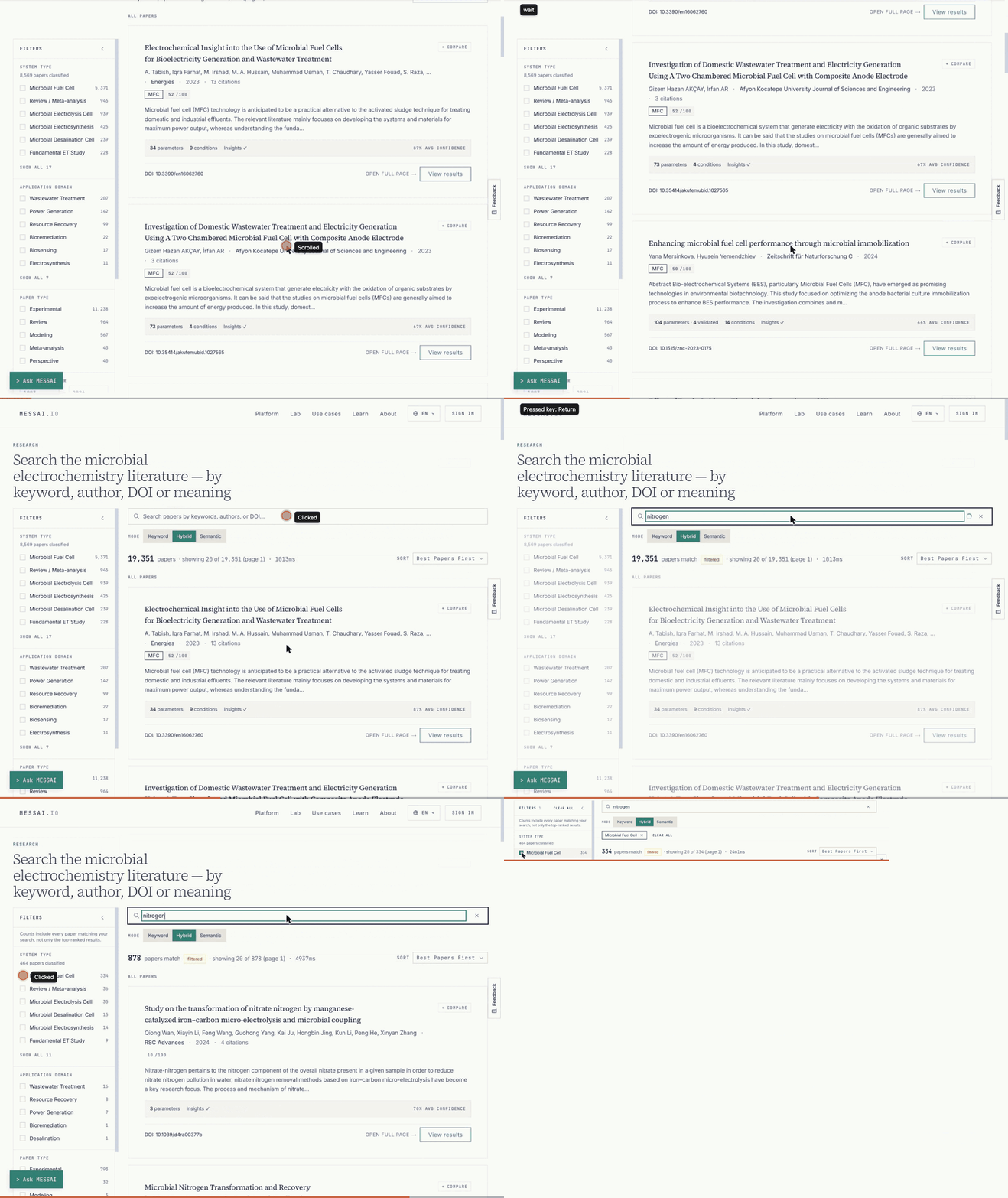
Counts on the paper list can differ from the paper page for the same paper.
One paper, with the values extracted from it laid next to the literature. Use it to check a number before you rely on it. Old links of the form /research/<id> forward here.
URL /research/paper/<ref>, where the reference is the paper’s id or short name from the listingAccess public
Steps
Reading the numbers
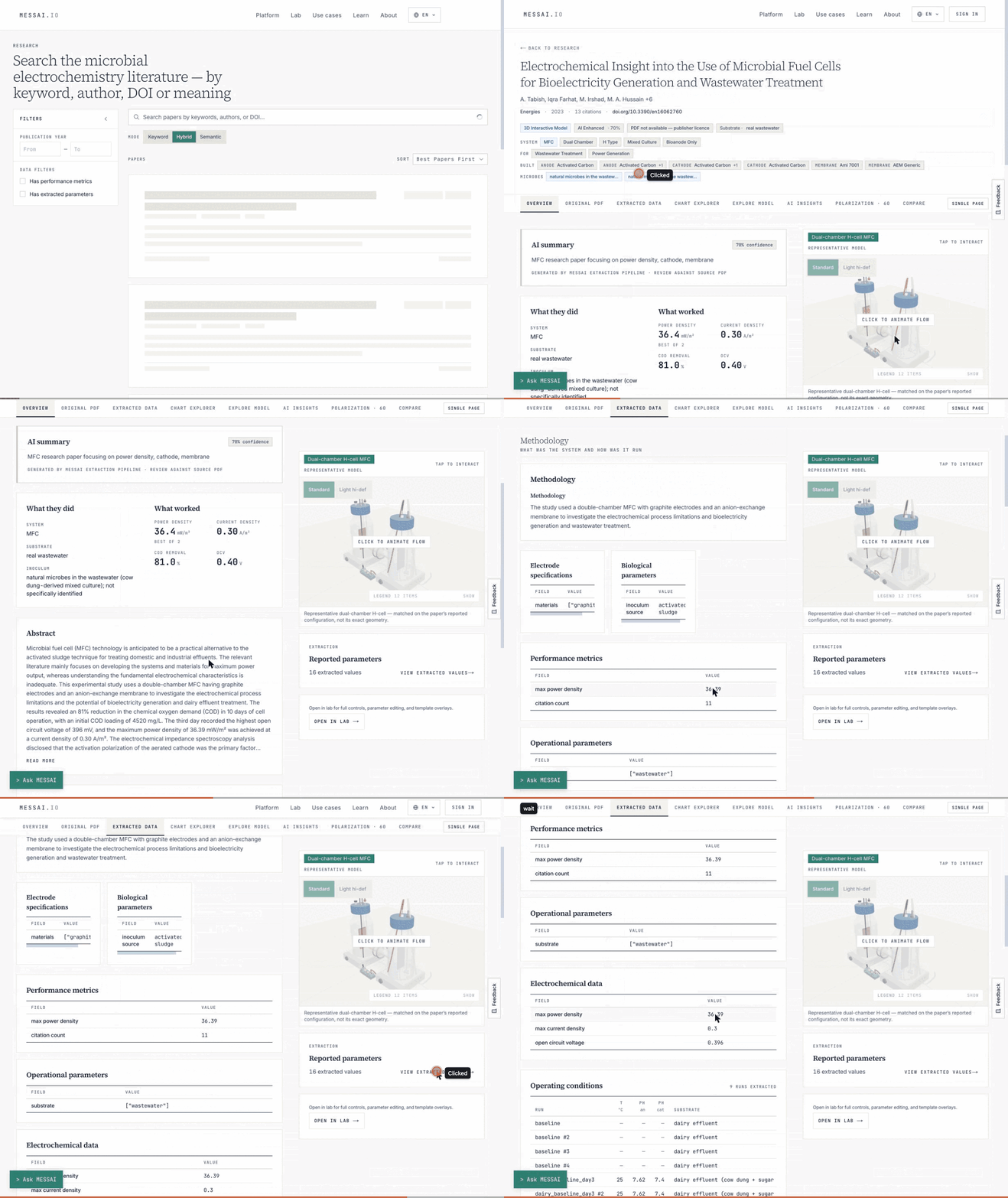
The number of extracted values here can differ from the count on the research list for the same paper.
Every canonical parameter of a microbial electrochemical system, with its definition, unit, literature range and how it couples to other parameters. This is where a name such as power density gets one meaning across papers.
URL /parameters, one page per parameter at /parameters/<slug>Access public
Steps
/parameters and search by name, or choose a category. The filter axis can switch between Category and Subject plus Role.Reading the numbers
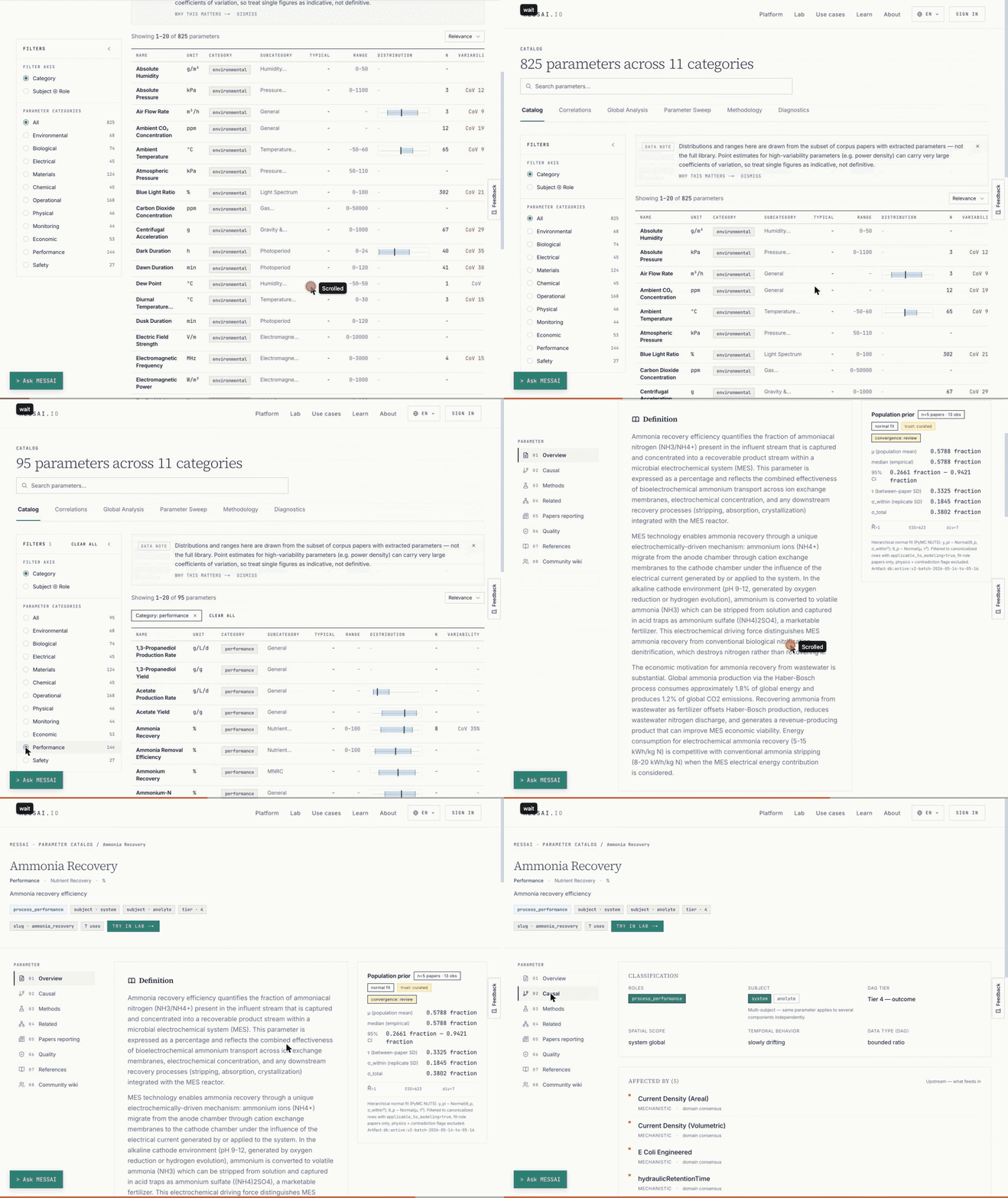
When recorded, the Electrical filter showed no rows although its count said 45. The recording uses Performance instead.
A graph of the parameters: evidence, causal structure, correlations and knowledge gaps in one view. Use it to see what is known to drive a target, and where the literature has little to say.
URL /parameters/knowledge-graphAccess public
Steps
Reading the numbers
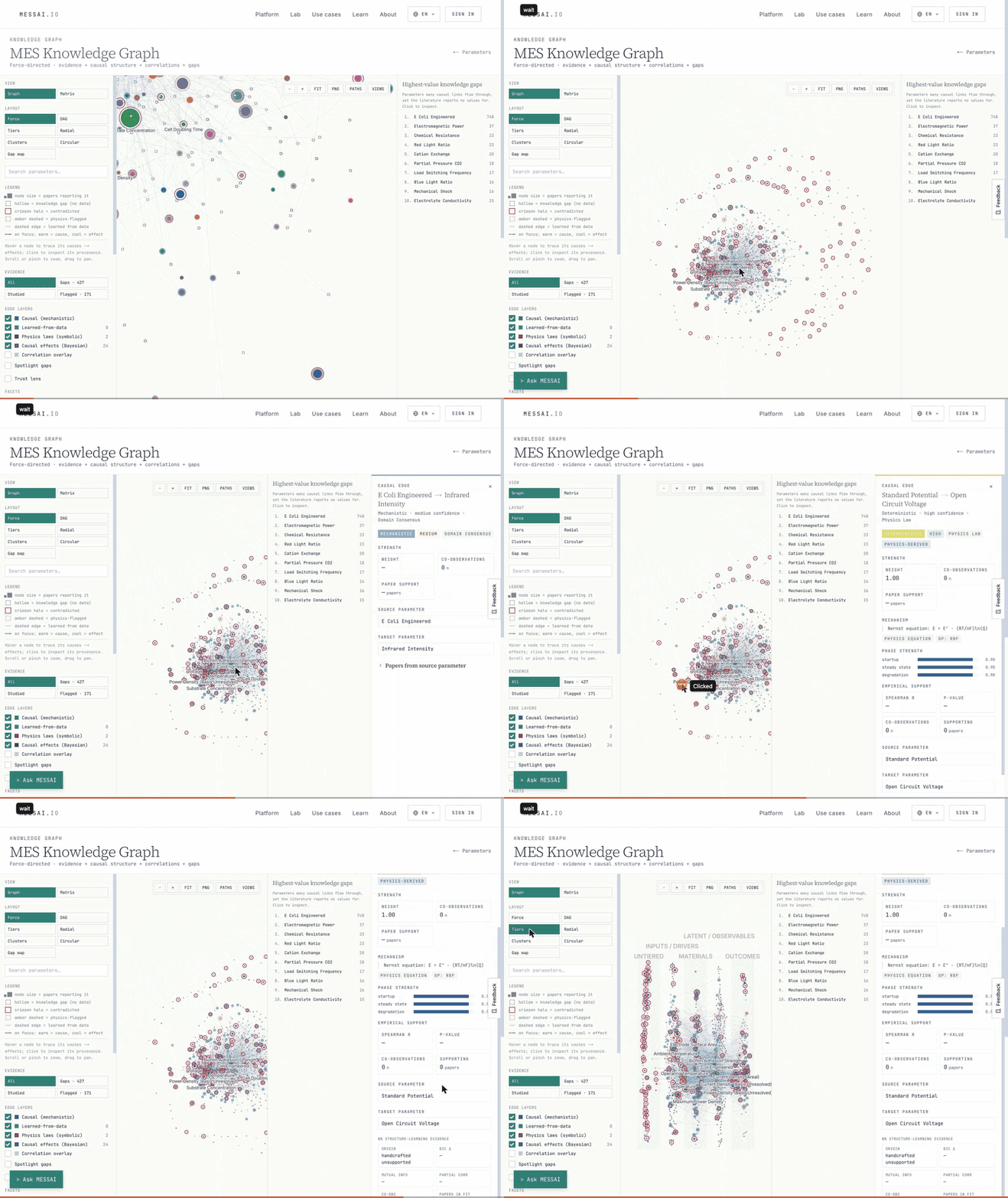
The drawer in this recording is for a link between two parameters, not a single node.
A workbench for designing a reactor: pick a model, edit its parts and operating conditions, and watch the prediction and the 3D model change together. It is for comparing designs, not for replaying a paper.
URL /lab; the build guide is at /lab/guideAccess public
Steps
/lab and choose a reactor model from the model list. On a phone, use the Model button. A link with ?model= opens that model directly.Reading the numbers
Performance forecasting for a configured system, with a confidence score and multi-objective optimisation. It is a form-driven companion to the lab: enter a configuration, get a forecast.
URL /predictionsAccess public; saving a prediction needs sign-in
Steps
Reading the numbers
This page is labelled Illustrative simulation and shows dashes instead of an interval. For live ranges, use the lab panel.
Live prediction panel in the lab, at /lab.
A checklist of what a paper must report so that another lab can compare or repeat it. Score a paper from its DOI, or tick the criteria for your own manuscript.
URL /tools/reproducibilityAccess public
Steps
Reading the numbers
A workspace per collaboration. The first is the nitrogen-cycling use case prepared for Dr. Benjamin Korth at Helmholtz-UFZ: what the corpus holds today, what each pipeline stage will add, and what the collaboration needs from the partner.
URL /collab/korth/nitrogen; source papers at /collab/korth/nitrogen/sourcesAccess public
Steps
Reading the numbers
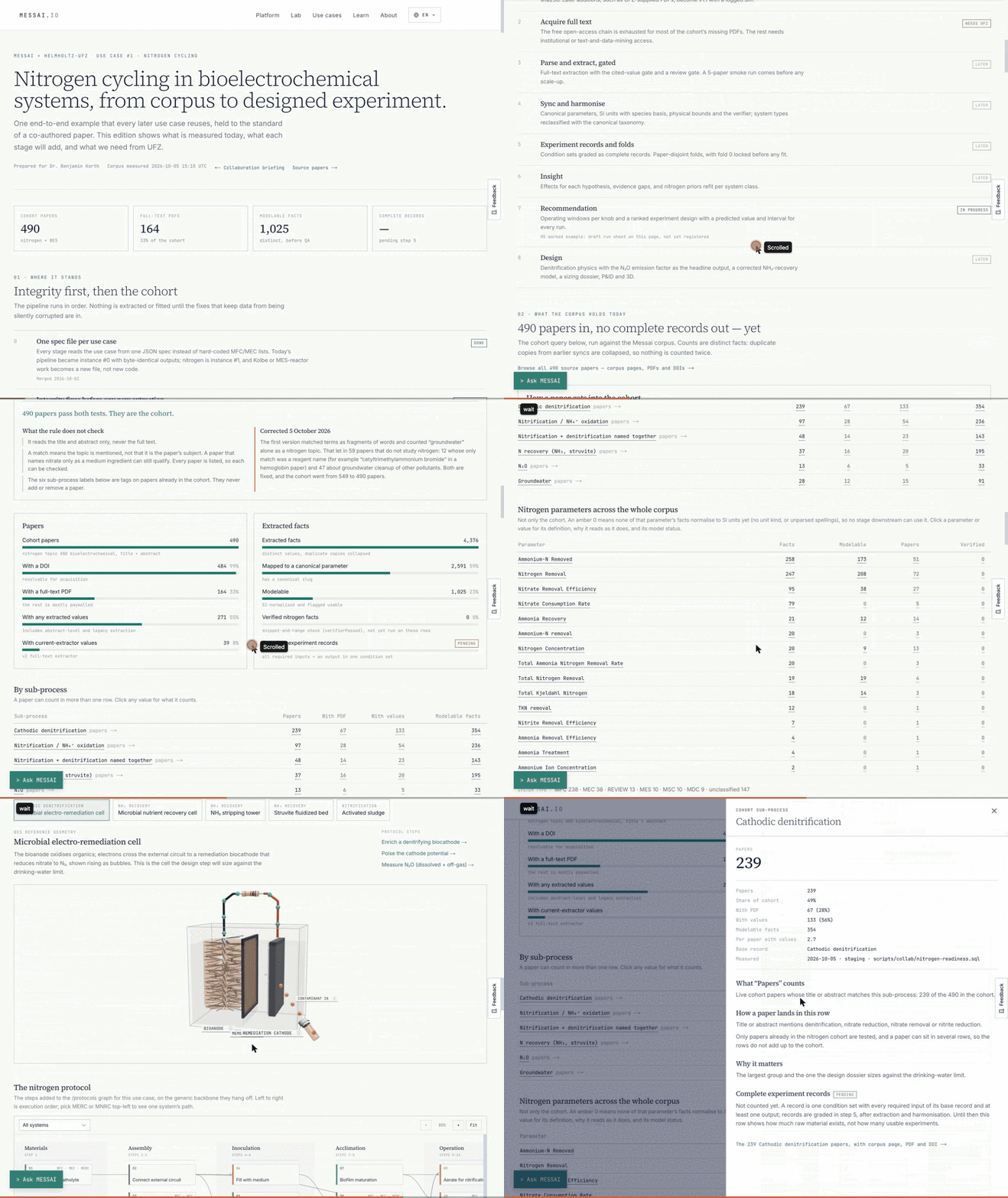
This page has no geographic map. It shows funnel panels, the protocol and a count explanation instead.
One page per predictor: the relations and constants in its code, what it leaves out, which artifacts calibrate its intervals, and the rigor gates over them. Read it before quoting a prediction.
URL /methods, one page per predictor at /methods/<id>Access public
Steps
/methods and pick the predictor for your system. Each shows its physics family and the systems it covers.Reading the numbers
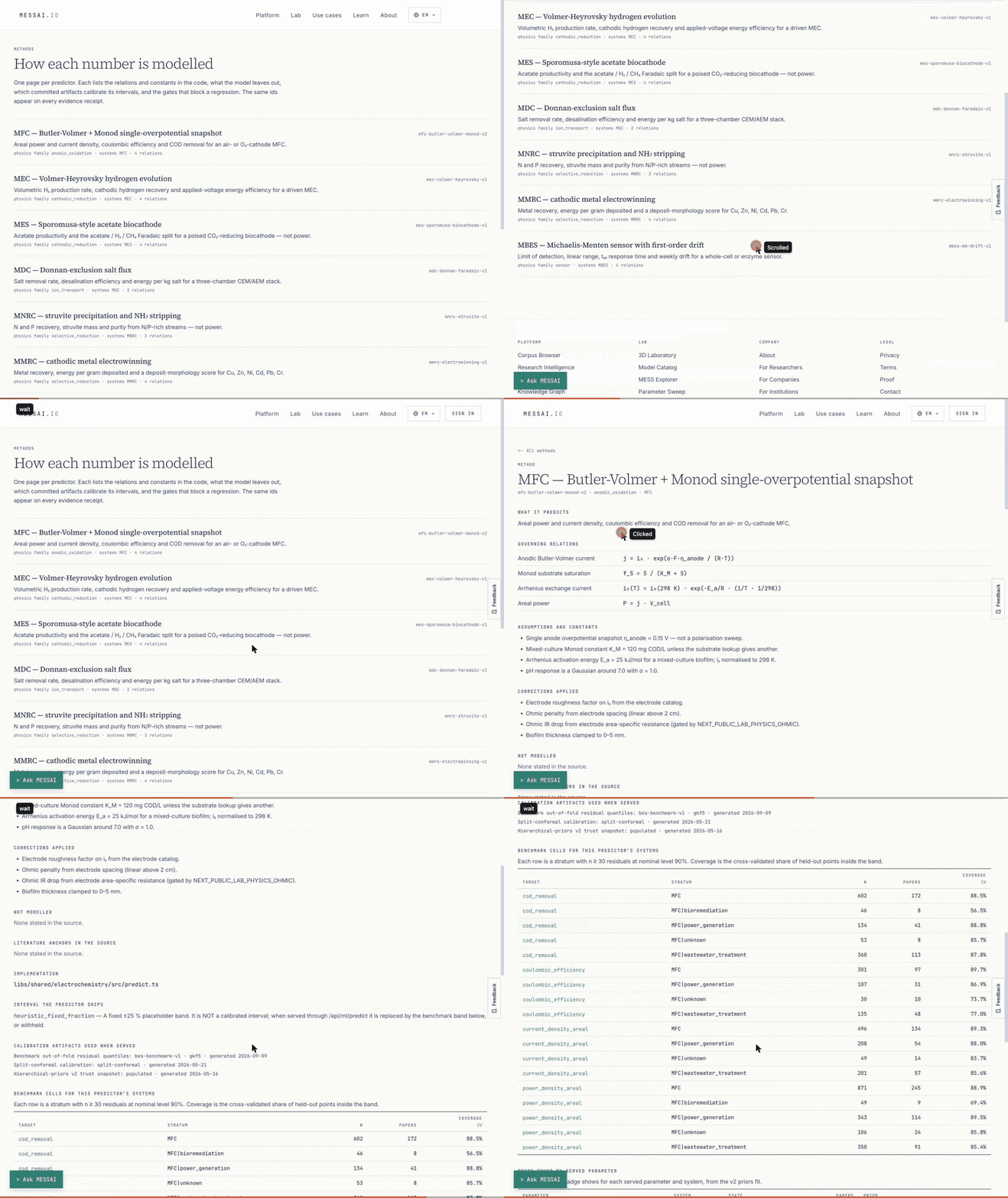
Corpus health tables for the team: catalog statistics, extraction statistics, embedding coverage and a database audit. This screen is for admins; it is not a public page.
URL /admin/statsAccess admin only. A teammate without an admin login can be given a shared password instead.
Steps
pnpm tsx scripts/check-actual-database-stats.ts against the environment you mean.Reading the numbers
The page you are reading. It holds the onboarding reference as tabs, so each subject has one home: the science, the corpus run, the platform map, operators, the symbol library, the October 2026 database overhaul and this walkthrough.
URL /learn/onboarding/atlas, with a short overview at /learn/onboardingAccess public
Steps
# reopens the same place.Reading the numbers